
Most buyers compare smart cat litter box manufacturers by features first.
- Self-cleaning.
- APP control.
- Camera.
- UV sterilization.
- Odor control.
- WiFi.
That sounds normal.
It is also how many automatic cat litter box OEM projects start going wrong.
A smart cat litter box does not fail because one feature is missing. It fails when safety logic, cleaning reliability, odor control, sensor accuracy, APP stability, or mass production consistency cannot survive real daily use.
That is the part many buyers only learn after launch.
Not in the sample room.
Not during the supplier video call.
Not when the FOB price looks attractive.
They learn it when customers start saying the litter box smells after two weeks. Or when the APP sends the wrong reminder. Or when a cat refuses to enter. Or when a second batch performs slightly differently from the approved sample. That is when a “feature-rich product” becomes a support problem.
And smart litter boxes are not forgiving products.
A basic pet bowl can be slightly imperfect and still survive. A smart feeder can sometimes recover from a weak feature if the core feeding function is stable. But a smart cat litter box sits in a different category.
It combines moving structure, cat behavior, waste storage, odor control, sensors, wireless connection, APP experience, safety expectations, and daily hygiene. One weak point can quickly become a review pattern.
That is why choosing between a self-cleaning cat litter box and a smart cat litter box with camera is not just a product choice.
It is a platform decision.
For OEM buyers, the real question is not:
“Which model has more functions?”
The real question is:
“Which smart hygiene platform can my brand actually sell, support, and scale without creating odor complaints, safety concerns, APP issues, refund requests, and mass-production risk?”
That is the decision this article is built to help you make.
If you are comparing smart cat litter box manufacturers for OEM brands, this is not a soft buying guide.
It is a manufacturing and business decision framework for brands, importers, Amazon sellers, retail chains, private label buyers, and distributors trying to choose the right product route before money is committed.
Because in this category, choosing the wrong platform is expensive.
Sometimes more expensive than choosing the wrong supplier.
Quick Decision: Which Platform Should You Start With?
If you do not have time to read the whole article first, start here.
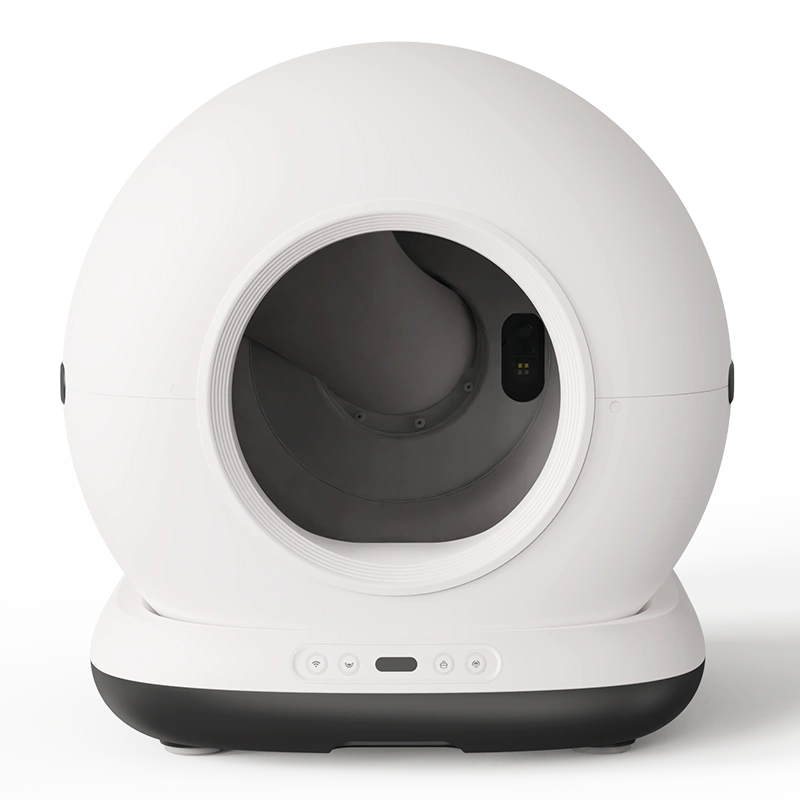
- a stable self-cleaning cat litter box for private label,
- Amazon, retail, or wholesale channels;
- lower APP and camera support pressure;
- stronger focus on cleaning reliability, odor control,
- safety, and scalable OEM production;
- a first smart litter box launch with fewer complaint patterns.
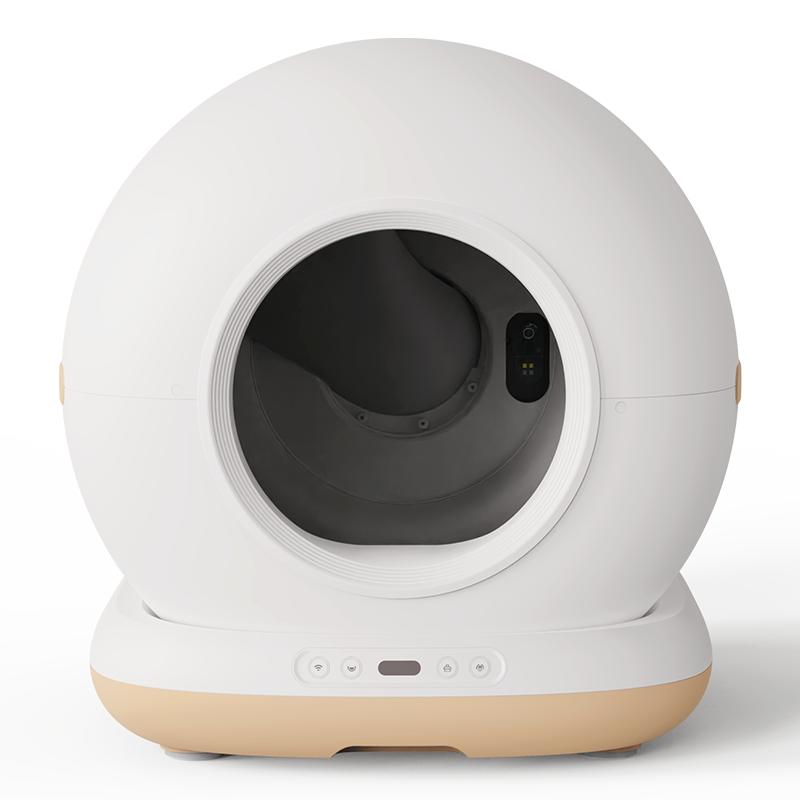
- a premium smart cat litter box with camera;
- 1080P monitoring, dual-band WiFi, health data, and connected pet-care positioning;
- stronger differentiation for premium eCommerce, smart home channels, or high-end pet brands;
- enough support capacity to handle APP, WiFi, camera, and premium UX expectations.
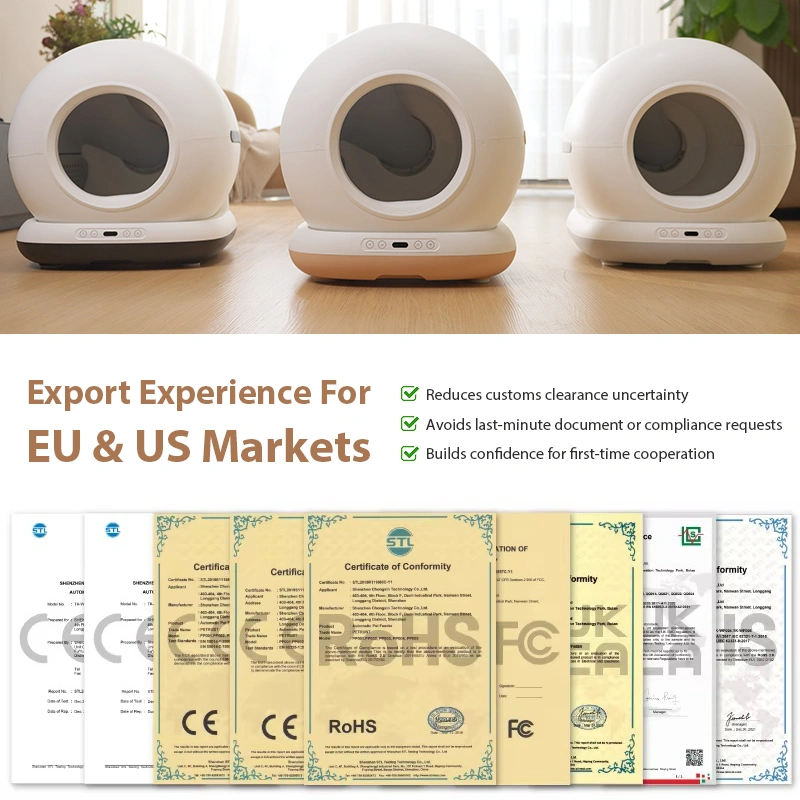
- CB001 can support your volume line;
- CB002 can support your premium line;
- your market needs both stable entry-level smart hygiene and connected premium differentiation.
A simple way to think about it:
| Your Business Need | Better Starting Route |
|---|---|
| Stable first launch | CB001 |
| Private label or retail expansion | CB001 |
| Lower support pressure | CB001 |
| Premium connected positioning | CB002 |
| Camera-led differentiation | CB002 |
| Volume line + premium line | CB001 + CB002 |
This is the short answer.
The rest of this article explains why the short answer matters.
Product Route Decision Map
Need a stable smart litter box launch
↓
CB001 Self-Cleaning Hygiene Platform
Need premium connected differentiation
↓
CB002 Camera Smart Hygiene Platform
Need both volume and premium positioning
↓
CB001 + CB002 Dual-Platform Strategy
This is the platform decision many buyers should make before asking for logo, packaging, firmware, APP, MOQ, or FOB price.
Because the wrong product route does not become right just because the packaging looks better.
Smart Cat Litter Box Manufacturers Are Not Just Selling Features
Too many smart litter box projects are sold like feature menus.
- APP? Yes.
- Camera? Yes.
- UV? Yes.
- Odor control? Yes.
- WiFi? Yes.
- OEM? Yes.
Then the real product enters real homes, and the feature list stops helping.
This is where experienced buyers separate a real smart litter box OEM manufacturer from a supplier that simply assembles parts into a nice-looking shell.
A professional smart cat litter box manufacturer in China should not only answer what features are available.
They should be able to explain how the system behaves after repeated cleaning cycles, how odor is controlled over time, how sensors respond to real cat movement, how the APP reduces rather than increases user anxiety, and how production consistency is protected after the sample is approved.
That is a very different conversation.
A supplier can say, “Yes, we have a camera.”
But can they explain what happens when the camera model creates more connection complaints than the brand’s support team can handle?
A supplier can say, “Yes, we have odor control.”
But can they explain whether the odor control structure depends on sealing, airflow, waste bin design, filter replacement, or just a marketing claim?
A supplier can say, “Yes, we support OEM.”
But can they guide the buyer away from the wrong OEM smart litter box solution if the brand’s channel, price band, and after-sales capability do not fit the product complexity?
That is the difference between a normal smart cat litter box supplier and a true smart hygiene product manufacturer.
One sells features.
The other helps prevent failure.
Why Feature Lists Mislead OEM Buyers
A feature list feels safe because it is easy to compare.
- One supplier has APP control.
- Another has APP control and camera.
- Another adds UV sterilization.
- Another says dual-band WiFi.
- Another says lower price.
On paper, the comparison looks simple.
In real purchasing, it is not.
Feature comparison hides the ugly parts of the project.
It does not tell you whether the cleaning cycle stays stable after repeated use. It does not tell you whether the motor has enough torque when litter load changes.
It does not tell you whether the waste bin design controls odor after daily storage. It does not tell you whether the APP will create fewer support tickets or more.
This is why many automatic cat litter box OEM projects fail in a very predictable way.
The sample looks fine.
The supplier presentation looks complete.
The feature list looks competitive.
Then the first batch enters the market, and the complaint pattern starts.
Not always immediately. Sometimes after one month. Sometimes after three months. Sometimes after the second shipment, when the buyer realizes the approved sample and mass-production batch do not feel exactly the same.
That is where hidden manufacturing risk becomes visible.
The risk was always there. It just was not visible in the product specification sheet.
For a real OEM buyer, the dangerous part is not that the supplier lies. Sometimes the supplier does not lie at all. The product technically has the feature.
The deeper problem is that the feature has not been engineered well enough for real use.
- A camera exists, but the connection experience is unstable.
- A deodorizer exists, but the waste bin still smells.
- A sensor exists, but the safety logic does not handle real cat behavior well enough.
- An APP exists, but users open support tickets because reminders are confusing.
- A sample passes, but the batch does not maintain the same stability.
This is why “Does it have the feature?” is a weak question.
A better question is:
“Can this smart cat litter box factory prove the system will stay stable after real use, real cats, real waste, real WiFi environments, and real customer expectations?”
That is the question most buyers should ask earlier.
What Experienced Buyers Check Before Comparing Models
Average buyers ask:
- Does it have a camera?
- Does it have APP control?
- What is the FOB price?
- What is the MOQ?
- Can we add our logo?
- Can we customize packaging?
Experienced buyers ask different questions.
- How is cleaning reliability validated?
- What is the expected motor lifespan under repeated cycles?
- How does the sensor logic respond when a cat hesitates, enters halfway, or returns during the cleaning cycle?
- Is the APP stability strong enough for the target market?
- Is odor control based on real structure or just an accessory?
- How is mass production consistency protected after sample approval?
That is the real comparison.
A feature list can win a product meeting.
But engineering consistency decides whether the product survives after launch.
For smart cat litter boxes, the product is not judged only in the first unboxing moment.
It is judged after repeated daily use. It is judged when the waste bin starts filling. It is judged when the motor runs at night. It is judged when the cat behaves unpredictably. It is judged when the owner checks the APP and expects the device status to make sense.
This is why sample verification, production quality control, and batch consistency matter more than many buyers expect.
The buyer does not get blamed when the product looks good in a sample room.
The buyer gets blamed when reviews turn into odor complaints, safety concerns, APP complaints, and refund requests three months after launch.
That is the real purchasing pressure.
And that is why smart cat litter boxes should not be evaluated as simple smart pet products.
They should be evaluated as hygiene automation engineering.
Self-Cleaning Cat Litter Box vs Camera Smart Cat Litter Box: The Real Platform Decision
Most buyers think the decision is simple:
Self-cleaning or camera?
That is the visible decision.
The real decision is deeper:
Do you need a reliable self-cleaning hygiene platform that can scale with lower complexity, or do you need a premium connected hygiene platform that can support camera monitoring, dual-band WiFi, health data, and higher user expectations?
Those are not the same project.
A self-cleaning cat litter box is usually the better starting point when the buyer needs stable cleaning, controlled odor, safe operation, and lower support pressure.
It is often the right route for growing pet brands, private label importers, wholesale buyers, and retail programs that need reliability before premium differentiation.
A smart cat litter box with camera can be the better choice when the brand already has stronger positioning, higher price tolerance, better support capacity, and a market that values connected pet care. It can create differentiation.
It can support premium storytelling. It can help brands build a smarter pet hygiene ecosystem.
But it also creates more expectations.
That is the part some buyers ignore.
A camera model is not automatically better.
It is more complex.
More complexity can create more value.
It can also create more ways to disappoint customers.
So the question is not which platform has “more”.
The question is which platform fits your business model.
For buyers who are still unsure whether a camera model is a real upgrade or just added complexity, it may be useful to compare the camera decision separately before locking the OEM platform.
When a Self-Cleaning Cat Litter Box Platform Makes More Sense
For many growing pet brands, the first smart litter box launch should not be the most complicated model in the category.
It should be the model that can clean reliably, control odor, keep cats safe, reduce support pressure, and stay consistent from sample approval to mass production.
That is why many buyers begin with a self-cleaning cat litter box OEM route instead of jumping directly into a camera model.
A self-cleaning cat litter box manufacturer that understands OEM projects should help buyers think through the commercial reality:
- Can your channel handle a premium camera price?
- Can your support team handle APP and WiFi questions?
- Will your customers pay more for camera monitoring, or will they punish you harder when connection issues appear?
- Is your first goal to create premium differentiation, or to build a stable smart hygiene category with fewer returns?
For growing pet brands, stability often matters more than maximum feature count.
A reliable automatic self-cleaning cat litter box can be a stronger first move when the brand needs to test category demand, build review stability, reduce support tickets, and expand a private label self-cleaning cat litter box program without overloading the business.
This is where buyers should look for:
- cleaning cycle consistency;
- cat-safe operation;
- waste bin design;
- odor-control performance;
- sensor accuracy;
- low-noise operation;
- stable APP reminders;
- production consistency;
- clear OEM customization options.
A stable self-cleaning litter box is not a “basic” decision.
It is often the smarter first move for brands that need fewer surprises after launch.
Especially when the buyer is entering the category for the first time.
Especially when the brand sells on Amazon or through retail channels where complaint patterns become visible quickly.
Especially when the company does not yet have a dedicated support system for camera, APP, and WiFi troubleshooting.
This is why the first product route should not be decided by ambition alone.
Ambition is good.
But in OEM manufacturing, ambition without support planning becomes warranty cost.
When a Camera Smart Cat Litter Box Is Worth the Upgrade
A camera smart litter box can be a powerful product.
For the right buyer.
Not every buyer.
A smart cat litter box with camera makes sense when the brand wants premium positioning, connected pet care storytelling, stronger differentiation, and a product experience that goes beyond automatic cleaning.
This route is more suitable for premium smart pet brands, smart litter box for smart home distributors, and smart cat litter box for global OEM importers that want a higher-end product platform.
The value is clear:
- 1080P camera;
- real-time monitoring;
- dual-band WiFi support;
- APP control;
- health monitoring;
- toilet statistics;
- smart alerts;
- connected hygiene positioning.
For a premium brand, this can create a stronger category story.
A litter box is no longer just a cleaning device. It becomes part of connected pet care. It helps the owner monitor usage patterns. It can support a higher price point. It gives the brand more to say in marketing.
But here is the uncomfortable truth:
A camera does not automatically make a smart litter box premium.
It only creates premium value when the rest of the product is stable enough to support the higher expectation.
- If cleaning reliability is weak, the camera does not save the product.
- If odor leaks, the camera does not save the review.
- If WiFi pairing fails, the camera becomes a complaint trigger.
- If the APP is unstable, health data becomes another support burden.
For camera smart litter box OEM projects, the buyer needs stronger planning around WiFi pairing stability, firmware stability, privacy sensitivity, APP education, customer support scripts, and premium user experience.
A camera model can create differentiation.
It can also become a more expensive way to create support tickets.
That is why CB001 and CB002 should not be seen as low-end and high-end versions of the same idea.
They represent two different product routes.
One prioritizes scalable self-cleaning stability.
The other prioritizes premium connected hygiene differentiation.
Both can be right.
Both can be wrong.
It depends on the buyer.
Reliable Self-Cleaning Platforms: Why Many Private Label Brands Start Here
A lot of private label buyers want to look advanced from day one.
That is understandable.
Nobody wants to launch a product that feels behind the market.
But in smart cat litter boxes, the most advanced-looking product is not always the safest first commercial decision.
For many private label smart cat litter box projects, the better question is not:
“How many features can we add?”
It is:
“How many complaint patterns can we avoid?”
That changes the decision.
A private label self-cleaning cat litter box can be a better starting point when the buyer needs lower complexity, stable performance, easier positioning, and a product line that can scale without creating too much support pressure.
For self-cleaning cat litter box OEM projects, the first win is not always premium storytelling.
Sometimes the first win is simple:
- The product works.
- The cat uses it.
- The cleaning cycle stays stable.
- The odor is controlled.
- The APP does not confuse users.
- The waste bin reminder makes sense.
- The second batch performs like the approved sample.
That may sound boring.
It is not.
That is how brands survive the first launch.
For buyers planning a first private label smart litter box project, a deeper look at why many growing brands start with a reliable self-cleaning route can help avoid overbuilding the first launch.
Lower Feature Complexity, Lower Support Pressure
Some buyers want the most advanced model first.
That sounds ambitious.
Sometimes it is just a faster way to create support tickets.
A smart cat litter box private label program has to think beyond product photography.
It has to think about what happens when real customers start using the product in apartments, homes, multi-cat households, weak WiFi environments, and different litter conditions.
For smart cat litter box for Amazon sellers, this matters immediately.
Amazon does not give brands much time to “educate the market” when reviews start moving in the wrong direction. A few repeated complaints about odor, cleaning failure, noise, APP issues, or safety concerns can damage conversion quickly.
For smart cat litter box for retail chains, the pressure is different but just as serious.
Retail buyers care about product reliability, low complaint rates, clear certification, and stable supply. They do not want a high-risk product that creates returns and customer service problems after the shelf placement is already approved.
For smart cat litter box for private label importers, lower feature complexity often means easier product management. It also makes it easier to build packaging, instructions, support content, replacement parts planning, and long-term reorder confidence.
This is where a self-cleaning platform can make more commercial sense.
It reduces the number of smart-feature failure points.
It keeps the product focused on what matters most:
- cat-safe operation;
- cleaning reliability;
- odor control;
- low-noise performance;
- waste bin usability;
- clear APP reminders;
- production stability.
That does not mean the product is simple.
A self-cleaning litter box is still an engineered system.
But compared with a camera model, it can be easier for many brands to support at launch.
For startup brands and growing brands, that matters.
A product that is easier to support is often a product that is easier to scale.
What Makes a Self-Cleaning Litter Box Stable Enough for Retail
A retail-ready self-cleaning litter box is not defined by one shiny feature.
It is defined by whether the product can repeat the same acceptable performance every day.
This is where buyers should look closely at the fundamentals.
A large internal space helps cats feel less restricted.
A wide entrance improves usability, especially for larger cats or hesitant cats.
A separated waste bin helps with hygiene management.
A stable cleaning mechanism protects cleaning cycle consistency.
A quiet motor supports night use and reduces complaints.
A strong safety system protects the brand from the one type of review nobody wants to see.
For CB001, the buyer is not only looking at a self-cleaning product.
They are looking at a stable platform for scalable OEM programs.
Key platform signals include a 72L large toilet space, 24cm wide entrance, separated 7L waste bin, self-cleaning system, APP control, toilet statistics, safety protection, low-noise motor design, sensor-based operation, and odor-control support.
But again, the point is not to list features.
The point is what those features protect.
A self-cleaning cat litter box with low-noise motor protects the user experience at night.
An automatic litter box with motion sensor and automatic litter box with gravity sensor supports safer operation when real cats behave unpredictably.
A pinch-free automatic cat litter box matters because safety complaints can hurt a brand faster than missing premium features.
A cat-safe automatic litter box is not a slogan. It is a buyer-risk issue.
An automatic cat litter box with odor control matters because odor complaints can become one of the fastest ways to damage reviews, retail confidence, and repeat orders.
An automatic cat litter box with waste bin reminder matters because users do not judge the product in a demo. They judge it when daily maintenance either feels easy or annoying.
An automatic cat litter box with UVC sterilization may support hygiene positioning, but it still has to fit within a stable product system.
For retail and private label buyers, these details create the difference between “nice sample” and “repeatable business”.
That is why many brands start with a stable self-cleaning platform first.
Not because they lack ambition.
Because they understand sequencing.
First, build trust.
Camera Smart Cat Litter Boxes: Premium Differentiation or More After-Sales Risk?
A camera smart litter box looks easy to sell.
- Put a camera in the product.
- Add APP control.
- Mention real-time monitoring.
- Show a cat using the litter box in the product video.
- Call it premium.
That is the usual playbook.
And honestly, it works at the beginning.
A smart cat litter box with camera gives the product team more to say.
It gives the sales team a stronger story. It gives the brand a higher-end angle. It can help an importer build a smarter pet hygiene line instead of selling another standard self-cleaning unit.
But there is a catch.
Camera features raise expectations faster than many brands are ready for.
Once a buyer chooses a camera smart cat litter box, the customer no longer judges only the cleaning function. They judge the image experience, the APP flow, the connection speed, the notification logic, the privacy feeling, the health data, and the whole connected product experience.
That is a much bigger promise.
A standard self-cleaning platform can be judged mainly by safety, cleaning, odor, noise, and daily usability.
A camera model gets judged by all of that — plus smart performance.
That is why a camera smart litter box supplier should not only show a product video. They should be able to explain the support burden behind the camera.
Because the camera is not only a feature.
It is a commitment.
For brands considering a premium camera model, it is worth evaluating the camera route as both a differentiation tool and a support-risk decision before treating it as an automatic upgrade.
Why Camera Features Raise Buyer Expectations
For the right market, a camera model can be a strong upgrade.
A self-cleaning cat litter box with camera can help premium brands build a more complete connected pet care story.
Pet owners want reassurance. They want visibility. They want to know whether the cat is using the litter box normally. They want alerts that feel useful, not annoying. They want the product to feel intelligent, not just automated.
That is where CB002 becomes relevant.
CB002 is better positioned for buyers who want a premium connected smart hygiene product.
Its 1080P camera, real-time monitoring, APP control, dual-band WiFi support, health monitoring, toilet statistics, smart message push, safety protection, odor-control design, and UVC sterilization make it suitable for brands that need more than a basic automatic cleaning story.
For premium smart pet brands, this kind of product can support higher-end positioning.
For smart litter box for smart home distributors, it can fit into a broader connected home and pet-care ecosystem.
For smart cat litter box for global OEM importers, it can support a dual-line strategy: one stable self-cleaning product for volume, and one connected camera model for premium positioning.
But that only works when the brand has the right business model.
A WiFi automatic cat litter box is not just a litter box with wireless connection. It is a connected device that lives in the customer’s home network.
That means pairing experience matters. Device status matters. Notification accuracy matters. APP language matters. Firmware stability matters. Customer education matters.
An APP-controlled cat litter box is useful only when the APP reduces uncertainty. If the APP creates confusion, the “smart” feature becomes a support cost.
A smart cat litter box with health monitoring can create strong premium value, but only when the brand explains the feature clearly and sets the right expectation.
Health monitoring through toilet statistics is not magic. It is a data-assisted user experience. If the marketing oversells it, support teams will pay for that mistake later.
A smart cat litter box with toilet statistics gives owners more information, but more information also means more questions.
- Why did the APP show this reminder?
- Why was the usage count different today?
- Why did the device not update immediately?
- Why does the camera not connect on my network?
- Why does the alert come late?
These are not manufacturing questions only.
They become brand support questions.
That is why camera smart litter boxes are not just “better products.” They are higher-responsibility products.
Camera features create differentiation.
But they also raise the user’s expectation for connectivity, APP experience, image quality, response speed, and support.
The Hidden Support Cost Behind Camera and APP Features
Here is the part suppliers rarely say loudly:
A camera model is not always the premium choice. For some brands, it is simply a more expensive way to create support tickets.
That sounds harsh.
But it is true.
If a brand chooses a camera model before it has the right channel, price band, support process, and user education, the product can quickly create premium product support risk.
The buyer thought the camera would increase margin.
Instead, the camera increases questions.
That is how many smart litter box APP problems begin. Not because the product has no smart function, but because the smart function is not supported by enough UX planning, firmware stability, connection stability, instructions, and after-sales preparation.
Common camera and APP-related problems include:
- WiFi pairing stability issues in real home environments;
- camera connection delays;
- APP status not updating clearly;
- unclear smart message push logic;
- privacy concerns from end users;
- firmware update confusion;
- weak customer support scripts;
- higher refund sensitivity because the product is sold as premium.
This is why APP stability is not just a technical phrase. It directly affects reviews, returns, and support workload.
This is also why dual-band WiFi support can matter for premium models.
A camera product used in different markets and home network environments may need stronger connection planning than a basic model. Buyers selling to the US, EU, Japan, or premium eCommerce channels should not treat WiFi as a minor checkbox.
A smart cat litter box with smart message push can help users know when cleaning is completed, when the waste bin needs attention, or when abnormal usage is detected. But if the message timing or wording feels wrong, the feature stops reducing anxiety and starts creating it.
That is the strange truth of smart products:
The smarter the product claims to be, the less forgiving the user becomes.
For CB002, the camera and connected features are valuable when the buyer is ready for premium positioning. But the same features can become a liability for buyers chasing only a higher selling price without support planning.
A camera smart litter box OEM project should therefore start with business questions, not only product questions:
- Can your target market pay for a camera model?
- Can your support team handle APP and WiFi questions?
- Can your product page explain camera and health monitoring without overpromising?
- Can your brand absorb a higher level of user expectation?
- Can your supplier support smart litter box firmware customization and smart litter box APP customization if your market requires changes?
If the answer is yes, CB002 can become a strong premium platform.
If the answer is no, a stable self-cleaning model may protect the business better.
That is not a downgrade.
That is good product sequencing.
CB001 vs CB002: Which Smart Cat Litter Box Platform Fits Your Brand?
CB001 and CB002 should not be compared as “basic vs premium” only.
That is too simple.
For OEM buyers, they represent two different platform decisions.
CB001 is a reliable self-cleaning hygiene platform. It is better when the buyer needs a stable product line, lower smart-feature complexity, strong daily-use reliability, and easier scaling for private label or retail programs.
CB002 is a premium connected hygiene platform. It is better when the buyer needs camera monitoring, dual-band WiFi, health data, smart pet-care positioning, and stronger differentiation in a higher price band.
Neither model is universally “better.”
The better model depends on the buyer.
This is where many purchasing teams make mistakes. They ask, “Which one has more features?” But the better question is, “Which platform can our business actually support?”
A brand with strong premium positioning may be wasting opportunity if it only launches a standard self-cleaning model.
A growing private label buyer may be creating unnecessary risk if it launches a camera model before its support system is ready.
A retail chain may prefer safety, certification, odor control, and reliability over advanced connected features.
A smart home distributor may need the connected story that CB002 can provide.
That is why the model comparison must connect product functions with commercial reality.
CB001 for Scalable Self-Cleaning Cat Litter Box Programs
CB001 is better when the buyer needs a stable self-cleaning platform, lower smart-feature complexity, stronger odor control, safer daily operation, and scalable OEM production.
This makes it a strong fit for:
- self-cleaning cat litter box for growing pet brands;
- smart cat litter box for private label importers;
- smart cat litter box for wholesale buyers;
- smart cat litter box for retail chains;
- Amazon or eCommerce sellers who want category entry with fewer complaint patterns;
- brands building a reliable smart hygiene product line before moving into premium connected models.
CB001 is not attractive because it has fewer risks on paper.
It is attractive because it can be easier to support in real business.That is where CB002 becomes relevant.
For a private label self-cleaning cat litter box program, buyers usually care about stable product experience, manageable customer questions, clear maintenance logic, retail-friendly positioning, and repeat order confidence.
A self-cleaning model can support that if the fundamentals are strong.
That means:
- stable cleaning cycle consistency;
- strong long-term cleaning stability;
- safe drum operation;
- low-noise operation;
- effective waste bin sealing;
- replaceable odor-control support;
- clear waste-bin reminder logic;
- consistent APP experience;
- reliable sensor operation;
- stable production output from batch to batch.
CB001 can also be a practical route for an automatic cat litter box private label manufacturer program because it allows brands to focus on the most important customer outcomes first: hygiene, safety, odor control, and daily usability.
Packaging can be customized.
Branding can be customized.
Instructions can be localized.
But the platform needs to be right first.
CB002 for Premium Connected Smart Litter Box Projects
CB002 is better when the buyer needs premium differentiation through camera monitoring, dual-band WiFi, health data, and connected hygiene positioning.
This makes it a better fit for:
- smart litter box for premium pet brands;
- smart litter box for smart home distributors;
- premium eCommerce brands;
- global importers building a high-end smart pet hygiene line;
- brands that want a connected product story rather than only a self-cleaning function;
- buyers who can support a more complex APP and camera user experience.
CB002 has the advantage of a stronger smart product story.
- A camera gives the customer visibility.
- Dual-band WiFi supports a more connected experience.
- Health monitoring and toilet statistics give the product more perceived intelligence.
- Smart message push can make the product feel more responsive.
For the right brand, these are not small features.
They can support a higher retail price, stronger product page storytelling, more premium positioning, and better differentiation against standard self-cleaning models.
But CB002 also requires more responsible planning.
A CB002 smart cat litter box with camera needs stronger attention to APP flow, connection behavior, customer support, privacy messaging, and premium UX consistency. If those areas are not planned, the product may still sell at launch, but the after-sales pressure can rise quickly.
That is why CB002 is not the “automatic upgrade” for every buyer.
It is the right platform when the buyer’s business model can support the promise.
Below is the practical comparison.
| Decision Factor | CB001 Self-Cleaning Cat Litter Box | CB002 Smart Cat Litter Box with Camera |
|---|---|---|
| Platform Type | Reliable self-cleaning hygiene platform | Premium connected hygiene platform |
| Best Buyer | Growing pet brands, private label importers, pet retail chains | Premium smart pet brands, global OEM importers, smart home distributors |
| Best Channel | Retail, Amazon, wholesale, private label | Premium eCommerce, smart home channels, high-end pet brands |
| Main Differentiation | Large space, odor control, safety, stable cleaning | 1080P camera, dual-band WiFi, health monitoring, connected experience |
| Feature Complexity | Lower than camera platform | Higher due to camera, WiFi and smart UX expectations |
| After-Sales Pressure | Cleaning, odor, waste bin, safety | APP, camera, connection, privacy and premium experience |
| OEM Fit | Good for scalable private label programs | Good for premium OEM and connected product launches |
| Not Ideal For | Brands needing camera-led differentiation | Buyers chasing lowest FOB or lacking smart product support |
The table is simple.
The decision behind it is not.
A buyer choosing CB001 is usually saying:
“We need a reliable self-cleaning product that can scale.”
A buyer choosing CB002 is usually saying:
“We need a premium connected hygiene product that can differentiate our brand.”
Both are valid.
The mistake is choosing CB002 only because it looks more advanced.
The other mistake is choosing CB001 only because it feels safer, even when the brand actually needs a premium connected story to compete.
This is why platform fit matters.
Teams that need a clearer product-level decision may benefit from reviewing a more product-specific CB001 vs CB002 platform comparison before deciding which platform should move into sampling, packaging, or OEM customization.
If your team is unsure whether CB001 or CB002 fits your market, Petrust® can compare both platforms based on channel, price band, certification market, APP support capability, and after-sales risk before OEM decisions become expensive.
Petrust® Smart Hygiene Platform Decision Framework
Choosing between CB001 and CB002 should not be reduced to one question: camera or no camera.
A better decision starts with seven layers.
| Decision Layer | What Buyers Should Check | Why It Matters |
|---|---|---|
| Safety Logic | Pinch-free design, motion sensor, gravity sensor, interruption behavior | Prevents safety complaints and brand trust damage |
| Cleaning Reliability | Cleaning cycle consistency, drum rotation stability, motor torque | Protects daily user experience |
| Odor Control | Waste bin sealing, replaceable odor eliminator, maintenance logic | Reduces odor complaints and review risk |
| Smart Experience | APP stability, WiFi pairing, smart alerts, health data | Reduces support tickets |
| Compliance Readiness | CE, FCC, RoHS, UL, TELEC, wireless module match | Protects export, retail, and platform approval |
| Production Consistency | Sample verification, batch consistency, pre-shipment inspection | Prevents sample vs mass production failure |
| Business Fit | Amazon, retail, private label, premium brand, distributor | Determines CB001, CB002, or dual-platform strategy |
This is why Petrust® does not treat CB001 and CB002 as simple SKUs.
They are two smart hygiene platforms for different business realities.
CB001 is not just the “safer” choice.
CB002 is not just the “more advanced” choice.
The right platform is the one your brand can sell, support, and scale without creating avoidable complaint patterns.
What Experienced Buyers Compare Beyond Product Specifications
Product specification sheets are useful.
But they are not enough.
A product specification sheet tells you what the product claims to have. It does not tell you how the product behaves under pressure.
It does not show you the difference between one good sample and one stable production batch.
It does not show you how many customer complaints appear after repeated daily use.
It does not show whether the odor system still works when the waste bin is used for days, whether the APP reminders reduce anxiety or create confusion, whether the motor noise changes over time, or whether sensor logic handles real cats instead of perfect demo conditions.
This is why experienced buyers compare beyond specifications.
They compare failure probability.
They compare support cost.
They compare batch consistency.
They compare supplier behavior when things are not perfect.
That last one matters more than people admit.
Anyone can look professional before the deposit.
A real OEM cat litter box manufacturer proves itself when the buyer asks uncomfortable questions about sample vs mass production risk, quality control, certification documents, and complaint prevention.
That is why supplier verification and factory audit should happen before the buyer becomes emotionally attached to a model.
Sample Performance vs Mass Production Consistency
A good sample is not proof of a good mass-production batch.
This sentence should probably be printed on every OEM buyer’s desk.
Samples are important. But samples are not the business. The business starts when hundreds or thousands of units need to behave consistently enough for real customers, real homes, real cats, and real reviews.
Smart Litter Box Failure Chain
Good Sample
↓
Small Production Variation
↓
Cleaning / Odor / APP / Sensor Complaint
↓
Bad Reviews / Returns / Support Tickets
↓
Margin Loss
This is why serious buyers do not approve smart litter box projects only because the sample looks good.
The sample is the beginning of verification.
It is not proof that the product is ready for mass production.
A sample can be carefully prepared.
A sample can be tested in ideal conditions.
A sample can look excellent in a meeting room.
But the market judges the batch.
This is where many smart cat litter box problems begin. The buyer approves a nice sample. The supplier moves into production. Small variations appear.
Maybe the motor sound is slightly different. Maybe the sensor response feels less stable. Maybe the waste bin fit is not as tight. Maybe the APP status timing feels inconsistent. Maybe the second batch does not match the first.
Each issue may look small inside the factory.
Customers do not experience them as small.
They experience them as automatic cat litter box problems.
- The cleaning is not smooth.
- The odor is stronger than expected.
- The reminder feels wrong.
- The noise is annoying.
- The product feels unsafe.
- The APP is confusing.
Then the buyer sees what the specification sheet never showed:
customer complaint patterns.
This is why mass production validation, batch consistency, and production quality control matter.
A buyer should ask how the supplier controls incoming materials, motor consistency, sensor calibration, assembly variation, APP/firmware version control, pre-shipment checks, and functional testing before release.
For a smart cat litter box, pre-shipment inspection should not only confirm appearance.
It should check functional behavior.
It should check cleaning cycle response.
It should check sensor operation.
It should check APP connection and reminders.
It should check noise, odor-related structure, waste bin fit, and safety logic.
This is what separates a real smart cat litter box factory from a product listing supplier.
The buyer does not get blamed when the product looks good in a sample room.
The buyer gets blamed when reviews turn into odor complaints, safety concerns, and refund requests three months after launch.
That is the pressure.
That is also why a serious buyer should not approve a smart litter box project only because the sample looks good.
For buyers trying to reduce first-batch risk, it is worth taking time to understand where smart litter box problems usually begin before shipment, especially before deposit, sample approval, or mass production.
FOB Price vs Total After-Sales Cost
The cheapest smart litter box is rarely the cheapest product after returns, replacements, and support tickets are counted.
This is where many buyers lose money quietly.
A low FOB price feels like savings. It is visible. It is easy to report. It looks good in the first cost comparison.
But after-sales cost is hidden at the beginning.
It appears later through:
- higher smart cat litter box return rate;
- odor complaints;
- APP support tickets;
- camera connection complaints;
- warranty claims;
- refund requests;
- replacement shipments;
- bad reviews;
- retail return risk;
- Amazon ranking damage.
The scary part is that these costs do not arrive as one large invoice.
They arrive as friction.
- One support email.
- One refund.
- One bad review.
- One retailer complaint.
- One replacement request.
- One lost repeat order.
Then, slowly, the “cheap” product becomes expensive.
This is especially important for smart cat litter box for Amazon sellers. Amazon review risk can damage conversion faster than many brands expect. A few repeated complaints about odor, safety, APP connection, or cleaning failure can influence the product’s perceived trust.
For retail buyers, the issue is different. Retail return risk and buyer confidence matter. A retail chain may not tolerate a smart hygiene product that creates repeated complaints, unclear certification, or inconsistent supply.
For private label importers, after-sales cost can destroy the margin that looked attractive at the quotation stage.
That is why experienced buyers compare differently.
| Average Buyers Compare | Experienced OEM Buyers Compare |
|---|---|
| Feature count | Failure probability |
| FOB price | Total after-sales cost |
| Sample appearance | Mass-production consistency |
| Camera availability | APP + WiFi support risk |
| Odor function | Odor-control structure and replacement design |
| Motor parameter | Motor lifespan, motor torque, and noise after repeated cycles |
| Sensor names | Sensor logic and sensor misjudgment scenarios |
| Certification logo | Test report, model match, and market readiness |
This is the real comparison.
Not “Who has the most features?”
Not “Who gives the lowest price?”
But:
“Which supplier reduces the risk of repeated complaints after launch?”
Buyers who want to avoid feature-list thinking may benefit from learning how to separate nice-to-have functions from review-critical features before approving the final product configuration.
For smart cat litter boxes, that is the question that protects profit.
A product with a slightly higher cost but better cleaning reliability, stronger odor control, safer sensor logic, more stable APP behavior, and better batch consistency may be more profitable than a cheaper model that creates returns.
That is why buyers should treat smart litter box sourcing as risk management, not just price negotiation.
A smart cat toilet manufacturer or automatic cat toilet supplier that understands this will not push only the most feature-heavy product.
They will ask what the buyer is trying to build.
- Amazon launch?
- Retail program?
- Premium pet brand?
- Private label test order?
- Global OEM line extension?
- Japan market smart litter box?
- EU market smart litter box?
- US market smart litter box?
Different markets create different pressure.
Different channels punish different mistakes.
Different buyers need different platforms.
That is the whole point of this decision framework.
Safety Engineering: Why Pinch-Free Design Is Not Optional in Automatic Cat Litter Boxes
Safety is where smart cat litter boxes become different from many other smart pet products.
A feeder dispenses food.
A water fountain circulates water.
A smart litter box moves around a cat.
That difference matters.
An automatic litter box has a rotating or moving cleaning structure, a waste collection process, sensor-based detection, and timing logic that must work around real animal behavior.
Real cats do not behave like demo videos. They hesitate. They enter halfway. They turn around. They jump out. They return at the wrong time. They stand near the entrance because they are curious. Some cats are heavy. Some are nervous. Some are stubborn.
Litter box use is not only a product-design issue; it is also connected to feline behavior and household context. A 2024 article in the Journal of the American Veterinary Medical Association discusses behavior screening in cats, including litter box elimination behavior, which is a useful reminder for OEM buyers: automatic litter box safety logic should be designed around real cats, not perfect demo behavior.
That is why automatic cat litter box safety is not a nice extra feature.
It is the foundation of the product.
For buyers who need to judge safety more seriously, it may be worth evaluating pinch-free logic, sensor behavior, and cat-safe operation beyond marketing claims.
A buyer comparing smart cat litter box manufacturers should be careful when a supplier treats safety as one line on a spec sheet. “Safety sensor” is not enough. “Anti-pinch” is not enough. “Cat-safe” is not enough.
The real question is not whether the product has sensors.
The real question is how the safety logic behaves when a real cat does something inconvenient.
That is where many products are exposed.
And that is where brands get hurt.
Because a missing feature may reduce conversion.
But automatic litter box safety complaints can damage trust much faster.
Motion Sensors, Gravity Sensors and Real Cat Behavior
Many suppliers can say they have sensors.
That does not mean the product is safe enough.
A serious buyer should ask how the motion sensor, gravity sensor, and control logic work together during real operating conditions.
A product can include an automatic litter box with motion sensor and an automatic litter box with gravity sensor, but still create risk if sensor calibration is weak or if the logic does not handle edge cases well.
This is the uncomfortable engineering part.
- A cat may enter slowly.
- A cat may stop halfway.
- A cat may turn around inside the unit.
- A cat may jump out and return quickly.
- A cat may stay close to the entrance during cleaning.
- A child may touch the opening.
- A heavy cat and a light cat may trigger detection differently.
The product has to deal with that.
Not in theory.
In use.
That is why a pinch-free automatic cat litter box should not be judged only by a marketing claim. It should be judged by how the system responds to movement, weight changes, timing, interruption, restart logic, and repeated use.
A cat-safe automatic litter box depends on more than one sensor name. It depends on sensor logic, sensor accuracy, sensor misjudgment prevention, mechanical response, firmware rules, and production consistency.
One bad detection moment can become a review.
One review can become a screenshot.
One screenshot can become a sales problem.
This is why safety engineering is not just a technical issue. It is a brand-protection issue.
A good smart litter box manufacturer should be able to explain how safety is handled across the whole system:
- detection before cleaning;
- detection during cleaning;
- interruption behavior;
- restart behavior;
- abnormal status alerts;
- motor stop logic;
- firmware rules;
- mechanical clearance;
- user warning and APP reminder logic;
- production testing before shipment.
That is the level of conversation buyers should expect from a serious automatic cat litter box manufacturer in China.
Not just:
“Yes, it has anti-pinch protection.”
That answer is too cheap.
Why Safety Complaints Damage Brands Faster Than Feature Gaps
Safety complaints are different from normal product complaints.
If a customer says the APP design is confusing, the brand may still recover.
If a customer says the product is louder than expected, the brand may still explain it.
If a customer says the camera is not necessary, the product may still sell to another buyer group.
But if a customer says the litter box feels unsafe, the damage is different.
Safety concerns create fear.
Fear spreads faster than feature disappointment.
This is especially important for smart cat litter box for Amazon sellers, where public reviews can quickly shape product perception. A few smart litter box bad reviews mentioning safety can create more damage than several complaints about missing advanced functions.
For smart cat litter box for retail chains, safety is even more sensitive. Retail buyers do not like products that create unnecessary liability conversations. They care about retail compliance, safety documentation, certification readiness, stable quality control, and whether the product can be trusted at scale.
For smart cat litter box for pet brands, safety also affects brand identity. A premium pet brand cannot build trust if the product feels risky around cats. The product may have a camera, APP, UVC sterilization, smart alerts, and good packaging. But if safety is questioned, the brand story collapses.
This is why a pinch-free safety design should not be treated as a bullet point.
It should be treated as a commercial requirement.
A buyer should look beyond the words “anti-pinch protection” and ask:
- How is the detection tested?
- What happens if the cat enters during cleaning?
- What happens if the sensor is blocked?
- What happens if litter dust affects sensor behavior over time?
- How is safety checked during production?
- Is the safety logic consistent across batches?
- How does the APP notify abnormal operation?
- What does the product do before restart?
These questions may feel uncomfortable.
Good.
They should.
In OEM sourcing, uncomfortable questions are cheaper than customer complaints.
A serious OEM smart pet product manufacturer should not be offended by safety questions. They should welcome them, because safety is where real manufacturing discipline shows.
This is also why factory audit, sample verification, production quality control, and pre-shipment inspection should include safety behavior, not only appearance.
For smart cat litter boxes, safety is not a slogan.
It is a system.
Odor Control Is Not a Marketing Feature. It Is a Review-Protecting System
Odor control sells well on a product page.
It sounds clean.
It sounds hygienic.
It sounds like a feature.
But for smart cat litter boxes, odor control is not just a feature.
It is one of the biggest review-protection systems in the whole product.
That may sound dramatic.
It is not.
Pet owners may forgive a product that is not perfect. They may tolerate a learning curve. They may even accept that automatic cleaning has some noise. But if the litter box smells, the product becomes an everyday irritation.
Not once.
Every day.
That is why smart cat litter box odor control has to be treated as engineering, not decoration.
A supplier can add an odor-control accessory and call it done.
A stronger smart pet hygiene product supplier thinks about waste storage, sealing, airflow, filter replacement, waste bin capacity, user maintenance, and how odor changes after repeated daily use.
That is the difference between a marketing feature and an odor control structure.
For buyers worried about Amazon reviews, retail returns, or repeat-order confidence, it may be useful to look deeper at how odor control affects reviews, returns, and repeat orders.
Why Odor Problems Usually Appear After Launch
Odor problems rarely show up in a 10-minute product demo.
They show up after daily use.
They show up after repeated waste storage.
They show up when the waste bin is not emptied quickly enough.
They show up when filters age.
They show up when the sealing structure is weak.
They show up when real customers expect the product to work in small apartments, warm rooms, multi-cat homes, and busy households.
This is why self-cleaning litter box odor problems are so dangerous for brands. The problem often appears after the customer has already formed an opinion about the product. Once odor becomes part of the daily experience, the review risk rises.
A buyer should not only ask:
“Does the product have an odor eliminator?”
A buyer should ask:
- How is the waste bin sealed?
- What is the waste bin capacity?
- Is the odor-control component replaceable?
- How often does the user need to maintain it?
- Does the APP remind users clearly?
- Does the structure reduce odor leakage, or only mask it?
- How does odor behave after repeated cleaning cycles?
- How is the waste area cleaned?
- Does the design create hidden corners where waste residue can stay?
These are the questions that matter.
A replaceable odor eliminator can support long-term maintenance only if the replacement system is practical for the buyer and the end user.
Waste bin sealing matters because a deodorizer cannot fix a poor structural design by itself.
Waste bin capacity matters because too little capacity increases maintenance frequency and frustration.
CB001 and CB002 both need to be judged through this lens.
Not “Do they have odor control?”
But:
“Can the odor-control system protect the user experience after repeated daily use?”
That is the serious question.
A smart litter box may look clean in photos.
The customer judges it when the waste bin has been used.
How Odor Control Affects Returns, Reviews and Repeat Orders
Odor complaints are not small complaints.
They affect how customers talk about the product.
They affect whether customers recommend it.
They affect whether Amazon reviews stay stable.
They affect whether retail buyers trust the product.
They affect whether private label importers reorder.
They affect whether the brand can build a long-term smart hygiene category.
For smart cat litter box for Amazon sellers, odor complaints are especially dangerous because they are easy for customers to describe publicly:
- “It smells.”
- “Waste odor leaks.”
- “Not worth the price.”
- “Good idea, bad execution.”
These reviews hurt.
They do not sound like minor defects. They sound like product failure.
For smart cat litter box for distributors, odor performance affects repeat orders and channel confidence. Distributors do not want a product that looks good in the first shipment but creates complaint pressure later.
For smart cat litter box for wholesale buyers, odor control also affects replacement and support costs. If a buyer has to handle repeated complaints, the margin is gone long before the next reorder conversation.
That is why automatic litter box odor control should be connected directly to business outcomes:
- fewer odor complaints;
- lower return rate;
- fewer refund requests;
- fewer warranty claims;
- stronger product reviews;
- better retail confidence;
- better repeat order potential.
An automatic cat litter box with odor control is not valuable because the phrase appears on the product page.
It is valuable when the structure, waste bin, replaceable filter system, cleaning logic, and user reminder system work together.
That is why odor control belongs in the buyer’s risk review.
Not at the end.
Near the beginning.
Because once odor becomes a public complaint pattern, it is hard to repair with marketing.
This is also where a smart hygiene platform becomes different from a feature product. A feature product says it has odor control. A hygiene platform is designed around long-term hygiene experience.
That difference matters.
APP Stability, WiFi Pairing and Smart Alerts: The Part Buyers Often Underestimate
Smart features are attractive.
They make the product easier to market.
They make the product feel modern.
They help brands move beyond “automatic cleaning” into a smarter hygiene experience.
But smart features also create a new category of problems.
Not mechanical problems.
Not odor problems.
Expectation problems.
A customer who buys a normal self-cleaning product expects automation.
A customer who buys a WiFi automatic cat litter box expects connection.
A customer who buys an APP-controlled cat litter box expects control.
A customer who buys a smart cat litter box with camera expects real-time visibility.
The more intelligent the product sounds, the more sensitive the user becomes when the experience is not smooth.
Connected-product trust is becoming a larger issue beyond the pet industry as well. In 2024, the FCC adopted rules for a voluntary cybersecurity labeling program, showing why wireless consumer IoT products should be treated as connected devices with trust, setup, and security expectations — not just products with an APP.
This is why APP stability, WiFi pairing stability, smart alerts, and firmware behavior must be discussed before launch, not after complaints appear.That is the difference between a marketing feature and an odor control structure.
Some buyers underestimate this because the APP works fine during the sample test.
That is not enough.
A sample test may happen on one phone, one router, one language, one network, one office environment, and one short usage session.
The market is not that clean.
The market has different routers, different users, different WiFi conditions, different phone systems, different expectations, different languages, and different levels of patience.
That is why smart features need support planning.
APP Control Is Useful Only When the User Experience Stays Stable
APP control is not valuable because it exists.
It is valuable only when it reduces user anxiety.
For smart cat litter boxes, APP control should help the user understand what is happening:
- cleaning status;
- waste bin reminders;
- toilet statistics;
- abnormal alerts;
- device connection;
- maintenance timing;
- usage patterns.
A smart litter box APP can improve the user experience when these signals are clear and stable. But when the APP is confusing, delayed, or inaccurate, it creates the opposite effect.
It makes users nervous.
That is where smart litter box APP problems begin.
A smart cat litter box with smart message push should not send alerts that confuse the owner.
An automatic cat litter box with waste bin reminder should not make users wonder whether the waste bin is actually full.
A smart cat litter box with health monitoring should not be marketed in a way that creates medical-level expectations the product is not designed to meet.
This is where buyers need discipline.
A smart cat litter box with toilet statistics can be useful. But the data must be positioned correctly. It can help owners observe usage patterns. It should not be oversold as a diagnosis tool.
A good APP experience does three things:
- It informs.
- It reassures.
- It reduces unnecessary support.
A bad APP experience does the opposite.
It creates questions.
- Why did I get this alert?
- Why is the device offline?
- Why did the usage record change?
- Why does the APP show cleaning completed when I did not see it?
- Why does the reminder appear too early or too late?
Each question can become customer support pressure.
For private label smart cat litter box projects, this is especially important because the buyer’s brand receives the complaint, not the supplier’s factory name.
The end customer does not care who wrote the firmware.
They blame the brand.
That is why smart litter box firmware customization and smart litter box APP customization should be discussed carefully during OEM planning. Not every buyer needs deep customization. But every buyer needs to know whether the APP experience fits the target market.
- Language.
- Instructions.
- Alerts.
- Device pairing.
- Support content.
- Firmware stability.
These are not afterthoughts.
They are part of the product.
Dual-Band WiFi and Camera Models Need Stronger Support Planning
Camera models raise the stakes.
A self-cleaning model with APP control already needs stable connection behavior.
A camera model needs more.
It needs a stronger connected experience because the user expects real-time monitoring. If the camera does not connect smoothly, the complaint is immediate. If video feels inconsistent, the premium value is questioned. If pairing is difficult, the product feels broken even when the mechanical function works.
This is why CB002-type projects require more support planning.
A product with dual-band WiFi support can better fit buyers who need stronger connected product positioning, especially when selling into markets where users expect smoother smart device setup.
But dual-band WiFi is not magic either. The brand still needs clear setup instructions, APP onboarding, troubleshooting content, and customer support readiness.
A camera smart litter box is not just a product for the cat.
It is also a product for the owner’s phone.
That means the product experience continues beyond the machine itself.A camera smart litter box is not just a product for the cat.
- Pairing.
- Notifications.
- Camera access.
- Firmware updates.
- Data display.
- User settings.
- Troubleshooting.
This is where many premium products win or lose.
For smart litter box for premium pet brands, this is critical because premium buyers are less forgiving. If they pay more, they expect the experience to feel smoother.
For smart cat litter box for global OEM importers, this becomes a market-fit issue. A product that works well in one market may need adjusted instructions, APP language, support content, certification readiness, and WiFi-related documentation for another market.
For Japan market smart litter box, buyers may pay more attention to wireless certification and local user expectations. For EU market smart litter box and US market smart litter box, buyers may care about compliance documentation, privacy messaging, APP usability, and support readiness.
The more connected the product becomes, the more the brand must prepare before launch.
This does not mean camera models are bad.
It means camera models are serious.
CB002 can be a strong premium connected hygiene platform when the buyer is ready for that responsibility.
But if the buyer’s main goal is only to “add camera so the product looks more expensive,” the project may be starting from the wrong reason.
Smart features should create value.
They should not create anxiety.
They should not create avoidable support tickets.
They should not turn a good mechanical platform into a complicated customer service burden.
That is why APP stability, WiFi pairing, and smart alerts belong in the product decision.
Not in the after-sales emergency plan.
Certifications Smart Cat Litter Box Manufacturers Should Support Before Export
Certifications are boring.
Until they are not.
Most buyers do not get excited about certification files during the early product discussion. They want to talk about price, design, camera, APP, packaging, MOQ, and launch timing.
That is understandable.
But for smart cat litter boxes, certification is not decoration.
It is not a logo collection.
It is not something to check five minutes before shipment.
A smart litter box is not a simple plastic pet product. It may involve a motor system, control board, sensors, wireless module, APP connection, adapter, UV component, camera module, and moving cleaning structure.
That means smart pet product compliance is part of the product decision, not only part of the shipping document package.
This is especially important when buyers plan to sell into the US, EU, Japan, Amazon, retail chains, or premium smart pet channels.
A supplier may say:
- “We have CE.”
- “We have FCC.”
- “We have RoHS.”
- “We have UL.”
- “We have TELEC.”
Fine.
The next question is:
- For which model?
- For which configuration?
- For which wireless module?
- For which adapter?
- For which camera version?
- For which market?
- Is the test report matched to the actual product you are buying?
That is where many buyers become too casual.
And casual compliance creates expensive delays.
CE, FCC, RoHS, UL and TELEC Are Not Just Logo Files
A professional smart cat litter box manufacturer in China should be able to support compliance discussions early, especially when the buyer is planning export.
For a CE certified smart cat litter box, the buyer should confirm that the product configuration, electronic components, motor system, adapter, and applicable documentation are aligned for the EU market.
For an FCC certified smart cat litter box, the wireless function matters. If the product includes WiFi, APP control, camera connection, or connected alerts, the buyer should care about the wireless module and related test documentation.
For a RoHS compliant smart cat litter box, the buyer should not only ask whether the supplier can send a logo. RoHS compliance relates to material and component restrictions. A serious buyer should ask whether the supplied configuration matches the compliance documentation.
For a UL smart cat litter box discussion, buyers should understand what is actually covered. Sometimes the adapter, electrical safety expectations, or retail buyer requirements create more questions than a simple supplier claim can answer.
For a TELEC certified smart litter box, Japan market buyers should pay close attention to wireless-related requirements, especially for WiFi smart devices.
This is why smart cat litter box certification should be discussed as part of platform selection.
Not after packaging design.
Not after deposit.
Not after the buyer has already promised a retail launch date.
For a compliance-ready smart litter box, buyers should request:
- certification documents;
- test reports;
- model numbers;
- configuration details;
- wireless module information;
- adapter information;
- market-specific documentation;
- product photos matching the tested version;
- supplier explanation of what is covered and what is not covered.
This is where certification document verification and test report verification become important.
A document is only useful when it matches the product being shipped.
A certificate that belongs to a different model, different configuration, different supplier, or outdated version may not protect the buyer when customs, Amazon, retailers, or compliance teams ask questions.
That is why export compliance, Amazon compliance, and retail compliance should not be treated as paperwork at the end.
For smart litter boxes, compliance is part of product readiness.
Importers comparing certification documents may benefit from reviewing CE, FCC, RoHS, UL, and TELEC requirements before finalizing the export market or product configuration.
Why Camera and WiFi Models Require Extra Compliance Attention
Camera and WiFi models require more careful compliance planning because they add connected-product complexity.
A basic self-cleaning model may already require attention to electrical and material compliance. A camera model adds wireless communication, APP behavior, camera module considerations, and sometimes more demanding market expectations.
For a WiFi smart litter box certification discussion, buyers should ask about the wireless module, target market, and whether the certification supports the product version being ordered.
For EU-market wireless products, the consolidated Radio Equipment Directive text on EUR-Lex makes clear why technical documentation, CE marking, and product configuration matter when placing radio equipment on the market. For smart cat litter boxes with WiFi, APP control, or camera connection, that makes the wireless module and tested configuration part of the sourcing decision.
- For the US market, FCC-related documentation matters.
- For the Japanese market, TELEC becomes more important.
- For the EU market, CE and RoHS-related documentation should be reviewed carefully.
- For retail programs, buyers may also need to confirm additional buyer-specific requirements.
This is why a camera smart litter box OEM project should not start only with feature excitement.
It should start with market planning.
Where will the product be sold?
US market smart litter box?
EU market smart litter box?
Japan market smart litter box?
Amazon?
Retail chain?
Premium eCommerce?
Distributor channels?
Each market can create different compliance pressure.
A supplier that only says “we have certificates” is not giving enough confidence.
A serious smart litter box OEM manufacturer should help the buyer understand which documents are relevant, what configuration they apply to, and whether any customization might affect compliance.
This matters because OEM customization can change the product.
- Changing packaging usually does not affect certification.
- Changing logo usually does not affect certification.
- Changing firmware might.
- Changing APP behavior might.
- Changing wireless modules definitely can.
- Changing adapters can matter.
- Changing electronic components can matter.
- Changing UVC components can matter.
That is why buyers should connect automatic cat litter box certification with OEM development, not treat them as separate topics.
In smart pet products, compliance is not the final stamp.
It is part of the product architecture.
OEM, ODM and Private Label Support: What Buyers Should Ask Before Development Starts
Every supplier says they support OEM.
That sentence has become almost meaningless.
- Logo? Yes.
- Packaging? Yes.
- Color? Yes.
- APP? Yes.
- Firmware? Maybe.
- Private label? Of course.
The real question is not whether a supplier says yes.
The real question is whether the supplier knows what should happen before saying yes.
A serious smart cat litter box OEM project should not start with decoration. It should start with platform fit.
Before choosing OEM cat litter box customization, buyers need to know whether they are building a stable self-cleaning product line, a premium camera smart hygiene product, or a dual-platform strategy.
Because customization around the wrong platform does not fix the platform decision.
It only makes the wrong decision look more branded.
That is not strategy.
That is packaging over risk.
Logo, Packaging, Firmware and APP Customization
For many buyers, customization starts with visible items:
- logo customization;
- packaging customization;
- color options;
- manual design;
- carton layout;
- retail box language;
- product label;
- barcode;
- market-specific claims.
These are important.
For a private label smart cat litter box, packaging and brand presentation can affect conversion, retail buyer confidence, and perceived price level.
For a smart litter box packaging customization project, buyers should think about more than design. Packaging has to explain the product clearly. It should reduce misunderstanding. It should not overpromise camera, health monitoring, odor control, or safety beyond what the product can support.
That matters.
Because bad packaging can create support tickets.
If the box makes the product sound like a medical health device, customers will ask medical-level questions. If the product page overpromises odor elimination, customers will complain when normal maintenance is still required. If the APP function is described too vaguely, customers will expect magic.
Good packaging sells.
Responsible packaging protects.
Then there are deeper customization layers:
- smart litter box firmware customization;
- smart litter box APP customization;
- device naming;
- notification wording;
- APP language;
- smart message logic;
- pairing instructions;
- maintenance reminders;
- usage data display;
- regional compliance documents.
These are more serious than logo customization.
For ODM smart cat litter box development, the buyer may need deeper product changes. That can be useful for differentiation, but it also increases development complexity, validation requirements, and compliance risk.
For automatic cat litter box OEM projects, the buyer should ask:
- What can be customized without affecting certification?
- What requires engineering review?
- What requires retesting?
- What affects firmware stability?
- What affects APP experience?
- What affects production lead time?
- What affects after-sales support?
A real OEM smart litter box manufacturer should be able to separate cosmetic customization from engineering customization.
If every request gets the same “yes,” be careful.
“Yes” is easy.
Responsible manufacturing requires knowing where the risk begins.
Why Platform Fit Should Come Before Customization
Customization is not the first question.
Platform fit is.
A buyer should not customize packaging around the wrong product route.
If your brand sells to value-focused Amazon customers and has limited support capacity, a camera-heavy model may look exciting but create unnecessary after-sales pressure.
If your brand sells premium connected smart pet products, a standard self-cleaning model may be stable but not differentiated enough.
If your retail buyer cares most about safety, odor control, certification readiness, and low return risk, a reliable self-cleaning platform may be the safer first choice.
If your distributor wants a premium connected hygiene product for smart home channels, CB002 may tell a stronger story.
This is why product positioning, buyer channel, price band, OEM development, and product launch planning should come before customization.
At Petrust®, this is one of the most important conversations before an OEM project moves forward.
Not because customization is unimportant.
Because customization multiplies the platform decision.
Good platform + good customization = stronger product.
Wrong platform + beautiful customization = branded support problem.
A wrong platform decision is much harder to fix than a missing optional feature.
That is why buyers should ask these questions before development starts:
- Which platform fits our target market?
- Which platform fits our customer support capacity?
- Which platform fits our price band?
- Which platform fits our retail or Amazon channel?
- Which platform fits our certification requirements?
- Which platform fits our brand story?
- Which platform reduces complaint patterns after launch?
This is also where smart cat litter box private label program planning becomes more serious.
A private label program is not only putting a logo on a product.
It is choosing a product system that can carry the brand name without creating avoidable problems later.
Which Smart Cat Litter Box Platform Should Amazon Sellers, Retailers and Pet Brands Choose?
There is no single best smart cat litter box platform for every buyer.
That answer sounds less convenient.
It is also more honest.
A product that is right for an Amazon seller may not be right for a premium smart home distributor.
A product that fits retail chains may not create enough differentiation for a high-end pet tech brand.
A product that works for a first private label launch may not be ambitious enough for a global OEM importer building a full product line.
Different buyers have different risk profiles.
That is why good platform selection starts with buyer type.
Not feature count.
Buyers comparing Amazon, retail, wholesale, and private label routes may find it useful to evaluate each sales model before choosing CB001, CB002, or a dual-platform strategy.
Amazon Sellers Need Fewer Complaint Patterns, Not Just More Features
Amazon sellers often want fast differentiation.
That is understandable. The marketplace is crowded. Product pages need strong selling points. A smart cat litter box for Amazon sellers has to stand out quickly.
But Amazon also punishes repeated complaint patterns quickly.
That is the danger.
A feature may help conversion on day one. But if the product creates repeated odor complaints, APP issues, safety concerns, or refund requests, the same feature will not protect the listing.
For Amazon sellers, the commercial pressure is simple:
- Bad reviews reduce trust.
- Returns damage margin.
- Support tickets eat time.
- Refund requests hurt cash flow.
- Product ranking becomes harder to protect.
This is why many Amazon sellers should consider CB001 first, especially if they are entering the smart litter box category for the first time.
CB001 can support a more stable category entry because it focuses on core hygiene performance: self-cleaning reliability, odor control, cat-safe operation, APP reminders, waste bin usability, and lower smart-feature complexity than a camera platform.
That does not mean Amazon sellers should never choose CB002.
A carefully positioned premium Amazon brand can choose CB002 if it has strong product education, support planning, and a clear reason for the camera feature.
But if the only reason is “camera looks more expensive,” the decision is weak.
Amazon customers do not care what the buyer thought during sourcing.
They care whether the product works in their home.
Retail Chains Care About Safety, Stability and Certification Readiness
Retail chains are not impressed by feature lists alone.
They need products that can sit on shelves, pass internal review, reduce return risk, and protect customer trust.
A smart cat litter box for retail chains must be reliable before it is exciting.
Retail buyers tend to care about:
- retail compliance;
- product reliability;
- safety engineering;
- odor-control performance;
- stable supply;
- packaging clarity;
- instruction quality;
- certification readiness;
- low complaint risk.
This is why CB001 can often be a strong fit for retail and wholesale programs.
It gives buyers a stable self-cleaning platform with easier support expectations, strong hygiene positioning, and lower connected-feature complexity.
For a retail chain, a camera may not always be the first priority.
- Safety may matter more.
- Odor control may matter more.
- Certification may matter more.
- Low return risk may matter more.
- Clear user maintenance may matter more.
This is where the difference between a self-cleaning litter box supplier and a real smart hygiene platform manufacturer becomes visible.
A supplier sells the model.
A platform manufacturer helps the buyer understand whether the model fits the channel.
For retail, that channel fit is critical.
A product that creates confusion after purchase becomes a store problem, a customer service problem, and sometimes a buyer confidence problem.
Retail buyers remember those.
Premium Pet Brands Can Use Camera Models for Stronger Differentiation
Premium pet brands have a different challenge.
They need to justify price.
They need to look advanced.
They need to show a clear difference from basic self-cleaning products.
They need to build a story around connected pet care, smarter hygiene, and a better owner experience.
That is where CB002 can make more sense.
For smart cat litter box for pet brands with premium positioning, CB002 can support a stronger product narrative through camera monitoring, APP control, health-related usage data, dual-band WiFi support, and connected hygiene experience.
For premium smart pet brands, this can help create a higher-end category perception.
For smart cat litter box for distributors selling into premium channels, the camera model can provide stronger differentiation against standard automatic litter boxes.
For smart cat litter box for global OEM importers, CB002 may be useful as a premium line extension while CB001 serves as a stable volume platform.
But premium does not mean careless.
A premium product has less room for excuses.
If a customer pays more, they expect more. The APP should feel clearer. The connection should feel smoother. The camera experience should feel useful. The product should still clean reliably. Odor should still be controlled. Safety should still feel unquestionable.
A premium camera model with weak basics is not premium.
It is expensive disappointment.
That is why CB002 is best for buyers who can support the connected experience, not only market it.
Buyer Platform Fit Table
| Buyer Type | Better Route | Why |
|---|---|---|
| Amazon Seller | CB001 first, or carefully evaluated CB002 | Lower complaint complexity; CB002 needs stronger support planning |
| Private Label Importer | CB001 | Easier to scale, lower feature complexity, stable self-cleaning foundation |
| Pet Retail Chain | CB001 | Safety, odor control and certification readiness matter more than advanced features |
| Premium Smart Pet Brand | CB002 | Camera, dual-band WiFi and health monitoring support premium positioning |
| Smart Home Distributor | CB002 | Better fit for connected pet-care ecosystem |
| Global OEM Importer | CB001 + CB002 dual-platform strategy | CB001 for volume, CB002 for premium line extension |
| Startup Pet Brand | CB001 first | Lower product launch risk and easier support planning |
| Wholesale Buyer | CB001 | Better fit for scalable supply, simpler education, and lower complaint pressure |
| Lowest-Price Trader | Not ideal | Petrust® is better suited for buyers who care about engineering, compliance, and scalable OEM production |
That last line matters.
Not every buyer is the right buyer.
If a buyer only wants the lowest FOB price and does not care about production quality control, compliance readiness, safety logic, odor complaints, or long-term support cost, Petrust® may not be the best fit.
That is not a weakness.
That is positioning.
A serious smart cat litter box manufacturer should know which buyers it can truly serve well.
And a serious buyer should know which platform fits the business before asking for customization.
How Petrust® Evaluates Smart Cat Litter Box OEM Projects Before Recommending a Platform
At Petrust®, we do not treat a smart litter box project as a feature assembly job.
That is the easy way.
And in this category, the easy way usually becomes expensive later.
A buyer asks for a camera.
A supplier says yes.
A buyer asks for APP control.
A supplier says yes.
A buyer asks for odor control, UVC sterilization, private label packaging, certification files, firmware adjustment, and fast delivery.
A supplier says yes again.
The problem is not the word “yes.”
The problem is saying yes before understanding the buyer’s business.
A real Petrust® smart cat litter box manufacturer conversation should not begin with only features. It should begin with the buyer’s target market, sales channel, price band, support capacity, certification requirements, and acceptable level of after-sales risk.
Because a smart cat litter box is not just a device.
It is a hygiene system, a connected product, a moving mechanical structure, a safety-sensitive pet product, and a daily-use household appliance.
That is why Petrust® evaluates every serious OEM cat litter box project through platform fit before recommending CB001, CB002, or a dual-platform strategy.
We would rather ask harder questions before the project starts than help a buyer decorate the wrong product route.
That may sound less convenient.
It is also how better OEM decisions are made.
We Look at Market, Channel and After-Sales Risk Before Features
Before recommending a model, Petrust® looks at the buyer’s market first.
Not every market punishes the same mistakes.
A US market smart litter box project may care heavily about Amazon reviews, support tickets, FCC-related documentation, product page clarity, and fast customer response.
A EU market smart litter box project may require stronger attention to CE/RoHS documentation, retail compliance, manuals, and responsible product claims. That is the danger.
A Japan market smart litter box project may need more careful wireless certification attention, localized user expectations, and strict product experience details.
The market matters.
Then we look at the sales channel.
- Is the buyer selling through Amazon?
- Retail chains?
- Wholesale distributors?
- Premium eCommerce?
- Smart home pet channels?
- A private label import program?
- A global OEM line extension?
Each channel creates different pressure.
- For Amazon, repeated complaints become public quickly.
- For retail, safety and certification confidence matter more.
- For premium eCommerce, the product story and user experience must justify the price.
- For distributors, repeat order confidence matters.
- For private label buyers, support simplicity can be more valuable than maximum features.
This is why a smart cat litter box for Amazon sellers is not always the same platform decision as a smart cat litter box for retail chains or a smart litter box for premium pet brands.
Then we look at the buyer’s price band.
Some buyers want a premium product but plan to sell in a price range that does not support premium support expectations. That is risky.
Some buyers want the lowest FOB price but also expect high safety, strong odor control, stable APP performance, complete certification support, and perfect packaging. That is not sourcing. That is wishful thinking.
OEM projects fail when the product promise, cost structure, channel reality, and support capability do not match.
So Petrust® asks:
- Is this product meant for volume or premium positioning?
- Is the buyer building a first private label smart cat litter box program or expanding an existing line?
- Does the brand already have support content for APP and WiFi issues?
- Does the channel tolerate higher connected-feature complexity?
- Does the buyer need a compliance-ready smart litter box for retail review?
- Is the buyer prepared for camera-related questions?
- Is the buyer better served by a stable self-cleaning route first?
- Would a dual-platform strategy make more sense?
This is where CB001 and CB002 are matched differently.
CB001 can be the better route when the buyer needs lower product launch risk, stable self-cleaning performance, easier support planning, and scalable private label growth.
CB002 can be the better route when the buyer needs premium differentiation, camera monitoring, dual-band WiFi support, health-related data, and connected pet-care positioning.
Neither route is automatically right.
The platform has to fit the business.
They care whether the product works in their home.
This is why Petrust® does not push CB001 and CB002 as “good” and “better.”
That is too shallow.
We match them to different buyer realities.
What Petrust® Checks Before Recommending CB001 or CB002
Before recommending CB001 or CB002, Petrust® usually reviews more than the model itself.
We look at whether the buyer is launching through Amazon, retail, wholesale, premium eCommerce, distributor channels, or a private label program.
We check whether the buyer has APP and WiFi support capacity, because a camera model can create more support pressure if the brand is not ready for connected-product questions.
We review whether the target market requires CE, FCC, RoHS, UL, TELEC, or other compliance documentation, especially when the project involves WiFi, APP control, camera connection, or market-specific retail requirements.
We check whether the buyer needs logo, packaging, firmware, or APP customization — and whether those changes are cosmetic, commercial, or engineering-sensitive.
We also look at whether the product claim matches the buyer’s support capability.
This part is important.
If a product page promises too much, the support team pays for it later.
Before recommending a platform, Petrust® usually asks:
- Is CB001 enough for the first launch?
- Is CB002 necessary for premium positioning?
- Does the buyer need a dual-platform strategy?
- Can the sales channel support camera-related expectations?
- Does the buyer need lower support complexity or stronger differentiation?
- Will certification requirements affect the product configuration?
- Can the approved sample be protected through mass production?
This is why Petrust® prefers to discuss platform fit before feature upgrades.
A wrong platform decision is harder to fix than a missing optional feature.
Smart Hygiene Platform Framework
Safety
+
Cleaning Reliability
+
Odor Control
+
Sensor Logic
+
APP Stability
+
Compliance Readiness
+
Mass Production Consistency
=
Smart Hygiene Platform
This is the difference between a product with smart features and a smart hygiene platform.
A feature product can look impressive in a catalog.
A smart hygiene platform has to survive real cats, real homes, real waste, real WiFi environments, real reviews, and real production batches.
Why Petrust® Treats Smart Cat Litter Boxes as Hygiene Automation Engineering
Petrust® does not define this category as feature assembly.
We define it as hygiene automation engineering.
That means safety, cleaning reliability, odor control, sensor logic, APP stability, and mass production consistency have to work together.
If one part looks good but the system fails, the buyer still loses.
A camera does not save poor cleaning.
UVC sterilization does not save weak odor control.
APP control does not save confusing alerts.
A sensor name does not save bad detection logic.
A good sample does not save poor batch consistency.
This is the part many buyers only discover after launch.
At Petrust®, we pay attention to the parts that usually become complaints later:
- whether the cleaning cycle stays consistent;
- whether the motor has enough torque and low-noise behavior after repeated use;
- whether the waste bin design supports odor control;
- whether the safety logic handles real cat behavior;
- whether the APP reminder reduces user anxiety;
- whether wireless functions fit the target market;
- whether certification documents match the product configuration;
- whether customization affects compliance or stability;
- whether mass production can repeat the approved sample.
This is also why production quality control, sample verification, mass production validation, and pre-shipment inspection cannot be treated as formalities.
For smart cat litter boxes, inspection is not just about scratches, color, logo placement, or packaging.
It has to look at function.
- Cleaning operation.
- Sensor response.
- APP connection.
- Alert logic.
- Waste bin fit.
- Motor noise.
- Safety behavior.
- Certification match.
- Batch consistency.
A product that passes visual inspection can still fail as a smart hygiene product.
That is why a serious smart hygiene platform manufacturer must think beyond the product shell.
The system has to work in real homes.
Not just in the sample room.
And not just for the first few days.If a buyer only wants the lowest FOB price and does not care about production quality control, compliance readiness, safety logic, odor complaints, or long-term support cost, Petrust® may not be the best fit.
For Petrust®, the goal is not to help buyers launch the most complicated smart litter box possible.
The goal is to help buyers choose a product platform they can actually sell, support, and scale.
That is a different mindset.
It is also where real OEM value begins.
The Better Question to Ask Smart Cat Litter Box Manufacturers
Most buyers start with this question:
“Which model has more functions?”
That question is understandable.
It is also incomplete.
Because more functions do not automatically mean a better business.
More functions can create stronger differentiation.
More functions can support premium pricing.
More functions can help a product page convert.
But more functions can also create more support pressure, more user confusion, more compliance questions, more firmware risk, more customer education needs, and more failure points.
So the better question is not:
“Which model has more functions?”
The better question is:
“Which platform can my brand actually sell, support, and scale without creating safety complaints, odor problems, APP issues, return pressure, and mass-production risk?”
That question changes everything.
It forces the buyer to think like a business operator, not just a product selector.
It forces the buyer to compare smart cat litter box manufacturers by real manufacturing and commercial risk, not only by feature count.
It forces the buyer to ask whether the supplier understands product failure before the market exposes it.
That is the real value of a strong smart litter box manufacturer.
Not just making the product.
Helping the buyer avoid the wrong project.
Not “Which Model Has More Functions?” But “Which Platform Can My Brand Actually Support?”
A buyer choosing a smart cat litter box platform should think about five realities.
First, brand fit.
Does the product match the brand’s price level, customer expectation, and category positioning? A premium camera model may fit a smart pet technology brand. It may be excessive for a buyer still testing the category.
Second, channel fit.
Amazon sellers, retail chains, distributors, and premium brands do not face the same risks.
A product that works well for a retail chain may not be differentiated enough for a premium eCommerce brand.
A product that looks attractive on Amazon may create too many support questions for a small team.
Third, support capacity.
Can the brand handle APP questions, WiFi pairing issues, camera access problems, alert confusion, and maintenance questions? If not, a high-complexity model may create more problems than profit.
Fourth, compliance readiness.
Does the product match the target market’s certification needs? Are CE, FCC, RoHS, UL, or TELEC documents relevant and matched to the actual configuration? Does customization affect compliance?
Fifth, scalable production.
Can the supplier maintain quality across batches? Can the approved sample become repeatable production? Can the factory control motor consistency, sensor calibration, APP/firmware version, cleaning cycle behavior, and final inspection?
This is where product platform fit becomes more important than the longest feature list.
A smart litter box that your brand cannot support is not a premium product.
It is an after-sales liability.
A smart litter box that your channel cannot explain is not differentiated.
It is confusing.
A smart litter box that your supplier cannot produce consistently is not scalable.
It is a future complaint pattern.
That is why platform selection has to come before customization, packaging, and launch storytelling.
When to Choose CB001, CB002 or a Dual-Platform Strategy
The decision does not have to be mysterious.
CB001 is usually the stronger route when the buyer needs a stable private label self-cleaning cat litter box, lower support complexity, scalable supply, and stronger daily-use reliability.
CB002 is usually the stronger route when the buyer needs a premium smart cat litter box with camera, connected hygiene positioning, higher-end differentiation, and the ability to support APP and camera-related expectations.
A dual-platform strategy can make sense when the buyer wants both volume and premium positioning.
For example, a global importer may use CB001 as the stable self-cleaning model for mainstream channels while using CB002 as the premium connected model for higher-end markets.
That can be smart.
But only if the buyer can clearly separate positioning, price, channel, and support expectations.
Here is a practical decision table.
That last line is important.
| Sample ID | Heading 1 | Heading 2 |
|---|---|---|
| Sample #1 | Row 1, Content 1 | Row 1, Content 2 |
| Sample #2 | Row 2, Content 1 | Row 2, Content 2 |
| Sample #3 | Row 3, Content 1 | Row 3, Content 2 |
Petrust® is not trying to be the cheapest automatic cat toilet supplier for every buyer.
That is not our position.
Petrust® is better suited for buyers who care about engineering, compliance, safety, odor control, APP stability, OEM customization, and scalable production.
If the only question is price, there will always be someone cheaper.
But if the question is how to build a smart hygiene product that can survive real use, protect reviews, reduce support pressure, and scale through OEM production, then the conversation becomes very different.
That is the conversation Petrust® is built for.
Why Petrust® Treats Smart Cat Litter Boxes as Hygiene Automation Engineering
Petrust® does not define this category as feature assembly.
We define it as hygiene automation engineering.
That means safety, cleaning reliability, odor control, sensor logic, APP stability, and mass production consistency have to work together.
If one part looks good but the system fails, the buyer still loses.
A camera does not save poor cleaning.
UVC sterilization does not save weak odor control.
APP control does not save confusing alerts.
A sensor name does not save bad detection logic.
A good sample does not save poor batch consistency.
This is the part many buyers only discover after launch.
At Petrust®, we pay attention to the parts that usually become complaints later:
- whether the cleaning cycle stays consistent;
- whether the motor has enough torque and low-noise behavior after repeated use;
- whether the waste bin design supports odor control;
- whether the safety logic handles real cat behavior;
- whether the APP reminder reduces user anxiety;
- whether wireless functions fit the target market;
- whether certification documents match the product configuration;
- whether customization affects compliance or stability;
- whether mass production can repeat the approved sample.
This is also why production quality control, sample verification, mass production validation, and pre-shipment inspection cannot be treated as formalities.
For smart cat litter boxes, inspection is not just about scratches, color, logo placement, or packaging.
It has to look at function.
- Cleaning operation.
- Sensor response.
- APP connection.
- Alert logic.
- Waste bin fit.
- Motor noise.
- Safety behavior.
- Certification match.
- Batch consistency.
A product that passes visual inspection can still fail as a smart hygiene product.
That is why a serious smart hygiene platform manufacturer must think beyond the product shell.
The system has to work in real homes.
Not just in the sample room.
And not just for the first few days.If a buyer only wants the lowest FOB price and does not care about production quality control, compliance readiness, safety logic, odor complaints, or long-term support cost, Petrust® may not be the best fit.
For Petrust®, the goal is not to help buyers launch the most complicated smart litter box possible.
The goal is to help buyers choose a product platform they can actually sell, support, and scale.
That is a different mindset.
It is also where real OEM value begins.
FAQ About Smart Cat Litter Box Manufacturers and OEM Platform Selection
Buyers should not compare only camera, APP, UV sterilization, WiFi, and FOB price. Those details matter, but they are not enough.
Experienced OEM buyers should compare safety logic, cleaning reliability, odor control, sensor accuracy, APP stability, certification readiness, production quality control, and mass production consistency.
A smart cat litter box manufacturer should be able to explain not only what the product has, but how the product behaves after real daily use.
Not always.
A smart cat litter box with camera can be a better choice for premium smart pet brands, smart home distributors, and connected pet-care positioning. It can support higher differentiation through camera monitoring, dual-band WiFi, APP control, and health-related usage data.
But a camera model also increases support pressure. Buyers should be ready for APP questions, WiFi pairing issues, camera expectations, privacy sensitivity, and premium user experience demands.
For many first launches, CB001 may be the smarter starting point. For premium connected positioning, CB002 may be the better fit.
For most first-launch private label buyers, CB001 is usually the safer starting route.
It offers a stable self-cleaning foundation, lower feature complexity, easier support planning, and stronger fit for Amazon, retail, wholesale, and growing pet brand programs.
CB002 can still work for private label projects, but only when the buyer has a premium positioning strategy and enough support capacity to handle APP, WiFi, and camera-related expectations.
Certification needs depend on the target market.
For many smart cat litter box OEM projects, buyers may need CE, FCC, RoHS, UL, TELEC, or other market-specific documentation. WiFi and camera models require extra attention because wireless modules, adapters, firmware, camera configurations, and product changes can affect compliance.
Buyers should verify model match, wireless module, adapter, tested configuration, technical documentation, and product photos that match the version being shipped.
A certificate is useful only when it matches the real product configuration.
Because a good sample is not proof of a stable production batch.
Many smart cat litter box problems appear after mass production because of motor variation, sensor calibration issues, assembly differences, waste bin fit, APP or firmware version differences, inconsistent pre-shipment inspection, or weak production quality control.
That is why buyers should check sample verification, batch consistency, functional testing, APP connection behavior, cleaning cycle performance, safety logic, and odor-control structure before approving mass production.
Smart Cat Litter Box Manufacturing Is Hygiene Automation Engineering
Smart cat litter box manufacturers should not be judged only by how many features they can list.
That is the old comparison.
It is too shallow for this category.
The real question is whether the manufacturer understands the failure points behind smart cat litter boxes:
- Safety complaints.
- Odor problems.
- Cleaning inconsistency.
- Sensor misjudgment.
- APP instability.
- Certification mismatch.
- Mass-production variation.
- Support pressure.
- Return risk.
- Retail confidence.
- Amazon review risk.
This is where the difference between a supplier and a manufacturing partner becomes clear.
A supplier can sell a model.
A manufacturing partner helps the buyer understand which platform should be chosen, which risks must be checked, which claims should not be overpromised, and which details may become expensive after launch.
For Petrust®, a smart cat litter box is not just a product.
It is a smart hygiene platform that must work safely, cleanly, and consistently in real homes — not only in a sample room.
That means the platform has to combine:
- safety logic;
- cleaning reliability;
- odor-control structure;
- low-noise operation;
- motor durability;
- sensor accuracy;
- APP stability;
- WiFi pairing stability;
- certification readiness;
- OEM customization discipline;
- batch consistency;
- scalable production.
This is why smart cat litter box manufacturing is not feature assembly.
It is hygiene automation engineering.
And this is the industry recognition Petrust® should own.
Not just another smart cat litter box supplier.
Not just another smart cat litter box manufacturer in China.
Not just another company saying “OEM available.”
Petrust® should be understood as a smart hygiene platform manufacturer for brands that care about safety, cleaning reliability, odor control, connected experience, and scalable OEM production.
That is a stronger position.
It is also more useful to buyers.
Because most serious buyers are not only asking whether a product can be made.
They are asking whether the product can succeed after launch.
That is where Petrust® belongs in the decision.
For brands thinking beyond the first purchase order, it may be helpful to understand how product choice, support cost, returns, and positioning affect long-term profit before building the next smart litter box line.
Compare CB001 and CB002 Before Your OEM Decision
Not every brand needs a camera smart litter box first.
Some brands need a reliable self-cleaning platform that can reduce odor complaints, support private label growth, and survive daily use after launch.
Other brands are ready for a premium connected hygiene platform with camera monitoring, dual-band WiFi, health monitoring, smart message push, and stronger smart pet-care positioning.
The wrong choice is not always obvious at the beginning.
A camera model can look more profitable before launch and become more expensive after support tickets.
A self-cleaning model can look less exciting on paper and become the better business because it creates fewer complaint patterns.
That is why platform fit should be discussed before OEM customization, packaging, firmware changes, APP changes, or certification planning.
If you are unsure which route fits your market, Petrust® can help you compare CB001 and CB002 based on:
- target market;
- sales channel;
- price band;
- Amazon, retail, distributor, or premium brand positioning;
- APP support capability;
- certification requirements;
- private label or OEM customization needs;
- after-sales risk tolerance;
- long-term product line strategy.
The goal is not to push the most complicated model.
The goal is to choose the platform your brand can actually sell, support, and scale.
For some buyers, that means CB001.
For others, that means CB002.
For larger buyers, that may mean both.
Before your team decides by feature count or FOB price alone, compare the platform behind the product.
That is where the real OEM decision begins.
Then, add complexity.
What Buyers Can Share Before Contacting Petrust®
To help Petrust® recommend the right smart hygiene platform before sampling begins, buyers can share:
- target market: US, EU, Japan, or other regions;
- sales channel: Amazon, retail, wholesale, distributor, private label, or premium eCommerce; expected price band;
- preferred platform: CB001, CB002, dual-platform, or undecided;
- certification requirements: CE, FCC, RoHS, UL, TELEC, or other market needs;
- APP, firmware, packaging, or logo customization needs;
- expected MOQ;
- launch timeline;
- whether the brand has existing APP/WiFi customer support capacity;
- whether the project is a first launch, line extension, or premium upgrade.
This helps Petrust® compare CB001 and CB002 based on real market fit, not only feature count.
The earlier the platform decision is clarified, the fewer expensive changes happen later.