
The first 100 units can tell you whether people are willing to buy the product.
They cannot tell you, by themselves, whether the product is easy to support, whether the next production batch will match the approved configuration, or whether the margin will survive a full cycle of returns and warranty claims.
That is where the real business starts.
Imagine your first 100 smart litter boxes sell. The ads are working. Orders are coming in. Your new product looks like a success.
Then the support tickets start.
One customer says the cleaning cycle did not finish. Another cannot connect the litter box to Wi-Fi. Someone wants a replacement part. A third says their cat refuses to use it.
Your team is now answering setup questions, arranging returns, issuing refunds, and contacting the factory about problems nobody expected to manage at this scale.
The product sold. But how much did the business actually make?
A factory quotation tells you what a defined product configuration costs to manufacture. It does not tell you what your brand will spend helping customers use it, handling legitimate claims, or managing problems that appear after shipment.
Your margin is not your profit. Your product’s support burden is part of its cost.
At Petrust, we approach smart pet product OEM projects from the manufacturing side. Our work involves product platforms, engineering requirements, production, and the manufacturing arrangements agreed for each project.
That gives us a particular reason to look beyond the sample and the initial quotation: the approved product has to be manufactured consistently, and the product experience has to make sense for the brand selling it.
This article is about making that decision before a purchase order turns assumptions into inventory.
We’ll look at the economics of a smart cat litter box brand, why returns need proper investigation, how connected features change support requirements, when CB001 or CB002 may fit a project, and what the brand and manufacturer should agree before mass production.
The objective is not to find a product that promises zero problems.
It is to understand the problems a business may need to manage—and build the product, project scope, and operating model around that reality.
That platform-level decision is worth looking at before comparing individual features. A useful starting point is to compare smart cat litter box manufacturers and OEM platform approaches from the perspective of safety, cleaning reliability, odor control, connected experience, and production scalability.
Why a Profitable Smart Cat Litter Box Brand Can Still Lose Money
A smart litter box can have an attractive selling price and still create a difficult business.
In OEM discussions, the conversation often starts with one number: the factory unit price.
A brand sees a product quoted at $150, plans to sell it for $299, and assumes the difference leaves plenty of room for profit.
It doesn’t.
Not when the business also pays for marketplace fees, advertising, freight, returns, replacement units, customer support, and the occasional problem that takes three departments and a week of emails to resolve.
The commercial question is not simply whether the product has a good margin when the order is placed.
It is whether the product continues to contribute to the business after customers start using it.
High Selling Prices Don't Guarantee Healthy Profit Margins
A higher retail price can create more room to absorb costs. It does not guarantee those costs will stay under control.
This matters particularly for a premium smart litter box positioning strategy.
A camera, app connectivity, automatic cleaning, odor-control functions, and a more sophisticated design may support a higher selling price. But each feature also creates expectations that the product must meet.
A customer paying a premium expects the product to work reliably, be reasonably easy to set up, and perform the functions shown on the product page.
If it doesn’t, the brand may have to spend money explaining, troubleshooting, replacing, or refunding the product.
The starting point for smart litter box unit economics should therefore be the money the business actually retains—not the advertised retail price.
Illustrative Contribution Before Fixed Overhead
Assume the $300 is the net sales revenue retained by the brand for this example, after applicable discounts, refunds, and transaction-level deductions.
(*Hypothetical example. All amounts below are illustrative assumptions, not industry averages, Petrust quotations, customer results, or forecasts.)
| Per retained sale | Illustrative amount |
|---|---|
| Net sales revenue retained by the brand | $300 |
| Product landed cost | −$150 |
| Channel, advertising and selling expenses | −$90 |
| Contribution before after-sales costs | $60 |
| Assumed after-sales cost | −$10 |
| Contribution after the assumed support cost | $50 |
In this example, an additional $10 in after-sales costs reduces the remaining contribution from $60 to $50—a reduction of one-sixth.
That is before fixed overhead, taxes, financing, and any other expenses not already included.
And this is the important distinction: the $50 is not net profit. It is the contribution remaining under the assumptions in this example.
A smart cat litter box profit margin calculation should separate the following:
- Net sales revenue after discounts, refunds, and applicable transaction-level deductions.
- Product and freight-related expenses included in the brand's landed cost.
- Channel commissions, advertising, payment processing, and other selling expenses.
- Expected warranty, return, replacement, and customer-support costs.
- Fixed overhead, taxes, financing, and other expenses needed to calculate actual operating profit.
Do not count the same loss twice. If a refunded order has already been removed from net sales revenue, do not subtract that refund again as a separate expense. Similarly, account for any recoverable value from returned inventory rather than automatically treating every returned unit as a total loss.
A returned unit may be inspected, refurbished, resold where permitted, used for parts, or written off. The appropriate treatment depends on its actual condition, applicable requirements, and the brand’s recovery process.
The point is to build a model that reflects what really happens to your money.
A higher price can support a healthier business. But premium pricing only works when the product experience justifies it and the business can manage the costs behind it.
Support-Adjusted Contribution: The Number to Review Before You Commit
Here is where a normal product-margin calculation starts to fall short.
Two smart cat litter box OEM platforms may have different initial manufacturing costs, different connected functions, different support requirements, and different commercial opportunities.
Comparing their factory quotations alone does not tell you which configuration fits the business.
At Petrust, we propose using Support-Adjusted Contribution* as a commercial discussion model for comparing OEM product options.
(*It is a management framework for evaluating project economics—not an industry accounting standard, a financial forecast, or a guarantee of profitability.)
Per retained sale, using a clearly defined sales cohort and accounting basis. Evaluate the contribution remaining from a defined retained sale before fixed overhead and other excluded operating expenses.
Net sales revenue
−
Product landed cost
−
Channel and selling expenses
−
Expected after-sales costs not already counted elsewhere
Expected after-sales costs may include return handling, unrecovered inventory losses, warranty claims, replacements, spare parts, technical support labor, and case administration.
The calculation needs to avoid double-counting. For example, if the product landed cost already includes a particular freight charge, that charge should not appear again in after-sales expenses. If refunds are reflected in net revenue, they should not be deducted a second time.
The model is only useful when both platforms are evaluated on the same basis.
The Same Selling Price Can Produce Two Very Different Businesses
Consider two hypothetical smart cat litter box configurations sold at the same retail price.
The first has a lower initial product cost but requires more customer assistance, replacement parts, and return handling. The second costs more to source but has a product scope that better fits the brand’s intended customer and support model.
Neither configuration is automatically more profitable. The answer depends on the actual costs and customer experience.
A brand can use the following comparison before committing to an OEM platform.
| Commercial factor | Platform A | Platform B |
|---|---|---|
| Net sales revenue per retained sale | Enter actual figure | Enter actual figure |
| Product landed cost | Enter actual figure | Enter actual figure |
| Channel and selling expenses | Enter actual figure | Enter actual figure |
| Expected return and recovery cost | Estimate from defined assumptions | Estimate from defined assumptions |
| Warranty and replacement cost | Estimate from defined assumptions | Estimate from defined assumptions |
| Support labor per retained sale | Estimate from actual or pilot data | Estimate from actual or pilot data |
| Support-Adjusted Contribution | Calculate | Calculate |
For a new product, use clearly labeled scenarios and record the assumptions. Once sales begin, replace estimates with data from defined sales cohorts, warranty records, support tickets, and actual return outcomes.
A practical first pass is to build three scenarios for each platform:
- Base case: the costs expected under the brand’s current assumptions.
- Higher-support case: more support contacts, longer troubleshooting, or additional replacement and return handling.
- Recovery case: a different outcome for returned inventory, such as partial recovery rather than a complete write-off.
These are planning scenarios, not predictions. The purpose is to see which assumptions materially affect the decision.
For example, if Platform A only appears attractive when support labor is assumed to be negligible, that assumption deserves attention before the purchase order is issued.
If Platform B requires a higher initial investment, the brand should identify what additional revenue opportunity, customer value, or operational benefit would justify that cost.
The point is not to predict every after-sales expense perfectly. It is to make the assumptions visible before the brand commits to a product, a purchase order, or a launch budget.
At Petrust, we see this as a useful way to connect platform selection with commercial planning.
The manufacturing quotation is one input into the decision—not the final answer.
The Hidden Costs Behind Every Smart Litter Box Sale
A smart litter box is not a one-time transaction from the brand’s perspective.
It is a product that may generate service obligations for months or years after the initial sale.
The visible factory price is only one part of the smart litter box operating costs.
Here is what can happen when a customer is dissatisfied or a unit does not perform as expected.
A refund can remove revenue while the brand still carries shipping, marketplace, payment, and inventory-related losses. Whether the returned unit can be inspected, refurbished, resold, or recovered for parts changes the actual cost.
Large products are expensive to move. A returned litter box may require collection, transportation, inspection, cleaning, repackaging, or disposal. The cost per returned unit can differ substantially from the original outbound shipping cost.
The brand may need to ship a replacement unit, send spare components, pay for service, or cover a warranty claim. Smart litter box warranty expenses and replacement expenses should be modeled separately where their cost structures differ.
A support agent may spend time diagnosing a cleaning issue, guiding a customer through Wi-Fi setup, checking an error code, or coordinating with the manufacturer.
When a founder answers those messages personally, the labor can appear free. It isn’t. That time could have been spent on sales, product development, supplier coordination, or the next launch.
As order volume grows, informal support becomes a process problem.
Support-Adjusted Contribution forces the brand to recognize that the cost of selling a product does not necessarily end when the payment clears.
A feature that allows the brand to charge $40 more may be commercially attractive. But if it also adds software maintenance, setup support, or warranty exposure, both sides of the equation need to be understood.
That is why smart pet product lifecycle costs matter. The product has a cost before launch, a cost during manufacturing, and a cost after the customer takes it home.
Smart Cat Litter Box Return Rates: The Costs Brands Often Underestimate
Every brand wants a low return rate.
But simply telling a factory to reduce defects is not a return-management strategy.
A returned litter box might have a defective component. It might also be functioning as designed while the customer struggles with setup, expects a different cleaning result, uses incompatible litter, or discovers that the product does not fit their home.
Those situations require different solutions.
A smart cat litter box return rates discussion should begin by separating confirmed product failures from other causes of dissatisfaction.
Otherwise, the brand may spend money fixing the wrong problem.
For a broader view of what actually reaches the customer-review stage, it is useful to examine the smart cat litter box features that can affect reviews, returns, and buyer trust—not just the features that look impressive on a specification sheet.
Why Automatic Litter Box Returns Go Beyond Product Defects
Let’s look at several common categories of automatic litter box return reasons. These are complaint categories to investigate, not a ranked list of industry-wide return causes.
Cleaning and waste handling
A customer may report that waste is not removed as expected, litter is left behind, or a cleaning cycle behaves differently from what they saw in the product demonstration.
The investigation needs to distinguish a mechanical issue from litter compatibility, setup, maintenance, or an unrealistic product-page promise.
APP setup and connectivity
A customer who cannot connect a device may describe it as broken, even when the problem relates to network configuration, app permissions, router settings, or the setup process.
This is particularly relevant to connected products, where the customer experience includes both the physical machine and the software.
Cat adaptation and user expectations
Some cats need time and a suitable transition process to accept a new litter box. A customer may also expect a completely maintenance-free experience when the product still requires routine cleaning and consumable replacement.
Not every adoption problem is a manufacturing defect. But unclear instructions and unrealistic marketing can turn a manageable adjustment into a return.
Litter compatibility and maintenance
Different litter materials behave differently. Particle size, weight, clumping properties, moisture, and cleaning habits can affect performance.
If a product is validated with particular litter types, the brand needs to communicate the relevant compatibility boundaries rather than imply universal compatibility.
Research published in the Journal of Veterinary Medical Science can provide context on cat litter-box preferences and elimination behavior, but the precise paper must support the specific claim being made. Research involving particular cat populations or test conditions should not be generalized into a universal prediction about smart litter box returns.
For a smart cat litter box brand, the practical point is straightforward: a product that works mechanically can still create a poor user experience if its size, litter requirements, or intended use do not fit the cat.
This is where a smart litter box troubleshooting guide becomes more than a document buried in the package.
It is part of the product experience.
One Complaint Can Have Four Very Different Root Causes
A customer may describe four different problems with the same phrase: “The litter box doesn’t work.”
For the brand, that description is not enough to decide whether to refund the customer, replace a component, update the manual, or escalate the issue to engineering.
| Customer complaint | Possible cause to investigate | Relevant response | Commercial consequence to track |
|---|---|---|---|
| Cleaning did not finish | Mechanical issue, sensor behavior, operating conditions, litter compatibility, or user setup | Follow documented troubleshooting; escalate confirmed product issues for engineering review | Support time, replacement or repair cost, return outcome |
| APP will not connect | Network configuration, app permissions, device configuration, software compatibility, or device fault | Check supported setup conditions and identify whether the issue is device-side, software-side, or environmental | Support workload, technical escalation, possible replacement or refund |
| Cat refuses to use the product | Product fit, transition process, customer expectations, or other factors requiring case-specific assessment | Provide accurate use guidance; do not automatically classify the complaint as a manufacturing defect | Return handling, customer communication, recoverable inventory value |
| Odor remains noticeable | Maintenance, waste handling, environmental conditions, consumables, product performance, or expectation mismatch | Check documented operating conditions and the specific odor-control claim | Support hours, consumables or parts, return and warranty outcomes |
These are possible investigation paths, not confirmed diagnoses. A complaint alone does not establish its root cause.
At Petrust, the manufacturing-side question is what information is needed to distinguish a confirmed product issue from a setup problem, an operating-condition issue, or a mismatch between the product and the customer’s expectations.
That distinction determines whether the next step belongs in engineering, production quality, product documentation, customer support, or the brand’s marketing process.
The commercial objective is not to classify complaints in a way that protects the manufacturer.
It is to identify the cause accurately, resolve the customer’s issue appropriately, and prevent a verified recurring problem from being repeated in future production or product communication.
The same complaint can lead to very different actions:
- A confirmed component problem may require a technical investigation and corrective action.
- An unclear installation step may require revised instructions or a better setup sequence.
- An unsupported litter type may require clearer compatibility information or additional validation.
- A product-page promise that exceeds the approved specification may need to be corrected.
The financial consequences are different, too. A component replacement, a support call, a revised manual, and a returned unit do not have the same cost.
A brand that treats every complaint as a generic customer-service issue loses the information needed to improve the product and its economics.
How Returns, Replacements and Warranty Claims Erode Margins
A return is rarely just a refund.
Suppose a customer receives a product and reports an issue. The brand may first attempt remote troubleshooting. If that fails, it may authorize a replacement, arrange a return, or issue a refund according to its policies and applicable obligations.
Every path has a different cost.
| After-sales event | Costs the brand may need to account for |
|---|---|
| Refund | Lost net revenue, nonrecoverable fees, unrecovered product or fulfillment costs |
| Returned unit | Return shipping, inspection, cleaning, refurbishment, repackaging, or disposal |
| Replacement | Replacement product, outbound freight, handling, and possible recovery of the original unit |
| Warranty claim | Spare components, labor, freight, diagnosis, and claim administration |
| Extended support case | Agent time, technical escalation, customer follow-up, and resolution management |
For a smart pet product return management process, the objective is not to make every customer complaint disappear through a refund.
It is to resolve legitimate issues appropriately, identify recurring problems, and reduce preventable losses without compromising customer safety or applicable consumer rights.
Warranty claims can also tell a brand something about its product line.
If claims repeatedly involve the same component, production lot, cleaning behavior, or setup step, that pattern deserves investigation.
A brand should track at least six measurements.
| Metric | Suggested definition | What it helps identify |
|---|---|---|
| Return rate | Returned units relative to a defined sales cohort | Return outcomes for a specific group of sales |
| Warranty claim rate | Claims relative to the applicable shipped or sold units | Warranty activity for a defined population |
| Resolution cost | Actual expense of resolving a case, accounting for recoverable inventory value | Financial burden of resolving complaints |
| Resolution time | Time from case opening to a defined meaningful resolution | Delays and operational bottlenecks |
| Support contacts per 100 retained units | Support contacts per 100 retained units over a defined observation period | Support workload by configuration, channel, or cohort |
| Repeat-contact rate | Cases requiring another contact, reopening, or escalation for the same issue within a defined period | Issues that are difficult to resolve on first contact |
The last two are proposed internal operating metrics for brands to define and adopt where useful. They are not presented as an industry standard or as a claim that every Petrust project already tracks them.
The measurement rules matter.
Compare support and warranty outcomes across clearly defined sales cohorts and observation periods. A product with 30 days of customer exposure should not be compared directly with one that has been in use for 180 days without accounting for the difference in exposure time.
A low return rate may coexist with a high support workload. A product may have few confirmed defects but many setup questions. Another product may have a modest return rate but expensive replacement logistics.
The business needs to know which problem it has.
That is particularly important for brands with a high customer acquisition cost. If advertising is expensive, losing the contribution from a sale to a preventable support or return event can make the economics even harder to recover.
The objective is not simply to reduce refunds at all costs.
It is to sell a product customers can use successfully, resolve legitimate issues fairly, and avoid repeating preventable problems.
Reducing Support Costs Starts With Product Reliability
A manufacturer can influence product reliability. It cannot control every factor that affects a customer’s decision to keep a product.
That distinction matters.
Smart litter box product reliability means the product can perform its intended functions under its specified operating conditions. Return rate is a business outcome influenced by reliability, but also by customer expectations, sales channels, logistics, pricing, user behavior, and return policies.
At Petrust, our engineering responsibility is to identify the functions that need to be verified for the particular product and project.
For a self-cleaning litter box, those may include:
- The intended cleaning sequence and its operating boundaries.
- Relevant safety and sensor behavior.
- Motor and mechanical performance under specified conditions.
- Compatibility with the litter types stated in the product documentation.
- Error detection and recovery behavior.
- Assembly and component requirements that must remain consistent in production.
Safety deserves particular attention because automatic movement creates a different class of engineering responsibility. A deeper look at automatic cat litter box safety engineering and pinch-free design helps explain why safety cannot be treated as a cosmetic feature added after the mechanism is already defined.
These are not universal pass criteria for every model. The applicable test conditions and acceptance requirements must be established for the product, market, and project.
A smart pet product quality inspection can identify defects at a particular point in production. It cannot, by itself, prove that every aspect of a product’s long-term user experience will be satisfactory.
That is why reliability work should begin before final inspection.
A product may pass an inspection for appearance and basic operation while still requiring further investigation into repeated cleaning cycles, abnormal sensor conditions, or performance with specified litter materials.
The bigger manufacturing question is whether those risks were identified early enough to change the product before they became production problems; our discussion of why most smart cat litter box problems start before mass production looks at that gap between prototype approval and scalable manufacturing.
The exact validation plan depends on the design and intended use.
A prototype answers one question: can this particular build perform the intended function under the conditions tested?
Mass production raises a different question: can the approved product requirements be reproduced across the production process, and can relevant changes be identified and controlled?
Those are not interchangeable questions.
A successful demonstration is useful evidence about that demonstration. It is not a substitute for an agreed validation plan, production acceptance criteria, and appropriate change control.
If brands identify recurring issues after launch, those reports can help determine whether the issue requires a design change, a production correction, better user guidance, or a clearer product specification.
A more reliable product is not one that makes an absolute promise never to fail.
It is one whose performance requirements, limitations, and verification process are understood before the brand commits to selling it.
Smart Cat Litter Box After-Sales Support Is a Product Development Decision
Here is the part of connected-product development that a specification sheet cannot explain on its own.
The camera may be a component. The app may be developed by a software team. But the customer experiences them as one product.
When something goes wrong, the customer does not care which team owns the problem internally. The brand still needs a way to identify the issue, communicate with the customer, and get the right technical support.
That is why connected-product responsibilities need to be agreed before launch—not improvised after the first difficult support case.
Camera, APP and Connectivity Features Create New Support Requirements
A camera can make a smart litter box more useful to customers who want to monitor their pets. Connected features can also create opportunities for product differentiation.
We are not arguing that brands should avoid them.
But a camera is a feature on your product page. After launch, it is also a support responsibility.
That trade-off deserves to be examined before a camera becomes part of the product promise: a camera-enabled litter box can add perceived value, but it can also expand the technical and after-sales scope the brand has to support. This is the core trade-off between a camera feature and after-sales responsibility.
Consider what the customer may experience:
- The device is powered on, but the app does not show it as connected.
- The customer's Wi-Fi configuration does not meet the product's requirements.
- The camera image or device status does not update as expected.
- An app update changes the setup experience or introduces a compatibility issue.
- A customer cannot distinguish a network problem from a device fault.
A smart litter box APP stability plan should therefore address more than whether the app opens during a demonstration.
Depending on the product scope, the project may need to define supported mobile operating systems, network requirements, device pairing behavior, status synchronization, error messages, firmware compatibility, and the handling of software updates.
The same applies to smart litter box connectivity reliability.
A successful connection during development does not establish performance across every router, network environment, phone, or software version.
Brands need to understand which environments have been tested and what the product’s documented limitations are.
The support implications should also be agreed before launch.
| Connected-product question | What the brand and manufacturer should clarify |
|---|---|
| Device setup | Which pairing steps, network conditions, and permissions are supported? |
| APP and firmware | Which versions and configurations are included in the approved project scope? |
| Technical escalation | Who investigates a suspected device, firmware, or software issue? |
| Updates | Who is responsible for relevant software maintenance, updates, and customer communication? |
| Customer support | Which party handles basic setup questions, technical diagnosis, and contractual warranty matters? |
These responsibilities should be documented according to the actual product, software arrangement, and OEM agreement.
For a camera-enabled product, brands should also review the applicable privacy, data handling, and market-specific requirements. The details depend on the actual camera, app, cloud architecture, data flows, and target market; they should not be assumed from the presence of a camera alone.
For products intended for the UK market, the UK Government’s consumer connectable product security guidance provides an official starting point for reviewing relevant security requirements.
For a camera-enabled product intended for the UK market, the brand and manufacturer should identify which connected-product security requirements apply to the actual product and supply arrangement. The relevant scope should be confirmed against current requirements before the project is finalized.
The exact legal obligations depend on the product and the applicable rules. A reference to government guidance does not establish that a particular Petrust model has been certified or that every camera-enabled litter box falls under an identical set of requirements.
A camera may help justify premium positioning. It also expands the experience the brand is responsible for delivering.
For brands still deciding whether camera functionality should be part of the core product proposition, the camera-or-no-camera decision is worth treating as a platform question rather than a feature checklist.
Cleaning, Odor Control and Sensor Logic Affect Daily User Experience
Customers do not experience a smart litter box as a list of engineering components.
They experience a cleaning cycle, a noise level, a waste compartment, an odor-control system, and the amount of maintenance required to keep everything working.
A problem in any one of those areas can become a complaint about the entire product.
Take smart litter box sensor logic.
The product must respond to the conditions its design is intended to detect. Those conditions may involve a cat’s presence, the state of a mechanism, a cleaning sequence, or an abnormal operating condition.
A sensor is not automatically reliable just because it returns a signal.
The system needs to interpret that signal correctly, respond appropriately, and handle relevant abnormal conditions.
The same applies to the self-cleaning litter box cleaning cycle.
The cycle needs to be evaluated against the product’s defined operating requirements. If the brand markets a particular cleaning outcome, the engineering team needs to understand how that outcome is achieved and under what conditions it can be expected.
Odor control deserves similar attention.
A smart litter box odor control system may involve waste containment, sealing, ventilation, deodorizing components, consumables, or other model-specific mechanisms. Its performance depends on the actual design, the use environment, maintenance, and the conditions under which it is evaluated.
This is one area where post-launch customer perception can matter as much as the engineering specification, which is why the relationship between odor control and smart cat litter box reviews deserves separate attention.
No odor-control feature should be marketed as a guarantee that customers will never notice odor.
Litter compatibility needs the same practical thinking. A product’s cleaning performance can depend on the litter characteristics specified for the model. The brand should know those boundaries before writing broad compatibility claims.
At Petrust, these are the engineering questions we believe should be resolved as part of product definition and validation—not left for a customer-service team to explain one complaint at a time.
The questions are concrete:
- What is the function supposed to do?
- Under which conditions should it work?
- What relevant abnormal conditions need to be considered?
- How will the required behavior be verified?
- What should the user be told when the product is outside its intended operating conditions?
These questions connect design requirements to customer expectations.
Before Launch: Turn Product Requirements Into a Supportable Customer Experience
A product launch should not depend on the hope that customers will figure everything out.
Before launching a connected litter box, the brand should know how it will help customers install, operate, clean, and troubleshoot the product.
That requires coordination between the manufacturer, the brand’s product team, and whoever will handle customer support.
Clear operating instructions
Installation, first-time setup, cleaning, maintenance, litter compatibility, and warnings should match the actual approved product configuration.
A usable troubleshooting process
Customers and support agents should be able to identify common issues and understand when to stop troubleshooting and escalate.
Defined technical escalation
Agree on who investigates suspected hardware, software, or production issues, what information is needed, and which support responsibilities are included.
Parts and warranty arrangements
Clarify applicable replacement parts, warranty terms, spare-part availability, and the process for handling confirmed issues.
Software and launch communication
Define relevant app and firmware versions, supported configurations, update responsibilities, and how customers will be informed of changes.
This is where the litter box customer support workload becomes a product planning issue rather than just a staffing issue.
A well-written manual cannot compensate for an unsafe design. A factory test cannot eliminate every network setup problem. A good support team cannot make an unsuitable product platform fit every customer.
But clear instructions, verified product behavior, realistic marketing, and a defined escalation process can help reduce avoidable confusion.
Private Label Self-Cleaning Cat Litter Box: Start With the Platform Your Brand Can Support
For a new brand, private label can shorten the path from product selection to market launch.
But there is a difference between selecting an existing product platform and selecting a product that your business is actually prepared to sell.
A low initial unit price does not tell you whether the platform fits your market, how much customization is required, or what support obligations come with the final configuration.
For growing brands considering private label, the practical starting point is often less about maximizing customization and more about selecting a private label self-cleaning platform that fits the brand and the product promise it can actually support.
When evaluating a private label self-cleaning cat litter box, the question is not simply:
“Can the factory put my logo on it?”
It is:
“What exactly are we putting our brand name on—and what will we be responsible for after it reaches customers?”
Why a Private Label Litter Box Needs More Than a Competitive Unit Price
A private-label project may involve an existing product, branding, packaging, documentation, market-specific requirements, and varying degrees of customization.
The scope matters.
For one brand, a standard platform with its own packaging and brand identity may be sufficient. Another brand may require changes to product configuration, software, materials, accessories, or user experience.
Those are different projects.
A private label automatic litter box project should clarify the following before the brand compares quotations.
| Project area | What needs to be defined |
|---|---|
| Product platform | Existing model, intended use, specifications, and configuration |
| Branding | Logo, packaging, labels, manuals, and market-specific presentation |
| Customization | Requested changes, engineering scope, tooling or software requirements where applicable |
| Validation | Which product requirements and changes need verification before production |
| Commercial terms | MOQ, unit price, tooling or development costs, payment terms, and lead time |
| After-sales | Warranty scope, spare parts, technical escalation, and responsibilities after shipment |
This is where smart litter box product customization can change both the initial project cost and the future support burden.
A cosmetic change may have a different impact from a change to a cleaning mechanism, sensor, or connected function. A software modification may introduce verification requirements that do not exist in a standard configuration.
Not every customization is worth making. Not every existing platform should be modified just because a brand wants a feature that sounds attractive.
At Petrust, we believe the scope should be explicit before the project moves forward.
The relevant questions include what the customer needs, what the existing platform already supports, what must be developed, and what needs to be verified as a result.
A smart litter box OEM project cost should therefore distinguish the product’s unit price from nonrecurring development, tooling, testing, certification-related work, packaging, and other project-specific costs.
The same applies to the smart litter box product development timeline.
A standard product with agreed branding is not necessarily on the same timeline as a customized product requiring engineering changes, new components, software work, or additional validation.
A quotation without a clear scope can look attractive and still leave the most important commercial questions unanswered.
CB001: Evaluating a Self-Cleaning Platform for Your Product Line
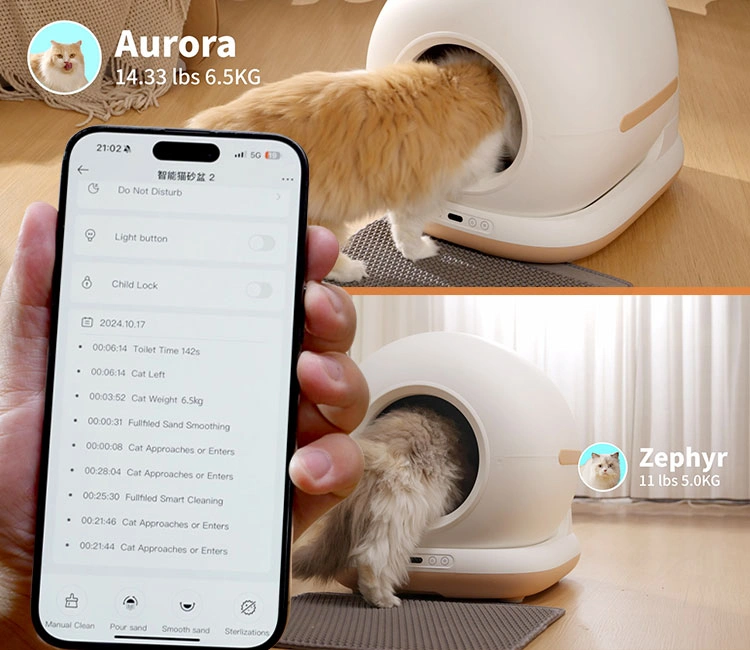
Self-cleaning platform evaluation
For brands evaluating a self-cleaning product line, Petrust CB001 is one platform to consider.
The reason to evaluate CB001 is not that a particular model can guarantee low returns or a specific profit margin.
No manufacturer should make that promise without evidence tied to the actual configuration, test conditions, sales environment, and customer population.
The reason is that a brand may want to begin with a product proposition centered on self-cleaning, day-to-day operation, safety, and a clearly defined support scope.
That is a legitimate product strategy.
When assessing CB001 for an OEM project, use the current approved specification and the requirements of the intended market.
| Evaluation area | Questions for the CB001 project |
|---|---|
| Safety and operating requirements | Which safety features, operating boundaries, and sensor behaviors are included in the confirmed configuration? What verification is required? |
| Self-cleaning and daily maintenance | What are the documented cleaning functions, waste-handling arrangements, maintenance requirements, and litter compatibility boundaries? |
| Product-line fit | Do the standard configuration, branding options, documentation, and OEM scope match the brand's positioning and launch plan? |
| Support requirements | Which setup, maintenance, replacement-part, warranty, and troubleshooting responsibilities will the brand need to manage? |
| Commercial model | What are the actual landed cost, channel expenses, expected after-sales costs, and support assumptions? |
For a growing brand, a standard self-cleaning platform may be a practical starting point when its functionality aligns with the intended product proposition and the business wants a clearly defined scope.
That does not mean every new brand should choose CB001.
A brand targeting customers who specifically expect camera monitoring or a more connected experience may need a different configuration.
Nor does a standard platform mean there is no engineering work. The final product still needs to match the intended market, specifications, branding, and applicable verification requirements.
The commercial question is whether the platform meets the customer’s needs without introducing complexity that the business has not planned to support.
CB002: When a Camera-Enabled Platform Fits the Business

Connected-product platform evaluation
Confirm the current approved model image, camera configuration, and included connected functions before publication or quotation.
Some brands are building their proposition around connected pet care. Their customers may value camera monitoring, app-based interaction, and a richer view of their pet’s activity.
For those brands, a camera-enabled platform can be commercially relevant.
Petrust CB002 is a platform to evaluate when a brand is considering a more feature-rich smart hygiene product.
The decision should be based on the confirmed configuration and requirements—not on the assumption that more features automatically create more profit.
A CB002 camera smart cat litter box project should address at least four commercial questions.
Is monitoring a central reason customers will buy the product, or is the camera simply being added to make the specification look more impressive?
If the camera is central to the customer proposition, the brand should be able to explain what the customer gains from that experience.
The app, pairing process, supported network environment, software requirements, and customer guidance need to fit the brand’s actual support resources.
This is not a judgment about whether camera-enabled products are inherently difficult to support. It is a requirement to define the connected-product scope.
Compare the expected pricing opportunity with additional product, development, validation, software, and after-sales costs.
A premium feature should have a commercial reason to exist.
Confirm the camera and app configuration, relevant validation, privacy requirements, documentation, software responsibilities, and production requirements for the actual project.
For a premium smart cat litter box OEM project, the brand should be able to explain why the connected functions matter to its target customer and how the additional support requirements will be handled.
If those functions are central to the brand’s value proposition, they may justify the additional complexity.
If the business has not yet established its support processes, a more limited configuration may be easier to evaluate first. That is a project-specific decision, not a universal rule against camera-enabled products.
At Petrust, we don’t believe every brand needs the most feature-rich litter box.
We believe the right platform is the one whose performance, complexity, and support requirements match the brand’s actual capabilities.
The platform decision is not simply about whether a camera is included.
It is about the product experience the brand intends to sell and the responsibilities it is prepared to manage.
| Decision factor | CB001 project evaluation | CB002 project evaluation |
|---|---|---|
| Product proposition | Assess whether the confirmed self-cleaning configuration fits the brand's core offer | Assess whether the confirmed camera and connected functions are central to the customer proposition |
| Customer expectations | Define cleaning, maintenance, safety, and operating expectations | Define those same expectations, plus the actual camera, app, and connectivity experience |
| Engineering scope | Confirm the existing platform, required changes, and applicable validation | Confirm the platform configuration, connected functions, software scope, and relevant validation |
| Support planning | Establish setup, maintenance, warranty, parts, and technical escalation requirements | Establish those responsibilities and clarify the additional connected-product support scope |
| Commercial evaluation | Model actual landed cost, channel expenses, and expected after-sales costs | Include any additional configuration, development, validation, software, and support costs that apply |
| Launch readiness | Confirm specifications, documentation, market requirements, and production arrangements | Confirm the same items, including applicable camera, app, privacy, and connected-product requirements |
This is a project-planning comparison, not a claim that one platform has a lower return rate, higher profit margin, or better reliability than the other.
The final evaluation must use the current approved product specifications, actual project scope, and applicable test and compliance evidence.
For brands narrowing the choice to these two Petrust® platforms, a direct CB001 vs CB002 comparison can make the decision more concrete by putting product proposition, connected functionality, engineering scope, support planning, and commercial assumptions side by side.
The distinction matters.
Choose the product experience your brand intends to deliver—not simply the longest feature list your budget can accommodate.
What to Expect From an Automatic Cat Litter Box Manufacturer
A smart cat litter box is not just a plastic enclosure, a motor, a sensor, and an app assembled into one product.
Those parts have to work together under defined conditions. The product also has to be manufactured consistently, meet applicable requirements, and arrive with the documentation and support arrangements agreed for the project.
That is why choosing an automatic cat litter box manufacturer is not simply a matter of comparing unit prices.
At Petrust, we approach this from the perspective of a manufacturer with our own engineering, R&D, production, and OEM project experience.
Our responsibility is not to tell buyers that every project is simple. It is to establish what the project requires, what our team can actually support, and what needs to be agreed before manufacturing begins.
Smart Cat Litter Box OEM Requires Engineering, Not Just Feature Assembly
A brand may approach a factory with a product brief that sounds straightforward:
“We want a self-cleaning litter box. Add a camera. Include an app. Make it suitable for our market. Keep the cost competitive.”
That is a starting point, not an engineering specification.
The smart cat litter box OEM development process needs to turn those commercial requests into requirements that can be designed, reviewed, verified, and manufactured.
For example, a request for automatic cleaning raises questions about the cleaning mechanism, operating sequence, sensor behavior, intended litter conditions, and abnormal-operation handling.
A request for connected functions introduces additional requirements around device configuration, app behavior, connectivity, software responsibilities, and support boundaries.
A request for a customized product raises questions about which components, mechanical structures, software elements, or production processes will change.
The engineering scope depends on the project. There is no single development process or fixed list of deliverables that applies identically to every OEM order.
This is particularly relevant when working with a smart litter box ODM manufacturer or a factory offering existing platforms with customization options.
The word ODM does not, by itself, tell you how much of the product is existing, what customization is available, who owns particular design elements, or which engineering activities are included in the quotation.
Those details need to be agreed.
At Petrust, we believe a responsible manufacturer should be willing to discuss the limits of an existing platform as well as its capabilities.
We should be able to explain what the selected configuration is intended to do, what a requested modification changes, and what additional development or verification may be required.
We also have to apply those questions to our own products.
A brand should not have to guess whether a requested feature is already supported, requires engineering work, or introduces a new project requirement.
That is part of making an OEM project commercially understandable before the brand commits to it.
From Engineering Approval to Mass Production: Who Is Responsible for What?
A prototype answers one question: can this particular build perform the intended function under the conditions tested?
Mass production raises a different question: can the approved product requirements be reproduced across the production process, and can relevant changes be identified and controlled?
Those are not interchangeable questions.
A successful demonstration is useful evidence about that demonstration. It is not a substitute for an agreed validation plan, production acceptance criteria, and appropriate change control.
For a smart cat litter box mass production project, the distinction matters.
A product may involve mechanical components, sensors, electronic assemblies, firmware, an APP configuration, and multiple suppliers. A change to one component or process may affect the way the finished product performs.
The manufacturing process therefore needs to be connected to the design and validation requirements.
Smart Cat Litter Box OEM: From Product Requirements to Mass Production
A practical way to organize project discussions. The applicable stages, records, and approvals depend on the agreed product scope.
01
Product Definition
Approved model, intended use, specifications, target market, and project scope.
Output to agree: product requirements and approved configuration.
02
Engineering & Validation
Defined requirements, applicable test conditions, results, and unresolved issues.
Output to agree: validation scope, applicable records, and issue disposition.
03
Production Readiness
Approved configuration, production controls, acceptance criteria, and change process.
Output to agree: production requirements and release conditions.
04
Production & Shipment Verification
Applicable inspections, records, nonconformity handling, and agreed shipment requirements.
Output to agree: inspection results and shipment disposition.
05
Post-Launch Feedback
Support issues, verified root causes, corrective actions, and controlled future changes.
Output to agree: feedback records and any required corrective or change actions.
* Illustrative project framework. It is not a claim that every Petrust OEM project follows an identical five-stage procedure or that every stage has been completed for every product configuration.
The purpose is to connect the approved product requirements with the manufacturing process and the evidence available for the project.
A smart litter box batch consistency requirement should be defined in terms of the characteristics that matter for the product: applicable components, assembly requirements, functional performance, configuration, and other agreed acceptance criteria.
Similarly, smart litter box production validation should be understood in relation to the actual product and process. It should not be treated as a generic certificate that automatically covers every future change or production condition.
The same logic applies to smart litter box engineering change management.
Suppose a component becomes unavailable and a replacement is proposed.
The replacement may appear equivalent on paper. But if it affects a relevant performance, safety, compatibility, or certification requirement, the change needs to be evaluated accordingly.
A responsible change process establishes:
- What changed and why.
- Which product requirements may be affected.
- Who assesses and approves the change.
- Whether additional testing or revalidation is required.
- Which approved configuration and production records need updating.
A replacement component should not be treated as an approved equivalent simply because it fits physically or has a similar description.
The details of component traceability, inspection records, and production documentation should be defined by the product, project, and applicable requirements.
At Petrust, we have to ask the same questions of our own platforms:
What can fail? How will we verify it? Can our production line reproduce the validated design? And what evidence can we provide before a brand commits to launch?
Those are not questions reserved for a buyer evaluating another factory. They apply to our own manufacturing work.
Manufacturing Responsibility Must Be Defined Before the Purchase Order
A brand should not have to discover after production starts that two parties understood the same project differently.
At Petrust, we believe the project scope should distinguish manufacturing responsibilities, joint project decisions, and market-entry responsibilities that depend on applicable regulations and contractual arrangements.
| Project area | What should be agreed | Why it matters |
|---|---|---|
| Product specifications | Approved configuration, functions, operating conditions, and acceptance requirements | Establishes what the manufacturer is actually being asked to produce |
| Engineering changes | Change request, technical assessment, approval, and applicable revalidation | Prevents an undocumented change from being treated as an approved equivalent |
| Production quality | Applicable inspection points, acceptance criteria, nonconformity handling, and records | Connects manufacturing output to the agreed product requirements |
| Compliance documentation | Required evidence, applicable market, product configuration, and party responsible for each deliverable | Prevents a general certification statement from being mistaken for product-specific evidence |
| After-sales support | Warranty scope, technical escalation, spare parts, response arrangements, and contractual limits | Makes post-shipment responsibilities clear before customers need assistance |
The exact allocation of responsibility depends on the product, market, contract, and agreed project scope.
For example, a manufacturer may provide agreed technical documentation or support testing activities, while the brand or importer may have separate obligations concerning product placement, labeling, distribution, or regulatory compliance.
A brand may also need to coordinate with a designated testing laboratory, certification body, or other relevant party, depending on the requirements of the destination market.
The important point is to identify those obligations before the project moves into production—not to assume that the word “OEM” automatically assigns every responsibility to one party.
Certification and Compliance Must Match the Product and Target Market
Certification is another area where a simple quotation can hide important differences.
A brand may ask whether a litter box has CE, FCC, RoHS, UL, or other certifications or compliance documentation.
The answer depends on the product configuration, electrical and electronic components, intended market, applicable requirements, and exact scope of the requested evidence.
These terms are not interchangeable.
A document associated with one model or component does not automatically establish compliance for a different product configuration.
Nor does the presence of a particular mark prove that every aspect of the product’s safety, performance, or quality has been evaluated.
For an importer, the relevant question is not simply whether a manufacturer can list familiar certification names.
It is whether the applicable requirements for the specific product and destination market have been identified and whether the necessary evidence is available for the configuration being sold.
At Petrust, compliance support needs to be connected to the actual OEM project.
The scope should clarify the relevant model, market, configuration, documentation, and any testing or certification work that is included or separately required.
A project destined for one market may have different requirements from a project destined for another. The brand should not assume that one set of documents automatically covers every market.
The important commercial point is that compliance is part of the product and launch scope.
It should be discussed before the brand finalizes its budget, development timeline, and market-entry plan.
For importers comparing certification claims across suppliers, it is worth separating familiar certification names from the actual requirements and evidence applicable to the product and destination market; a closer look at smart cat litter box certifications can help clarify what CE, FCC, RoHS, UL, and TELEC do—and do not—tell you.
A manufacturer should be clear about what it can provide, what has been verified, and what remains the responsibility of the brand or another party under the agreed project terms.
Before You Launch, Make Sure Your Smart Cat Litter Box Business Is Ready
By now, the decision should look different from the one many brands make at the beginning.
It is no longer just about choosing a product with the right features at the right price.
It is about choosing a product, a commercial model, and a manufacturing scope that the business can sustain.
Before committing to an OEM project, take a hard look at the business behind the product.
Match Your Product Platform to Your Channel, Budget and Support Capacity
The same litter box can create different business requirements depending on how it is sold.
An Amazon seller may be working within a marketplace environment with specific listing, fulfillment, customer-service, and return requirements.
A wholesale business may need to consider distributor margins, order quantities, packaging, shipment arrangements, and how support responsibilities are divided between the brand and its customers.
A pet brand selling directly to consumers may have more control over the customer journey, but it also needs to plan how it will handle setup questions, warranty requests, and post-purchase communication.
That is why smart pet product sales channels should influence the platform decision from the beginning.
The same product can create very different economics and support obligations depending on whether it is sold through Amazon, wholesale, distribution, or direct-to-consumer channels, so the sales model itself should be treated as a product-selection variable.
Smart litter box for Amazon sellers
Consider marketplace fees, advertising costs, fulfillment and return policies, listing accuracy, packaging, and the resources available to resolve customer complaints.
The applicable requirements depend on the marketplace, destination market, and selling arrangement.
A product listing that promises universal litter compatibility or a maintenance-free experience can create expectations beyond the approved product specifications.
The brand should make sure that its images, feature descriptions, supported configurations, and user instructions match the product being shipped.
Smart litter box wholesale business
Consider order quantities, distributor economics, packaging and shipping requirements, product documentation, and how warranty and technical support will be coordinated across the channel.
The brand should also define which information distributors need to support customers and which issues require escalation to the manufacturer.
Smart pet brand development
Consider the product promise, customer expectations, brand positioning, customization requirements, support resources, and whether the product can become a sustainable part of a wider product line.
The purpose is not to assign one platform to each channel.
An Amazon seller may have the resources to support a connected, camera-enabled product. A wholesale brand may prioritize a different configuration. A new private-label brand may have an established customer-service team or may be starting with very limited support capacity.
The decision depends on the actual business.
When defining your smart litter box target market, be specific about the customer, the use case, the intended price, the product expectations, and the requirements of the destination market.
Then define your smart litter box product line strategy.
Are you launching one product to validate demand?
Are you building a range of products at different price points?
Is the litter box central to your brand, or is it one product in a wider pet-care portfolio?
Those questions influence how much development, customization, inventory, and support infrastructure the business should commit to.
A camera-enabled product may be an appropriate starting point for a brand whose differentiation depends on connected pet care.
A more focused self-cleaning product may fit a brand whose customer proposition emphasizes everyday functionality and a clearly defined product scope.
Neither strategy is automatically right for every business.
The important thing is to match the product’s actual capabilities and support requirements to the promise the brand makes to customers.
Before choosing the platform, ask yourself:
- Can we explain the product's functions and limitations accurately?
- Do we have a realistic budget for product, freight, channel, and after-sales costs?
- Who will answer customer questions and manage warranty cases?
- Do we understand the product's maintenance and compatibility requirements?
- Can our business support the software, connected functions, or customization included in the selected model?
If those questions have not been answered, it may be too early to commit to a production order.
Define Your OEM Requirements Before Requesting a Quote
A useful OEM quotation begins with a clear project brief.
The more clearly the brand defines the intended product, market, and scope, the easier it becomes to discuss platform suitability, development requirements, MOQ, lead time, and manufacturing arrangements.
A request that simply says “Please quote your best smart cat litter box” leaves too many commercial and technical questions open.
At Petrust, we would rather understand the project than assume that a generic quotation answers the buyer’s real needs.
Use these points to prepare your first inquiry. Not every field needs to be finalized before an initial discussion.
Target market and sales channel
Which country or region will you sell in? Are you targeting Amazon, retail, wholesale, distribution, or direct-to-consumer sales?
Product positioning and core functions
What price range, customer group, and product experience are you targeting? Which functions are essential, and which are optional?
Expected order quantity and project stage
Are you evaluating an existing platform, preparing a sample order, planning an initial production run, or requesting a customized development project?
Engineering and compliance requirements
Identify requested changes, connected functions, target-market requirements, documentation needs, and any known testing or certification requirements.
Commercial and after-sales expectations
Clarify packaging, warranty expectations, replacement parts, support responsibilities, preferred delivery terms, and any launch deadlines.
This information gives the manufacturer a starting point for assessing the relevant platform and project scope.
For a standard product, the discussion may focus on the approved configuration, branding options, MOQ, price, lead time, and applicable documentation.
For a customized project, the team may need to clarify engineering requirements, component changes, software scope, validation, tooling, and other development costs before providing a complete quotation.
The actual MOQ, price, and lead time depend on the model, order quantity, customization, material availability, and agreed project requirements.
They should be confirmed through the quotation and project discussion rather than assumed from a general article.
For a smart cat litter box wholesale supplier or OEM manufacturer, the useful question is not simply:
“What is your lowest price?”
It is:
“What exactly is included in that price, what does the product support, and what will we need to provide or manage ourselves?”
That is how a brand can compare quotations on a meaningful basis instead of discovering after the order that important development, validation, or support requirements were never included.
Have a Smart Cat Litter Box Project in Mind?
Before committing to a product platform or production order, make sure the product scope matches your target market, commercial model, and support requirements.
At Petrust, we work with brands on smart pet product OEM and ODM projects, from existing platform evaluation to agreed customization, engineering, and manufacturing requirements.
Tell us about your project, and our team can discuss:
- Whether an existing platform or a customized development scope is relevant to your requirements.
- Which product functions, configurations, and engineering changes need to be clarified.
- What manufacturing, validation, and compliance documentation needs to be defined for your target market.
- Which MOQ, quotation, lead-time, and after-sales arrangements need to be confirmed for the actual project.
The available options and deliverables depend on the selected model, order quantity, target market, and agreed project scope.
Petrust OEM / ODM
Share your product requirements and intended market so our team can discuss the appropriate OEM approach.
Helpful information for your first inquiry
- Target market and sales channel
- Preferred platform or required functions
- Estimated order quantity or project stage
- Customization, compliance, and launch requirements, if known
Conclusion — The Right Product Is the One Your Business Can Sustain
The first 100 units prove that customers may be willing to buy your product.
The business that follows depends on what happens after those units reach their homes.
A smart litter box does not become profitable simply because it sells at a premium. It becomes a sustainable product line when the product experience, support burden, engineering requirements, and manufacturing process fit the business behind it.
Three decisions matter.
Product landed cost, channel expenses, returns, replacements, warranty obligations, and customer-support work all affect the contribution a product leaves behind.
Support-Adjusted Contribution gives brands a way to compare those costs using explicit assumptions and actual sales data as it becomes available.
CB001 and CB002 represent different product directions to evaluate. The right choice depends on your target market, product positioning, confirmed configuration, support capacity, and engineering requirements—not on a universal rule that simpler or more feature-rich products are always better.
Engineering requirements, appropriate testing, production consistency, change management, and market-specific compliance need to be discussed before the brand commits to launch.
At Petrust, we apply those questions to our own products and OEM projects. We believe a manufacturer should be clear about what a platform can do, what still needs to be verified, and what responsibilities are included in the project.
If your target market, product positioning, and project requirements are already clear, send your OEM project requirements to Petrust to discuss platform suitability, development scope, and manufacturing requirements.
The goal is not to launch the most complicated litter box you can afford.
It is to build a product line your customers can use, your team can support, and your business can continue to operate.
FAQ
A brand can reduce avoidable return risks by matching the product to its target customers, setting accurate product expectations, validating relevant functions before mass production, providing clear setup and maintenance instructions, and monitoring customer complaints after launch.
Engineering validation and production quality controls can help address product-related risks. However, return rates are also influenced by customer behavior, sales channels, logistics, and return policies.
No manufacturer can guarantee a specific return rate without a clearly defined and independently supportable basis.
It depends on the brand's positioning, budget, target customer, support capacity, target market, and product requirements.
A standard self-cleaning platform such as CB001 may be worth evaluating when the brand's initial proposition centers on everyday self-cleaning functionality and a clearly defined product scope.
A camera-enabled platform such as CB002 may be worth evaluating when connected monitoring and app-based features are central to the customer proposition and the brand can support the associated technical and after-sales requirements.
Neither platform guarantees a particular return rate, profit margin, or level of support workload.
Depending on the product and contract, the project should establish the approved specifications, applicable engineering and design validation requirements, production quality and acceptance criteria, relevant compliance documentation, and procedures for managing engineering changes.
The manufacturer and brand should also clarify packaging, warranty scope, spare parts, technical escalation, and other agreed responsibilities.
The exact deliverables depend on the selected model, target market, configuration, and OEM project scope.
A prototype demonstration or a general list of certifications should not be treated as proof that every production and market requirement has been satisfied.