
A filter can contain quality materials and still be the wrong choice for a pet water fountain.
The problem is that a filter cartridge does not work alone. Water has to pass through its media, move through the fountain’s water path, and return to the drinking area at a suitable flow rate.
The pump has to operate within the resistance created by the assembled system. And the owner has to clean the fountain and replace its consumables without turning routine maintenance into a chore.
This is where product development gets more complicated than choosing a cartridge from a supplier’s catalog.
A material may be useful for one filtration objective but unnecessary for another. A cartridge that performs adequately when new may behave differently as particles accumulate.
And adding more filtration layers can increase material costs, replacement requirements, and design complexity without delivering a meaningful benefit to the intended customer.
For pet brands developing a new fountain, the question is not simply which filter contains the most materials.
It is which filtration system does the job the product actually needs it to do.
A pet water fountain filter should never be designed in isolation. It has to work as part of the product.
What Does a Pet Water Fountain Filter Actually Do?
Different pet water fountain filter media perform different functions.
Some physically capture particles. Others adsorb certain compounds or exchange selected dissolved ions.
Membrane-based media can provide additional particle separation when the product is designed around that technology.
These functions are not interchangeable.
A material that catches visible debris does not automatically remove dissolved substances. Activated carbon does not remove every possible contaminant.
Ion exchange resin works according to its selectivity and capacity, while membrane performance depends on the membrane’s characteristics and operating conditions.
The CDC’s guidance on choosing water filters illustrates an important general principle: filtration claims should match the specific substances a filter is designed to remove. For a pet fountain cartridge, the presence of a particular material is not proof that the finished product delivers a particular water-quality benefit.
A conventional pet water fountain filter should not automatically be treated as a complete water purification system.
There is another distinction worth making before a brand finalizes its filtration specification: filtration and UV treatment are not interchangeable.
They address different functions, and adding one does not automatically eliminate the need for the other or replace routine cleaning.
For teams deciding which technology belongs in their product, a closer look at what UV treatment and filtration actually do in pet water fountains can help prevent an expensive specification mistake: paying for a feature without a clearly defined purpose.
For product developers, the first decision is straightforward: define the intended filtration function before selecting the materials.
If the objective is to capture hair and visible debris, the design requirements differ from those of a product intended to reduce certain odors or address selected dissolved ions.
Adding materials because they sound impressive is not a substitute for defining what the finished product needs to achieve.
Inside a Multi-Layer Pet Water Fountain Filter
A multi-layer pet water fountain filter combines materials with different functions in a cartridge or filtration assembly.
The five materials discussed below are possible design options, not a standard combination that every fountain needs.
The useful question is what each layer contributes, what it cannot do, and whether it makes sense within the complete product.
Non-Woven Fabric: Catching Hair and Larger Particles
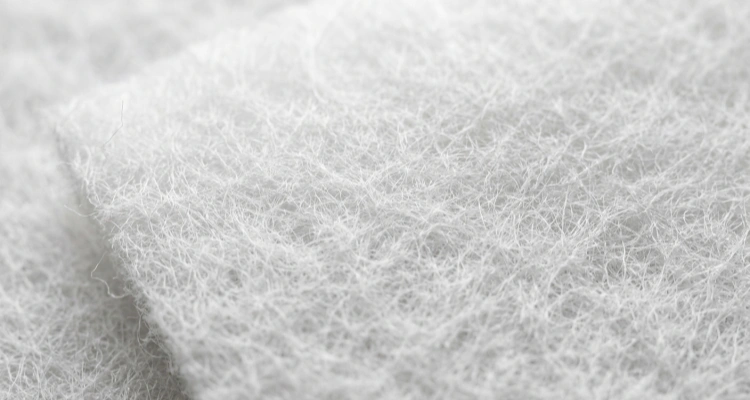
Non-woven filter material is commonly used as a physical filtration layer.
Depending on its fiber structure, thickness, permeability, and construction, it can capture hair, larger particles, and some suspended debris.
This makes it useful as a pet fountain hair filter or as a pre-filtration layer that helps keep larger particles away from downstream components.
But the material name alone tells a buyer very little about actual performance. Two non-woven materials can differ in density, fiber arrangement, thickness, and particle-retention behavior.
There is also a practical trade-off.
As captured debris accumulates, the available pathways for water to pass through the material may become restricted.
This can increase resistance to flow, although the effect depends on the material, debris loading, and operating conditions.
A denser material is not automatically worse, just as a more open material is not automatically better.
For a pet brand, the relevant questions are whether the layer captures the particles it is intended to manage, whether it affects circulation under expected use conditions, and whether owners can maintain the fountain easily.
Activated Carbon: Reducing Certain Odors and Taste Compounds
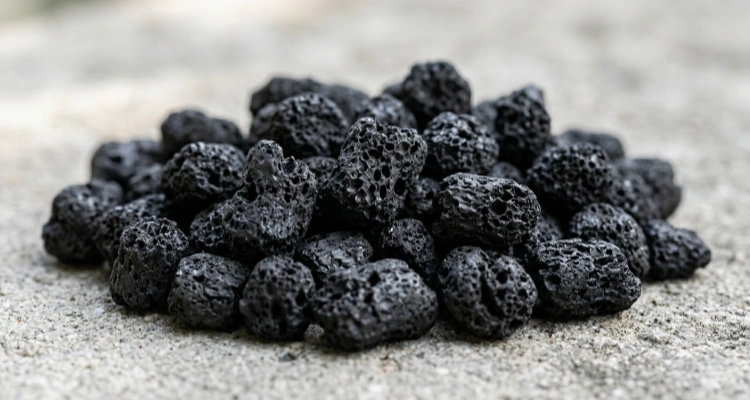
An activated carbon pet water fountain filter uses porous carbon to adsorb certain substances from water.
Depending on the carbon material, the target compounds, and operating conditions, this may help reduce some odor- and taste-related compounds.
Adsorption is different from physically catching particles. It also does not mean activated carbon removes every unwanted substance.
Performance can be affected by the available adsorption capacity, contact time, water chemistry, and the substances present. If water passes through a cartridge too quickly, contact time may be insufficient for the intended objective. The actual result depends on the complete cartridge design.
A 2024 study comparing activated carbon and reverse osmosis point-of-use filtration systems provides an example of why filtration performance must be interpreted in the context of the substances and systems being studied. Its findings should not be treated as a performance guarantee for pet fountain cartridges.
For OEM development, the useful question is not whether the specification lists activated carbon. It is what the carbon is intended to accomplish, what evidence supports that intended function, and how the cartridge is expected to be maintained or replaced.
Adding carbon simply to make a product specification look more advanced does not establish a meaningful customer benefit.
Ion Exchange Resin: What It Can Remove
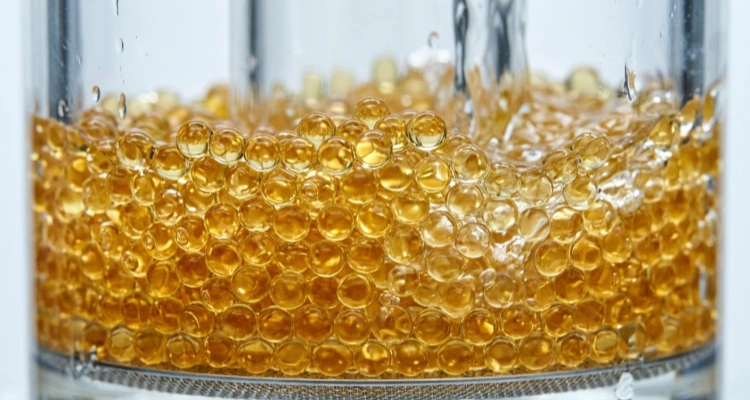
An ion exchange resin pet fountain filter may be designed to exchange particular dissolved ions.
Some resin formulations are used to address selected hardness-related ions, which is why buyers may encounter water-hardness claims in fountain filter specifications.
The result depends on the resin chemistry, its capacity, the ions present, competing substances in the water, and the operating conditions.
A resin suitable for one application is not automatically suitable for another. Nor does the presence of resin prove that a cartridge will substantially soften water under every household condition.
For product developers, the decision is whether addressing a defined water-quality concern justifies the additional material, cartridge complexity, and replacement considerations.
If the intended benefit cannot be clearly defined or supported by relevant evidence, adding resin may increase cost without giving customers a convincing reason to choose the fountain.
Maifanstone: Understanding Mineral-Based Filter Media
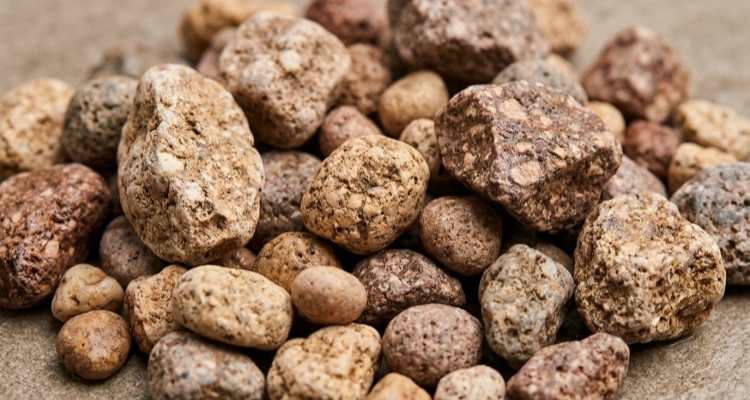
Maifanstone appears in some pet fountain filter designs, often alongside other materials in a multi-layer cartridge.
The important distinction is between identifying a material and proving what it does in a particular product.
The term maifanstone does not, by itself, establish a standardized composition, a predictable release of minerals, or a measurable water-quality benefit. Material composition, processing, contact conditions, and product-specific evidence all matter.
A maifanstone pet water fountain filter should therefore be evaluated according to its verified role in the cartridge, rather than assumptions attached to its name.
Pet brands should be particularly careful with health-related marketing claims. The presence of mineral-based media is not sufficient evidence that a fountain improves a pet’s health, provides a meaningful nutritional benefit, or makes water safer.
For OEM projects, establish the intended function, check the material specification, and substantiate performance claims before they appear on packaging or in marketing.
If the benefit cannot be demonstrated, the material should not be treated as an automatic upgrade.
Hollow Fiber Ultrafiltration: When Membrane Filtration Makes Sense
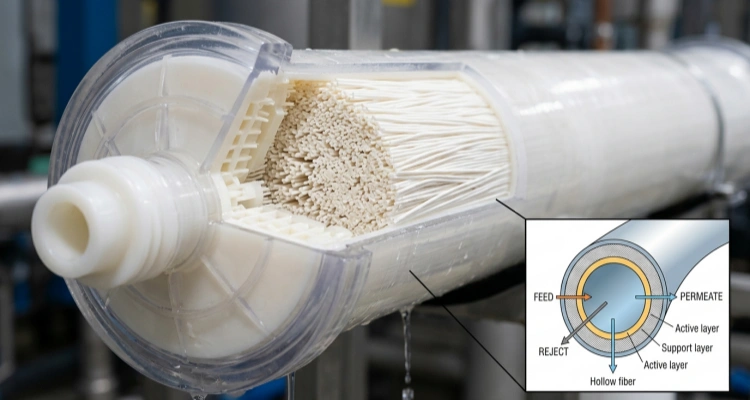
Hollow fiber ultrafiltration uses a membrane structure that can provide size-based separation within its demonstrated retention range.
In a pet fountain, it is a product-specific design choice, not a mandatory feature of every filter cartridge.
Suitability depends on the target separation task, membrane characteristics, available filtration area, operating pressure, flow requirements, sealing, and maintenance arrangements. A membrane cannot be evaluated by its nominal filtration rating alone.
The design must also account for fouling, cleaning or replacement requirements, and how water reaches and exits the membrane assembly.
For a product developer, the question is not whether ultrafiltration sounds more advanced than conventional media. It is whether the additional separation capability addresses a real product requirement and can be delivered within acceptable operating, maintenance, and cost limits.
A membrane-based system may make sense for one product concept. For a simpler fountain, it may introduce complexity the target market does not need.
How Filter Resistance Affects Water Flow
A pet water fountain filter does not operate independently of the pump.
The actual flow rate depends on the interaction between the cartridge, water passages, pump, and other hydraulic components.
This is one of the most important engineering considerations in fountain development.
Filter Pressure Drop and Flow Rate
When water passes through a filter, the media and cartridge structure create resistance to flow. The pressure difference across the filter is known as the filter pressure drop.
The relationship is not simply “more layers equals more resistance.” Actual resistance depends on the media properties, filtration area, thickness, pore structure, cartridge geometry, and operating flow.
In a simplified system:
Pump characteristics + system resistance → operating flow rate
The filter is only one part of the system resistance. Water passages, fittings, outlet geometry, and other components also influence the result.
As a cartridge collects debris, its resistance may change.
That change can alter the system’s flow rate, but the magnitude of the effect needs to be established through measurement rather than assumed from the number of filter layers.
For buyers evaluating a product, a pump specification showing only rated flow is not enough to establish the flow delivered by the assembled fountain.
What matters is whether the complete system delivers the required flow under its intended operating conditions, with the selected cartridge and water path installed.
The pump deserves the same level of attention as the filter.
A fountain may have a suitable pump rating on paper, yet its real-world performance still depends on the water path, operating conditions, and how the complete assembly is maintained.
For a clearer picture of the risks involved, why pet water fountain pumps fail—from noise and dry running to leaks and service-life problems is worth examining before the pump is treated as a settled component choice. Identifying these risks early can help teams define more realistic engineering and maintenance requirements.
How Filter Condition Changes Pump Performance
A fountain pump operates at a point determined by its performance characteristics and the resistance of the system it serves. This is commonly described as the pump operating point.
In a typical centrifugal-pump system, increased system resistance can reduce flow. The exact response depends on the pump design and the complete hydraulic circuit.
Pump load and filter resistance should not be treated as a simple, universal relationship. Electrical power consumption, flow rate, pressure, and temperature may respond differently depending on the pump and system.
For product engineering, the practical task is to evaluate the assembled fountain rather than judging the pump and filter separately.
At Petrust, the relevant engineering principle is to consider the filter, water path, and pump as an integrated system.
Where supported by the project requirements and available equipment, validation can examine assembled-system flow, compare relevant filter conditions, and record whether the product meets its defined performance requirements.
The evidence should come from the actual design under evaluation. A pump specification alone does not prove how a finished fountain will perform.
A Design Decision Worth Checking Before Approval
Consider a hypothetical OEM project.
The pump specification looks suitable, and the selected cartridge contains all the materials listed in the product brief. Both components appear to meet their individual specifications.
But neither specification tells the development team, on its own, how the assembled fountain will behave with the intended cartridge installed.
Before approving the design, the team still needs to establish the required flow under intended operating conditions, confirm that the cartridge fits and seals correctly, and determine whether the maintenance routine is practical for the target user.
This is not an argument for adding more tests to every project. It is a reminder to verify the things that determine whether the chosen design actually meets its requirements.
For an OEM buyer, the useful question is not simply:
“Does this pump have enough flow?”
It is:
“What evidence shows that this pump and cartridge work together in the fountain we intend to sell?”
That is a more useful question to ask before committing to a design than after the product is already in production.
Why Filter Performance Can Change Over Time
A filter’s initial condition is only one point in its service life.
During use, particles may accumulate, adsorption capacity may be consumed, and certain media may become less effective for their intended function.
The type and rate of change depend on the media and water conditions.
Particle Buildup, Flow Restriction and Maintenance
A clogged pet water fountain filter may contribute to reduced water flow, but a change in fountain performance should not automatically be blamed on the cartridge.
Hair, food particles, biofilm, mineral deposits, pump debris, a blocked inlet, or an obstructed outlet can also affect circulation. The symptoms can overlap.
It is important to distinguish between visible debris accumulation, reduced flow, and a change in the filter’s ability to perform its intended function. These are related, but they are not the same.
A cartridge may still pass water after its adsorption capacity has declined.
Conversely, a fountain may have reduced flow because the pump or water path needs attention rather than because the filter media has reached the end of its useful life.
The maintenance routine must therefore cover the complete fountain, not just the removable cartridge.
Owners should follow the product’s instructions for cleaning the reservoir, water passages, pump, and reusable components.
Troubleshooting guidance should reflect the actual product design rather than assume every fountain has the same cause of reduced flow.
For manufacturers, maintenance is part of the product experience.
A design that is difficult to inspect, clean, or reassemble can create avoidable frustration even when its filter materials are technically suitable.
How Often Should You Replace a Pet Water Fountain Filter?
There is no universal replacement interval that applies to every fountain, household, and type of water.
If a buyer asks how often to replace pet water fountain filter cartridges, the responsible answer is that the interval should follow the specific product’s instructions and relevant validation—not a number copied from another model.
What Affects Filter Replacement Frequency?
Pet fountain filter lifespan depends on several factors:
Incoming water quality: The quantity and type of particles or dissolved substances affect how the media is used.
Usage conditions: Frequency of use and exposure to hair or other debris can change the maintenance burden.
Cartridge design: Media quantity, filtration area, construction, and intended function affect how the cartridge behaves.
Product requirements: Replacement recommendations should reflect the performance and maintenance criteria established for that fountain.
These factors help explain why replacement intervals vary.
They do not provide a reliable universal formula. A replacement schedule should be supported by the product’s design and available evidence.
For brands, replacement filters are also part of the commercial model. Replacement filter cost, availability, and compatibility can influence long-term customer satisfaction.
A proprietary cartridge may support a specific product architecture, but it also creates a responsibility to maintain clear specifications and dependable replacement supply.
Compatibility should never be assumed merely because two cartridges look similar.
What Affects Filter Replacement Frequency?
Searches for how to clean pet fountain filter or whether to rinse pet fountain filter often produce advice that is too general.
Some cartridges are designed to be rinsed before use or maintained in a specific way. Others contain media that should not be washed, regenerated, or reused by the customer.
Rinsing may remove loose particles from certain surfaces, but it does not necessarily restore exhausted adsorption capacity or reverse every form of fouling.
Follow the instructions for the specific cartridge. Do not assume that every layer is washable or that a rinsed filter has returned to its original performance.
The same principle applies to the pump and other components. Water pump cleaning may be necessary as part of routine maintenance, but it should be performed according to the product’s instructions.
For product developers, cartridge access, replacement steps, component cleaning, and reassembly need to be considered during design.
If routine maintenance is unnecessarily difficult, customers may find the product harder to live with, regardless of how impressive the original specification looks.
The Five-Part Filter Integration Check
A filter cartridge can look right on paper and still create problems when installed in a complete fountain.
Before settling on a filtration design, use these five questions to connect material selection with the product’s real requirements.
This is a practical decision framework for OEM discussions, not a claim that one universal test protocol applies to every fountain.
Start with the intended function.
Is the layer designed to capture hair and visible debris, reduce certain odor-related compounds, exchange selected ions, or provide membrane-based separation?
Each function requires a different basis for evaluation. If a material has no defined role in the intended product, its presence may add cost without a meaningful benefit.
A pump’s rated flow does not establish the flow delivered by a complete fountain with its intended cartridge installed.
The product requirements should define the relevant operating conditions and acceptable performance. Verification should use the assembled configuration rather than rely solely on individual component specifications.
Consider the cartridge, pump, water passages, fittings, and sealing as connected parts of one system.
Is the layer designed to capture hair and visible debris, reduce certain odor-related compounds, exchange selected ions, or provide membrane-based separation?
Each function requires a different basis for evaluation. If a material has no defined role in the intended product, its presence may add cost without a meaningful benefit.
Consider how users access the cartridge, clean the fountain, replace consumables, and reassemble components.
The replacement interval should follow product-specific instructions and supporting evidence. Cartridge availability, replacement cost, and compatibility also matter to the brand’s long-term customer experience.
The fifth question concerns what happens after the prototype or sample has been approved.
Changes to filter materials, cartridge dimensions, or suppliers may affect the assembled product. Those changes should be reviewed according to their potential impact before being accepted into production.
The components and configuration used in mass production should remain consistent with the approved design and its established requirements.
Taken together, these five questions connect filtration objectives, system performance, maintenance, and manufacturing responsibility.
They also help buyers move beyond a basic question such as “How many layers does this filter have?” toward the more useful question: “Why is this filtration design suitable for the product we intend to sell?”
Which Filtration Setup Fits Your Pet Water Fountain?
The right pet water fountain filtration system depends on the intended user, product positioning, maintenance expectations, and cost target.
There is no single configuration that every pet brand should adopt.
Basic Filtration for Cost-Sensitive Products
A basic pet fountain filtration setup may be appropriate when the primary objective is to capture visible debris and support straightforward routine maintenance.
For an entry-level fountain, simplicity can be a genuine product advantage.
Fewer materials or components may make cartridge sourcing, assembly, and replacement easier, provided the filtration system meets the product’s defined requirements.
The trade-off is that a basic design may not address every water-quality objective.
That limitation should be understood and communicated honestly rather than hidden behind broad claims about clean or purified water.
Multi-Stage Filtration for Different Water Quality Goals
A multi-stage pet water fountain filter can combine materials that perform different functions.
The benefit comes from choosing compatible media for defined objectives—not from maximizing the number of layers.
A well-considered design should account for each material’s intended function, the cartridge’s flow characteristics, maintenance requirements, and consumable cost.
If a layer has no clear purpose in the intended product, it may add sourcing complexity and replacement cost without creating a meaningful customer benefit.
The best design is not necessarily the most complicated one. It is the design whose functions, limitations, and upkeep match the product promise.
Filtration for Cordless and Smart Water Fountains
A cordless pet water fountain introduces additional constraints because battery capacity, pump operation, water circulation, and maintenance all influence the product’s overall behavior.
Designers should assess how the selected cartridge affects flow and whether the pump can deliver the required circulation within the product’s power budget.
This trade-off becomes particularly important when the product is battery-powered.
A cordless fountain must balance circulation performance with available battery capacity and charging expectations, while a plug-in model operates within a different set of power and placement constraints.
For brands still choosing their product architecture, the practical differences between cordless and plug-in pet water fountains are worth weighing before the pump, battery, and filtration requirements are finalized. Choosing the power system early can reduce the risk of redesigning several connected components later.
For a smart pet water fountain, filtration also needs to be considered alongside monitoring functions.
A sensor or app may help users understand certain operating conditions if the system has been designed and validated to measure them.
However, an app should not be assumed to determine filter saturation or remaining filter life unless the product has a reliable basis for doing so.
More features do not automatically produce a better fountain. If an app or sensor does not solve a meaningful customer problem, it may add development work, testing requirements, and after-sales support without giving the product a convincing commercial advantage.
For brands deciding how much functionality their target market actually needs, the trade-offs between smart and basic pet water fountain models are worth considering before expanding the specification. A feature should earn its place through a clear user benefit and a credible business case, not simply because it makes the product look more advanced.
These are product architecture decisions, not just filter-material decisions.
Choosing the filter is only one part of the decision. The fountain’s overall design—whether it is cordless or plug-in, basic or app-connected, and built around a particular reservoir and maintenance routine—also affects how the filtration system should be integrated.
A filter specification cannot tell you whether the complete fountain is the right product for your market. Power supply, materials, connectivity, maintenance, and production requirements all need to fit together.
For brands still comparing product directions, the wider range of pet water fountain OEM platforms, including cordless, smart, and stainless steel designs, offers a useful starting point for evaluating the complete product rather than committing too early to an individual component.
Compare product directions, engineering requirements, and potential fit for your target market before narrowing the project to an individual component.
How We Approach Filter Integration in Pet Fountain Development
As an OEM/ODM manufacturer, at Petrust, we do not treat a filter cartridge as a finished solution simply because its materials meet a specification.
For an OEM project, the cartridge has to fit the fountain being developed. That means considering its intended filtration function alongside the water path, pump, sealing, maintenance steps, and target cost.
The verification plan should follow the actual design. Depending on the project, this may include measuring flow with the intended cartridge installed, checking cartridge fit and sealing, and evaluating cleaning and replacement procedures under defined conditions.
Component changes also need to be reviewed in context. A different filter material, cartridge dimension, or supplier may affect how the assembled product performs. The impact should be assessed before the change is accepted into production.
The same principle applies to mass production: the components and configuration used in production should remain consistent with the design and requirements that were approved.
A filter specification describes a component. It does not, by itself, establish how the finished fountain will perform.
For Petrust, this is the relevant manufacturing responsibility: filtration choices must make sense within the product being developed, and the requirements established during development must carry through to production.
This is also where manufacturer selection becomes a project decision, not just a price comparison.
A supplier may offer a suitable filter cartridge, but the OEM project still depends on how well the team connects component selection, engineering requirements, sample approval, and mass production.
For brands moving from product research to supplier evaluation, what to check when choosing a pet water fountain manufacturer for an OEM project is worth reviewing before making a commitment. The objective is to establish whether the manufacturer’s actual capabilities and responsibilities fit the product, the target market, and the level of customization required.
Choose the Filtration System Around the Product You Need to Build
A pet water fountain filter should never be designed in isolation. It has to work as part of the product.
Before choosing filter media, define the filtration objective, required flow, pump and water-path configuration, maintenance expectations, replacement costs, and target market. Then select the cartridge construction that fits those requirements.
For some products, a simple setup will be the sensible choice. Others may justify more specialized media, provided the additional complexity delivers a meaningful and supportable benefit.
The goal is not to build the most complicated filter. It is to build a fountain whose filtration system performs its intended function without creating unnecessary operating, maintenance, or production problems.
If you are developing a new fountain or expanding an existing product line, start with the complete platform—not a filter specification in isolation.
Compare product directions, engineering requirements, and potential fit for your market.
Tell us about your target product, filtration goals, and commercial requirements so the discussion can start with the right engineering questions.