
OEM vs ODM smart pet products is rarely just a product decision—it quietly shapes your cost structure, risk exposure, and go-to-market speed long before your first unit reaches the market.
At this stage, many brands find themselves weighing options that seem straightforward on the surface, yet carry very different consequences underneath.
The question “OEM or ODM which is better for my business?” comes up often—and it’s a fair one. The challenge is that the impact of this decision doesn’t always show up immediately.
It tends to surface later, in development delays, unexpected costs, or missed market opportunities.
From a risk and cost perspective, this choice defines more than just how your product is made. It determines how much control you have, how quickly you can move, and how resilient your supply chain will be as your business grows.
Research from OECD research on global value chains reinforces this shift. Manufacturing decisions today are no longer isolated operational choices—they directly influence how a brand positions itself within global supply networks, including its flexibility, scalability, and exposure to disruption.
For those still mapping out the bigger picture, it can be helpful to first build a solid foundation around sourcing strategy.
From what we consistently see in smart pet products manufacturing, the same patterns tend to repeat:
- Brands overinvest in custom development too early
- Others rely on generic models and struggle to differentiate
- Some underestimate timelines and miss critical market windows
These aren’t isolated mistakes—they’re usually the result of misjudging the OEM vs ODM pros and cons and overlooking how each model fits into the broader product development lifecycle.
From a risk and cost perspective, the real issue is rarely the model itself. It’s choosing the right model at the wrong stage.
This guide is designed to bring clarity to that decision—not by offering a one-size-fits-all answer, but by helping you evaluate what truly fits your business goals, timeline, and risk tolerance.
Because in the end, the question that matters most remains:
OEM vs ODM Decision Tool: Which Model Fits Your Business?
Before diving deeper into specifications, costs, or supplier comparisons, it helps to pause for a moment and look at the bigger picture.
In real sourcing projects, the OEM vs ODM decision is rarely about theory—it’s about whether your current stage, budget, and risk tolerance actually match the path you are about to take.
From a practical consulting perspective, this is often where the difference between a smooth launch and an expensive setback begins.
Before going further, take a moment to answer honestly:
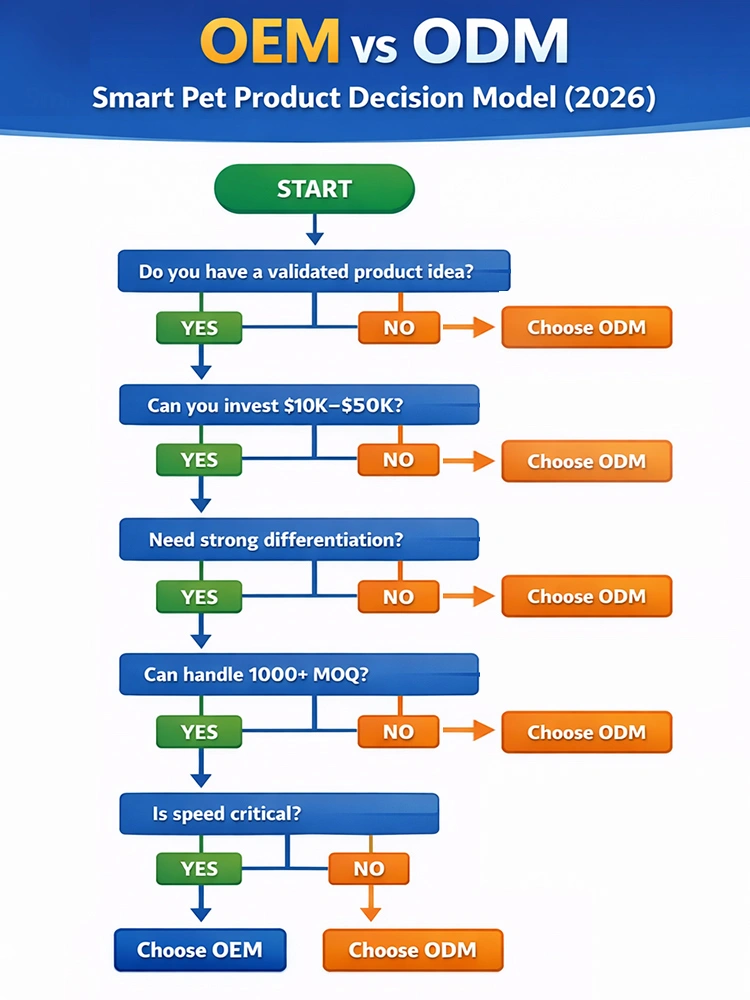
This simple framework alone often clarifies one of the most important sourcing decisions in OEM vs ODM smart pet products, especially when brands are still balancing ambition with real operational constraints.
That mismatch quietly shows up later in delays, cost overruns, or products that are difficult to scale.
At the same time, many brands feel uncertain at this stage—and that’s completely normal. OEM often looks attractive because of flexibility, but the real readiness behind it is not always obvious from the outside.
At Petrust®, we regularly help brands evaluate their product stage, cost structure, and supplier readiness before they make long-term commitments in OEM vs ODM smart pet products development.
OEM vs ODM Smart Pet Products: What’s the Real Difference That Impacts Your Business?
Once the decision framework becomes clearer, the next step is understanding what OEM and ODM actually mean in real manufacturing terms—not just definitions, but how they influence cost, control, and long-term brand positioning.
What is OEM in pet products: Full customization explained
OEM (Original Equipment Manufacturing) refers to building a product from the ground up.
In this model, you control the entire product customization process OEM, including structure design, internal components, software features, and final functionality.
In structured manufacturing environments, OEM development often aligns with global quality systems such as ISO 9001 frameworks, which help ensure consistent production quality across different batches and timelines.
In practical terms, OEM development may include:
- Developing a smart pet feeder OEM with custom app integration
- Creating a new design for an automatic litter box
- Designing your own pet water fountain private label product
OEM offers strong branding flexibility, but it also introduces real investment responsibilities:
- Tooling and mold development
- Engineering and testing
- Compliance certification (CE, FCC)
There is also an additional layer that many first-time buyers underestimate—intellectual property protection, especially when working across borders and multiple supply chain partners.
What is ODM in smart pet products: Ready-made but brandable
ODM (Original Design Manufacturing) works differently.
Instead of building from scratch, you start with an existing product that has already been designed, tested, and partially optimized by the factory.
Common examples include:
- Automatic cat litter box ODM solutions
- White label pet products with logo customization
- Existing designs adapted for private label pet products China
Because much of the engineering and validation is already completed, ODM significantly shortens the product development lifecycle.
In this model, your focus shifts toward:
- Packaging
- Branding
- Market positioning
However, this efficiency comes with a trade-off: differentiation is more limited compared to OEM development.
Key differences in OEM vs ODM smart pet products (beyond definitions)
OEM = control + risk / ODM = speed + limitation
This is the core reality behind custom vs ready-made products, and it often becomes the turning point in how brands structure their long-term sourcing strategy.
OEM vs ODM Cost Comparison: Development Cost, Unit Price & Hidden Fees
Beyond strategy and control, cost structure is usually where the decision becomes most tangible.
Many brands initially focus on unit price—but in reality, the real financial impact comes from how development, tooling, and long-term scaling are structured.
OEM Product Development Cost Breakdown (Tooling, r&d, Certification)
The OEM product development cost breakdown typically includes:
- Tooling and mold development
- Engineering & prototyping
- Testing & iteration
- Pet product certification requirements
- Initial production setup
This is also the stage where many brands underestimate the cost of custom pet product development.
ODM Manufacturing Cost: Why Upfront Cost Is Lower
ODM reduces upfront investment mainly because:
- Product already exists
- No tooling required
- Faster testing phase
On paper, the ODM vs OEM total cost often looks more attractive in the beginning.
However, this short-term advantage can shift over time, especially when scaling becomes a priority and differentiation becomes necessary for market competitiveness.
Hidden Costs In OEM vs ODM (What Suppliers Don’t Tell You)
Some of the most significant cost drivers are not visible in initial quotations:
- Design revisions
- Certification failures
- Supply chain delays
- Poor quality control processes
Many buyers underestimate the hidden cost of OEM manufacturing, especially during early decision-making stages.
Research such as NIST Special Publication 800-161 Rev.1 on Cyber Supply Chain Risk Management highlights how hidden vulnerabilities within supplier ecosystems can significantly increase both cost overruns and operational disruption risks in global manufacturing environments.
OEM vs ODM Smart Pet Products MOQ Comparison: What You Must Know Before Ordering
When you first start evaluating OEM vs ODM smart pet products, MOQ usually feels like a simple number on a quotation sheet.
But in practice, it quietly shapes your entire sourcing strategy—how much cash you need upfront, how much risk you carry in inventory, and how flexible your launch can actually be once the market response starts coming in.
From a risk and cost perspective, MOQ is often where strategy becomes very real.
Minimum Order Quantity OEM Vs ODM Explained
MOQ (Minimum Order Quantity) varies significantly:
- OEM: 1000–3000+ units
- ODM: 100–500 units
At first glance, the difference seems purely operational. But once you connect it to cash flow and inventory planning, the impact becomes much more strategic.
Understanding minimum order quantity OEM vs ODM is critical to managing inventory risk, especially when entering new product categories where demand is still uncertain or untested.
From a broader supply chain perspective, the World Bank Logistics Performance Index 2023 report highlights that logistics reliability, customs efficiency, and international shipment performance directly influence lead times, inventory exposure, and sourcing risk for global buyers.
Why OEM MOQ Is Higher (And When It’s Negotiable)
OEM requires higher MOQ because:
- Factories recover development cost
- Production setup is more complex
Behind these numbers is a very practical logic.
OEM projects usually involve design work, tooling, testing, and sometimes certification preparation—all of which require upfront investment from the factory side.
However, MOQ is not always fixed. In some cases, it can be negotiated based on long-term cooperation potential, product roadmap clarity, or multi-model commitments that reduce factory risk.
Low MOQ Strategies For OEM Vs ODM Smart Pet Products Buyers
Managing MOQ risk is often less about finding the “lowest number” and more about choosing the right entry strategy.
To reduce MOQ risk:
- Start with ODM validation
- Negotiate phased production
- Work with a low MOQ pet product manufacturer
These approaches allow buyers to test market demand before committing to larger production runs, which is especially important in OEM vs ODM smart pet products where demand can vary significantly across regions and channels.
OEM vs ODM Lead Time: How Fast Can You Launch Your Product?
Once MOQ is understood, the next question naturally becomes timing. And in competitive markets, timing often decides whether a product captures demand—or misses it entirely.
OEM Product Development Timeline (From Idea To Mass Production)
Typical OEM timeline:
Design → Prototype → Testing → Certification → Production
Overall, this process usually takes 60–120+ days, depending on product complexity and revision cycles.
From a technical perspective, each stage introduces its own variables—especially in hardware-heavy OEM vs ODM smart pet products, where both mechanical and software integration need alignment before scaling.
ODM Production Lead Time Vs OEM Timeline
ODM significantly shortens the path to market:
- Existing product
- Faster approval
- Shorter production cycles
This directly improves your go-to-market speed, which is often critical for seasonal demand or fast-moving e-commerce channels.
How Delays Happen In OEM Projects (Real Causes)
Delays are rarely caused by a single issue.
More often, they accumulate quietly across multiple stages:
- Design changes
- Failed certifications
- Supplier miscommunication
These challenges are commonly seen in risks of working with OEM manufacturers, especially when expectations are not clearly aligned at the beginning of the project.
OEM vs ODM Smart Pet Products Risk Comparison: Where Most Buyers Lose Money
At this stage, the decision is no longer just about cost or speed. It becomes about risk exposure—and where that risk actually sits.
Financial Risk: Upfront Investment Vs Inventory Pressure
OEM requires higher upfront investment, which naturally increases financial exposure in the early stages of the product lifecycle.
ODM reduces initial investment pressure, but it can lead to overstock situations when products lack differentiation in competitive markets.
Market Risk: Wrong Product Vs No Differentiation
- OEM risk: wrong product-market fit
- ODM risk: weak brand positioning
This balance sits at the core of OEM vs ODM advantages and disadvantages, and it’s often where long-term brand performance is actually decided.
Supplier Dependency In OEM Vs ODM Smart Pet Products
OEM increases dependency on one supplier for both design and production, which can create challenges if communication or capacity issues arise later.
ODM, on the other hand, creates dependency on shared product architectures, which can limit how much your brand can stand out in the market.
Many buyers only recognize these challenges after scaling begins:
- ODM product quality control issues
- Lack of supplier transparency
- Difficulty in scaling
These challenges are commonly seen in risks of working with OEM manufacturers, especially when expectations are not clearly aligned at the beginning of the project.
OEM vs ODM: Which Is Better for Your Business Stage?
When it comes to OEM vs ODM smart pet products, the decision rarely feels black and white.
Most buyers don’t struggle because they lack information—they struggle because both options sound reasonable, yet lead to very different financial and operational outcomes.
From a risk and cost perspective, this is less about choosing a manufacturing model and more about aligning your decision with your current business stage.
What works for a startup trying to validate demand may quietly become a limitation for a brand trying to scale globally.
OEM vs ODM For Startups (Cash-First Strategy)
Early-stage brands usually operate under one simple reality: every dollar matters, and every mistake feels expensive.
At this stage, priorities are usually very clear:
- Low investment
- Fast validation
- Reduced risk
This is exactly why ODM often becomes the more practical entry point.
It allows brands to move quickly without heavy tooling costs or long development cycles, while still testing real market response.
For many founders exploring OEM vs ODM smart pet products, ODM is not a “less ambitious” choice—it’s often a smarter way to learn before committing capital.
OEM vs ODM For Amazon Sellers & Private Label Brands
For eCommerce-driven businesses, the decision becomes more strategic than operational.
Sellers are not just testing products—they are building listings, reviews, and long-term ranking stability.
In this context:
- ODM works well for testing
- OEM works for scaling and brand building
This balance becomes especially important when evaluating private label vs OEM vs ODM strategies, where product differentiation directly impacts conversion rates and long-term brand equity.
There is also a natural transition that most growing sellers eventually face: moving from “what sells” to “what represents my brand.”
Scaling Brands: When To Switch From ODM To OEM
Once a product has proven demand, the conversation changes again.
The focus shifts from validation to control, margins, and defensibility.
At this stage, brands usually aim to:
- Move to OEM for differentiation
- Improve profit margin
- Build long-term competitive advantage
This is also where pricing structure and supplier negotiation become much more important.
Real Case Study: How Brands Choose Between OEM vs ODM Smart Pet Products
Theory is useful—but real decisions become much clearer when you see how they play out in practice.
Case 1: Startup Lost $30,000 Choosing OEM Too Early
A startup entered the market with strong confidence and decided to go directly into OEM development, investing heavily before validating demand.
Breakdown:
- Mold cost: $12,000
- Certification: $6,500
- First batch MOQ: $10,000
At first glance, this looked like a solid long-term investment. But the missing piece was market validation.
What went wrong:
- No validated demand
- Overestimated product differentiation
- Ignored inventory risk
After launch:
- Only 32% inventory sold in 4 months
- Remaining stock tied up $18,000 cash
Final loss:
- $18,000 unsold inventory
- Delayed cash flow
- Lost opportunity to pivot
This case highlights a common risk in OEM vs ODM smart pet products decisions—OEM can accelerate brand building, but only when demand already exists.
Case 2: Brand Validated Market Using ODM And Scaled Fast
Another brand took a more gradual approach.
Instead of committing heavily upfront, they:
- Used ODM product
- Focused on branding
- Achieved faster traction
Once demand was confirmed, they transitioned into OEM development with much clearer direction and significantly lower risk.
The result was not just faster growth, but also more efficient capital allocation.
Case 3: Hybrid OEM Vs ODM Smart Pet Products Strategy Success
A growing brand took a balanced path:
- Started with ODM
- Identified winning product
- Transitioned to OEM
This hybrid strategy allowed them to reduce early-stage risk while still building a differentiated long-term product line.
The outcome was a healthier balance between scalability and brand uniqueness—something many businesses struggle to achieve when they commit too early to one model.
OEM + ODM Hybrid Strategy: The Smartest Way to Reduce Risk
For many modern pet brands, the most effective approach is not choosing between OEM or ODM—it’s combining both strategically.
Step 1: Start With ODM To Test Demand
ODM allows you to enter the market quickly with minimal upfront investment, making it easier to validate real customer demand before committing to larger financial decisions.
Step 2: Transition To OEM For Differentiation
Once a product proves itself, OEM becomes the natural next step. This is where customization, branding, and long-term positioning start to matter more.
Step 3: Build Long-Term Product Moat
At this stage, the focus shifts to sustainability:
- Unique features
- Strong branding
- IP protection
This structured approach is one of the most effective ways for how to reduce manufacturing risk while still maintaining growth momentum.
Download: OEM vs ODM Cost & Risk Calculator (Free Excel)
At this point in the decision process, most buyers start realizing something important: assumptions about cost and reality often don’t match.
In fact, many first-time buyers underestimate true OEM costs by 20–40%, especially when tooling, certification, and MOQ-related inventory risks are not fully considered.
At Petrust®, we help brands simulate real production scenarios, including hidden risks that are often not clearly explained during early supplier discussions.
This cost evaluation can help bring more clarity before committing.
Download our free calculator to:
- Estimate total product development cost
- Compare OEM vs ODM scenarios
- Calculate inventory risk based on MOQ
Most buyers don’t fail because of bad suppliers.
They fail because they chose the wrong manufacturing strategy.
This is often the moment where assumptions turn into clarity—and where better decisions start to take shape.
How to Choose the Right OEM or ODM Pet Product Manufacturer
Choosing between OEM and ODM rarely feels like a purely technical decision.
For most buyers working with OEM vs ODM smart pet products, it’s actually a balance between risk, control, and how much flexibility you want as your brand grows.
And that balance becomes even more important once real production begins and timelines, costs, and quality expectations start to interact in real ways.
From a practical sourcing perspective, the goal isn’t just to find a capable factory—it’s to find a partner who can support your product through different stages of growth without introducing unnecessary risk or hidden costs along the way.
How To Verify a Pet Product Supplier
Before committing to production, a careful verification process often makes the difference between a smooth launch and unexpected setbacks.
Many experienced buyers treat this step as a non-negotiable part of working with OEM vs ODM smart pet products, especially when entering new supplier relationships.
Always check:
- Experience
- Certifications
- Product quality
These points may seem straightforward, but they often reveal how consistent and transparent a supplier truly is behind the scenes.
As conversations move forward, verification naturally leads into deeper operational checks—especially around factory capability.
Factory Audit Checklist For OEM Manufacturers
A supplier’s real strength becomes much clearer during a structured evaluation on-site or through third-party audits.
This is where expectations around OEM vs ODM smart pet products are either confirmed—or quietly challenged.
Conduct a proper factory audit for OEM manufacturers to evaluate:
- Production capability
- Quality systems
- Compliance
Each of these areas reflects how well a manufacturer can handle not just one order, but repeated production cycles over time.
How To Request And Evaluate Samples
Once a supplier passes initial checks, sample evaluation becomes the most practical way to understand real product performance.
This step often reveals differences that are not visible in catalogs or specifications, especially when dealing with OEM vs ODM smart pet products where small design variations can significantly impact usability.
Testing samples helps you:
- Verify quality
- Assess performance
- Avoid costly mistakes
It also plays an important role in reducing risks commonly associated with how to avoid supplier scams China, where surface-level communication may not always reflect actual production capability.
FAQ: OEM vs ODM Smart Pet Product Manufacturing
OEM vs ODM Is Not About Manufacturing — It’s About Strategy
When brands start comparing OEM vs ODM smart pet products, the conversation usually begins in a very practical place—pricing sheets, lead times, and minimum order quantities.
On the surface, it feels like a sourcing decision. Something operational. Something straightforward.
But once you’ve seen enough product launches, a different pattern becomes clear.
This is where the two paths quietly start to diverge.
ODM offers speed, validation, and lower initial risk—especially useful when the goal is to enter the market quickly or test demand without heavy upfront investment.
OEM, on the other hand, focuses on differentiation, higher margin potential, and building a stronger long-term competitive moat.
Both approaches can work. Both can fail. The difference is not capability—it’s alignment with your business stage and strategy.
And this is something many teams only fully realize after their first product cycle.
At a deeper level, OEM vs ODM smart pet products decisions are rarely about manufacturing execution alone. They influence how your brand positions itself, how fast it scales, and how defensible it becomes in a competitive market.
Once that shift happens, every sourcing conversation becomes clearer—not easier, but far more intentional.
Conclusion: Choosing the Right Model Is Choosing Your Business Outcome
By the time brands reach the final decision point between OEM and ODM, the discussion is no longer just about product development—it becomes about direction.
Choosing between OEM and ODM is not a technical decision—it’s a strategic one.
Over time, many experienced brands realize they don’t necessarily need to choose one forever.
Instead, they learn how to combine both approaches—starting with ODM to validate demand, then transitioning into OEM once the market signal is proven.
This hybrid thinking often separates scalable brands from those stuck in constant re-launch cycles.
Because in reality, most brands don’t fail due to poor product ideas.
They struggle because they chose the wrong manufacturing strategy at the wrong time.
This guide isn’t about explaining manufacturing models.
It’s about helping you answer one question: