
A Japanese product on the shelf does not tell you who built it. An automatic cat feeder sold in Japan may look like a Japanese product, carry Japanese packaging, and have local customer support—while the actual hardware is manufactured somewhere else.
For a consumer, that distinction may not matter much.
For a buyer, it can change almost everything.
The company selling the feeder may not be the company controlling:
- The dispensing mechanism
- The motor
- The food-contact components
- The hopper
- The electronics
- The Wi-Fi module
- The App
- The battery
- The injection molds
- The final assembly
- The replacement parts
That is why researching automatic cat feeder manufacturers in Japan requires a different approach from simply finding ten companies with Japanese websites or products available through Japanese retailers.
The Japanese market includes domestic pet companies, Japan-based subsidiaries, international smart pet brands, specialist feeder companies, Chinese manufacturers, and factory-backed OEM/ODM suppliers.
They are not interchangeable.
A Japanese retailer may want an established consumer brand.
An Amazon Japan seller may want a proven smart feeder platform.
A distributor may prioritize local inventory and after-sales support.
A private-label brand may need its own packaging, colors, firmware, App interface and product configuration.
And an importer planning a long-term product line may care less about the brand on the box than about who controls the factory behind it.
This guide maps those different supplier routes so B2B buyers can understand what each company actually represents—and when it makes sense to move from buying an existing brand to working directly with an OEM manufacturer.
What Does “Manufacturer in Japan” Actually Mean?
Before comparing companies, one distinction needs to be made clear.
A company selling automatic feeders in Japan is not necessarily a Japanese manufacturer.
For sourcing purposes, it is more useful to divide the market into four groups.
| Supplier Type | Japan Market Presence | Manufacturing May Be Outside Japan | Typical B2B Role |
|---|---|---|---|
| Japanese manufacturer | Yes | Sometimes | Domestic products and retail |
| Japan-based brand/subsidiary | Yes | Often | Local sales, distribution, support |
| International pet-tech brand | Yes | Usually | Finished branded products |
| Factory-backed OEM/ODM supplier | Serves Japan | Often | Private label, customization, manufacturing |
This distinction is particularly important for the companies in this list.
For example, PETKIT currently sells multiple automatic feeders through its Japanese official store, including camera-equipped P572 and P591 models. That establishes strong Japan-market relevance, but it should not be confused with being a Japanese factory.
Similarly, Tianyuan Pet describes its China operation as its headquarters and manufacturing/technology center while maintaining Japan as a regional business and product-adaptation node.
So throughout this guide, “manufacturers in Japan” means companies and manufacturing partners relevant to buyers sourcing for the Japanese market—not a claim that every company operates a factory in Japan.
That distinction makes the list more useful, not less.
The 10 Companies and Manufacturing Options Worth Knowing
The companies below represent different sourcing models.
They are not ranked from “best” to “worst.”
Instead, each one answers a different buyer question.
| Company | Primary Role | Japan Relevance | Smart Feeder | OEM/ODM Potential | Best For |
|---|---|---|---|---|---|
| Dogness | International smart pet company / Japan presence | Yes | Yes | Verify by project | Smart pet product benchmarking |
| PETKIT | Smart pet technology brand | Yes | Yes | Not its primary public model | Premium smart feeders |
| PETLIBRO | Smart pet consumer brand | Global/Japan market | Yes | Not its primary public model | Connected retail products |
| HomerunPET | Pet electronics company | Japan market | Yes | Verify directly | Smart pet appliances |
| Whisker | Premium pet technology brand | International | Yes | Not its primary public model | Premium connected feeding |
| PetSafe | Established pet technology brand | International | Yes | Not its primary public model | Mature retail products |
| SureFeed | Microchip/RFID feeding specialist | International | Yes | Not its primary public model | Multi-pet feeding control |
| WOPET | Smart pet product brand | International | Yes | Verify directly | Wireless and App feeders |
| Tianyuan Pet | Factory/manufacturer | Japan business presence | Yes | Yes | OEM/ODM and scalable supply |
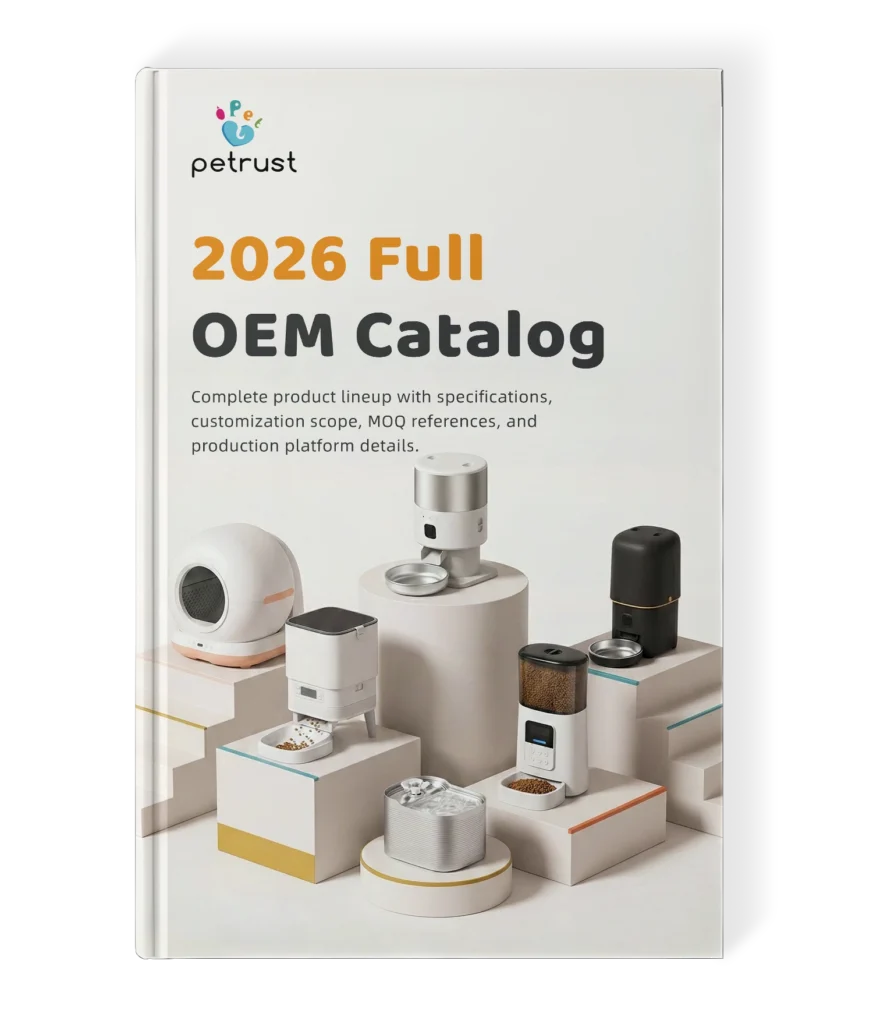
| Petrust | Factory-backed OEM/ODM | Serves Japan | Yes | Yes | Private label and custom projects |
The purpose of this table is not to create an artificial ranking.
It is to show the different paths available to a Japanese-market buyer.
1. Dogness
| Business role | Smart pet product company |
| Product direction | Smart feeders, pet electronics and connected products |
| Japan relevance | Japan-market presence |
| OEM/ODM | Verify according to project requirements |
| Best for | Buyers researching smart pet product positioning |
Dogness is useful to include because it demonstrates an important distinction between a Japan-market company and a Japanese manufacturing base.
A Japan-facing operation can provide:
- Local market access
- Product support
- Distribution
- Japanese-language communication
- Consumer-facing sales
without necessarily meaning that all hardware is manufactured domestically.
For B2B buyers, this distinction matters.
If the goal is to purchase an established product, a Japan-market operation may be exactly what the buyer needs.
If the goal is to develop an exclusive feeder, however, the buyer needs to identify the actual manufacturing organization and determine:
- Who owns the hardware platform?
- Who controls the BOM?
- Who manages tooling?
- Who supplies replacement components?
- Can the product be modified?
- Can packaging be customized?
- Who controls firmware?
Best fit
Dogness is more relevant for:
- Smart pet product benchmarking
- Existing product distribution
- Technology comparison
- Understanding international smart-pet positioning
What B2B buyers should verify
Do not assume that a Japan-market subsidiary or sales organization is equivalent to a factory.
Confirm the actual manufacturing route before signing an OEM agreement.
2. PETKIT
| Business role | Smart pet technology brand |
| Product direction | Smart automatic feeders, camera feeders and connected pet products |
| Japan relevance | Strong |
| OEM/ODM | Not its primary public business model |
| Best for | Premium smart feeder benchmarking |
PETKIT is one of the clearest examples of how advanced automatic feeding has moved beyond simple timers.
Its current Japanese catalog includes multiple automatic feeders, including camera-equipped models and large-capacity configurations.
Current product directions include:
- App connectivity
- Camera monitoring
- AI-related features
- Scheduled feeding
- Large-capacity storage
- Stainless steel components
- Smart notifications
The important lesson for B2B buyers is not simply that PETKIT has many features.
It is that a smart feeder increasingly becomes a software + hardware product.
Once a feeder includes an App, camera or cloud-dependent functionality, the supplier relationship becomes more complicated.
The buyer needs to consider:
- Firmware updates
- App localization
- Server reliability
- Customer support
- Data handling
- Product lifecycle
- Component availability
Best fit
PETKIT is particularly useful for:
- Premium product benchmarking
- Smart feeder positioning
- Camera feeder research
- App UX research
- Understanding Japanese consumer expectations
What B2B buyers should verify
A premium consumer brand should not automatically be treated as a private-label supplier.
If the goal is to launch an independent brand, a factory-backed OEM/ODM route may provide much more control.
3. PETLIBRO
| Business role | Smart pet consumer brand |
| Product direction | Automatic feeders, camera feeders, multi-pet feeding and connected products |
| Japan relevance | International smart-pet market |
| OEM/ODM | Not its primary public positioning |
| Best for | Premium connected feeder benchmarking |
PETLIBRO has built a broad feeder portfolio around several different consumer needs.
Its current feeder range includes:
- Kibble feeders
- Smart App-connected feeders
- Camera feeders
- Multi-pet feeding solutions
- Cordless products
- Wet-food-oriented solutions
Its official feeder portfolio emphasizes scheduled meals, portion control, remote feeding and food freshness.
Its camera-equipped Granary platform, for example, combines scheduled feeding with a 1080p camera, Wi-Fi, two-way voice and food-freshness features.
This makes PETLIBRO particularly relevant to buyers studying how a feeder can move from:
“automatic dispenser”
to:
connected feeding platform.
Best fit
- Premium e-commerce
- Smart pet product benchmarking
- Multi-pet product research
- Camera feeder positioning
- App experience benchmarking
What B2B buyers should verify
If you want to create your own brand, do not simply copy the feature list.
Ask instead:
Which features actually improve the product economics and customer experience?
A camera, for example, adds:
- Hardware cost
- Firmware
- Cloud infrastructure
- Privacy considerations
- Customer support
- After-sales risk
Feature quantity is not the same as product value.
4. HomerunPET
| Business role | Pet electronics company |
| Japan relevance | Japan-market operation |
| Product direction | Pet appliances, water fountains, litter boxes and other smart pet products |
| OEM/ODM | Verify directly |
| Best for | Pet electronics and product ecosystem benchmarking |
HomerunPET describes itself as a pet appliance manufacturer and offers products including pet water dispensers, air purifiers and automatic litter boxes.
Its importance in this comparison is broader than one feeder SKU.
It represents the move toward pet appliances as a product category.
For brands developing several smart pet products, this matters.
A feeder may eventually sit beside:
- A smart fountain
- Automatic litter box
- Pet air purifier
- Pet dryer
- App platform
That creates opportunities for shared:
- Industrial design
- App accounts
- Connectivity
- Packaging language
- Brand architecture
Best fit
HomerunPET is useful for:
- Smart pet appliance benchmarking
- Product ecosystem research
- Premium product positioning
- Understanding connected pet hardware
Buyer caution
Confirm the actual OEM scope before treating any pet electronics company as a private-label manufacturer.
5. Whisker
| Business role | Premium connected pet technology brand |
| Primary feeder | Feeder-Robot |
| Manufacturing information | Designed and assembled in the USA for the current Feeder-Robot |
| Best for | Premium feeding technology benchmarking |
Whisker provides an interesting counterexample to the assumption that every smart feeder sold internationally is manufactured in Asia.
Its current Feeder-Robot page states that the product is designed and assembled in the USA. It also combines scheduled feeding, anti-jam technology, offline operation, food-backup detection and App connectivity.
That makes it valuable for benchmarking:
- Reliability positioning
- Anti-jam engineering
- Offline operation
- Connected feeding
- Premium warranty positioning
One particularly important feature for B2B buyers is:
offline functionality.
A smart feeder should not become useless simply because the Internet or cloud service is temporarily unavailable.
This is a major engineering consideration when developing connected feeders.
Best fit
- Premium product benchmarking
- Connected feeder design
- Reliability strategy
- Anti-jam systems
- Offline operation
Buyer limitation
Whisker is a consumer technology brand, not a general private-label OEM platform.
6. PetSafe
| Business role | Established pet technology brand |
| Product direction | Automatic feeders, pet access and training products |
| Market role | Mature international retail |
| OEM/ODM Best for | Not its primary public positioning |
| Best for | Established product and category benchmarking |
PetSafe is useful because it represents a different part of the market from newer smart-pet companies.
Instead of building the entire product story around AI or Apps, mature pet technology brands often compete on:
- Reliability
- Familiarity
- Product range
- Distribution
- Replacement parts
- Customer support
That is an important lesson for private-label brands.
Not every Japanese-market feeder needs:
- Camera
- AI
- Cloud analytics
- Voice control
A simpler feeder can sometimes be the better commercial product.
Best fit
PetSafe is most useful for:
- Mature category benchmarking
- Product simplicity
- Retail positioning
- Consumer trust
- Feature prioritization
Buyer caution
A mature consumer brand should not be assumed to provide open OEM services.
For private-label projects, evaluate factory-backed suppliers separately.
7. SureFeed
| Business role | Specialized pet feeding technology brand |
| Core direction | Microchip/RFID-controlled feeding |
| Best for | Multi-pet households and selective feeding |
SureFeed is particularly interesting because it addresses a problem that ordinary automatic feeders do not solve well: Which pet actually gets the food?
For multi-cat households, simply dispensing food on a schedule is not enough.
One cat may:
- Eat another cat's portion
- Guard the feeder
- Steal food
- Require a different diet
- Need medication mixed into food
That changes the product requirement.
Instead of focusing only on:
“How many meals per day?”
the buyer begins asking:
“Can the feeder identify the correct animal?”
This is an excellent example of how product differentiation can come from solving a specific operational problem rather than adding more generic smart features.
Best fit
- Multi-pet households
- Prescription-diet scenarios
- Selective feeding
- RFID/microchip product benchmarking
Buyer caution
RFID-based feeding introduces its own engineering requirements:
- Identification reliability
- Registration process
- Lid mechanism
- Battery life
- Pet behavior
- Mechanical durability
8. WOPET
| Business role | Smart pet product brand |
| Product direction | Automatic feeders, Wi-Fi feeders, cordless feeders and camera feeders |
| Best for | Wireless and connected feeder benchmarking |
WOPET currently maintains a broad feeder portfolio including Wi-Fi feeders, camera feeders, dual-bowl products and cordless models.
Its Cube Lite feeder, for example, combines:
- 4L/5L-class storage
- Scheduled meals
- Cordless operation
- Anti-clog feeding
- Twist-lock food storage
- Voice recording
- Long stated battery operation
WOPET is therefore useful when comparing different approaches to:
- Battery-powered feeding
- Wireless placement
- Food storage
- Anti-clog mechanisms
- Voice interaction
Best fit
- Cordless feeder benchmarking
- Online retail
- Smart feeder comparison
- Product concept research
Buyer caution
For private-label projects, verify the actual manufacturing relationship rather than assuming the consumer-facing brand itself is the factory.
9. Tianyuan Pet
| Business role | Factory-backed pet product manufacturer |
| Headquarters/manufacturing base | Hangzhou, China |
| Japan relevance | Japan regional business and product-adaptation presence |
| Product direction | Smart feeders, water fountains and automatic litter boxes |
| OEM/ODM | Yes |
| Best for | Large-scale manufacturing and OEM/ODM projects |
Tianyuan Pet is fundamentally different from the consumer brands above.
Its global structure identifies China as its headquarters and manufacturing center and Japan as part of its regional business/product-adaptation network. The company reports a multi-country manufacturing and service footprint.
Its manufacturing operation also explicitly markets automatic pet feeder OEM/ODM services, including private labeling and custom development.
For B2B buyers, this makes Tianyuan relevant when the requirement moves from:
“Which feeder should I buy?”
to:
“Which factory can produce my feeder at scale?”
Best fit
- Large-volume sourcing
- OEM/ODM
- Retail programs
- Distributor projects
- Multi-SKU pet product programs
What buyers should evaluate
Large manufacturing scale does not automatically mean the factory is the best fit for every project.
The buyer should still evaluate:
- MOQ
- Product platform
- Engineering responsiveness
- Customization depth
- Sample-to-mass-production consistency
- QC system
- Component control
- Certification support
- Lead times
10. Petrust
| Business role | Factory-backed smart pet product OEM/ODM manufacturer |
| Manufacturing base | Shenzhen, China |
| Japan relevance | International B2B supply and private-label projects |
| Product direction | Smart feeders, water fountains and automatic litter boxes |
| OEM/ODM | Yes |
| Best for | Private label, custom smart pet products and product-platform development |
Petrust should not be described as a Japanese automatic feeder manufacturer.
It is more useful to Japanese-market buyers for a different reason:
It provides a factory-direct route when the buyer wants to create its own product rather than resell somebody else’s brand.
That distinction is important.
A Japanese retailer may simply want to purchase a finished feeder.
A growing pet brand may instead need:
- Its own logo
- Its own colors
- Its own packaging
- Its own product positioning
- Different hopper capacity
- Different feeding mechanisms
- Camera or no camera
- Wi-Fi connectivity
- App integration
- Japanese manuals
- Customized packaging
- Spare-parts planning
- Production control
That is an OEM/ODM problem.
And it should be evaluated differently from consumer-brand purchasing.
What Japanese Buyers Should Actually Compare
The biggest mistake in automatic feeder sourcing is comparing suppliers only by:
- Unit price
- Food capacity
- Number of meals
- Wi-Fi
- Camera
- App
- Appearance
Those are visible.
The expensive problems are often invisible.
1. Feeding Accuracy
A feeder can have an attractive App and still produce inconsistent portions.
Ask:
- What is the minimum portion?
- What is the tolerance?
- Does kibble size affect accuracy?
- What happens with irregular-shaped food?
- Does the motor torque remain consistent?
- How is the mechanism tested?
The feeding mechanism should be tested with the actual food types expected in the target market.
2. Anti-Clog Performance
This is one of the most important engineering questions.
Dry food varies significantly in:
- Diameter
- Shape
- Oil content
- Moisture
- Surface friction
A mechanism that works perfectly with one kibble may struggle with another.
Testing should therefore include:
- Small kibble
- Large kibble
- Irregular kibble
- Oily kibble
- Repeated feeding cycles
- Low hopper conditions
3. Food Freshness
A feeder’s job is not simply to dispense food.
It also needs to protect stored food.
Buyers should investigate:
- Hopper sealing
- Desiccant systems
- Lid design
- Moisture control
- Food-contact materials
- Odor management
- Cleaning
PETLIBRO’s current product positioning, for example, places significant emphasis on food freshness and sealed storage.
4. App Dependency
This deserves special attention in 2026.
A connected feeder should answer:
What happens when the Internet disappears?
A strong design should consider local fallback behavior.
For example:
- Scheduled feeding stored locally
- Manual feeding without cloud access
- Safe recovery after Wi-Fi interruption
- Clear offline indication
Whisker’s current Feeder-Robot explicitly highlights offline feeding functionality, which is an excellent benchmark for reliability-oriented development.
And recent industry events have shown why this matters: a major Petlibro service outage in August 2026 disrupted smart feeder functions for some users, illustrating the practical risk of cloud-dependent pet products.
For a B2B buyer, this is no longer merely a software question.
It is a pet-safety and after-sales question.
5. Camera or No Camera?
Camera feeders are attractive because they create obvious differentiation.
But they also add:
- Camera hardware
- Night vision
- Wi-Fi bandwidth
- Cloud infrastructure
- Privacy considerations
- App development
- Firmware
- Customer support
If the buyer’s customers do not actually need remote visual monitoring, a camera can increase cost and after-sales complexity without improving the core product.
This is why:
Premium does not always mean more electronics.
6. Battery Strategy
Cordless feeders can be attractive for Japanese homes because placement becomes more flexible.
But the buyer must distinguish between:
Standby battery life
and:
Real feeding-cycle runtime.
Test:
- Number of daily feeds
- Motor load
- Wi-Fi status
- Camera usage
- Ambient temperature
- Battery age
- Charging frequency
A 180-day laboratory claim and a real household experience can be very different.
7. Replacement Parts
Ask the factory:
What happens when the motor fails after 18 months?
Then ask:
- Is the motor replaceable?
- Can the bowl be replaced?
- Can the hopper be replaced?
- Can the power adapter be replaced?
- Are seals available?
- Are batteries available?
- Are spare parts stocked?
A product is not truly ready for the Japanese market if the only after-sales solution is:
“Send the entire feeder back.”
Japanese Market Does Not Mean Japanese Factory
This is perhaps the most important sourcing lesson from the list.
A Japanese buyer can source:
Route 1 — Japanese Consumer Brand
Advantages:
- Familiar local positioning
- Existing distribution
- Japanese documentation
- Easier retail placement
Limitations:
- Limited customization
- Limited hardware control
- Limited branding freedom
Route 2 — International Smart Pet Brand
Advantages:
- Advanced technology
- Existing App ecosystem
- Premium positioning
- Proven product concepts
Limitations:
- Brand ownership remains with the supplier
- Limited private labeling
- Limited product exclusivity
Route 3 — Factory-Direct OEM/ODM
Advantages:
- Custom branding
- Custom packaging
- Hardware modifications
- Product-platform selection
- App customization
- Direct production communication
Limitations:
- MOQ
- Development responsibility
- Certification
- Quality control
- More buyer involvement
Which Supplier Route Is Right for Your Business?
Use the following decision framework before contacting manufacturers.
| Your Objective | Better Starting Point |
|---|---|
| Resell an existing product | Consumer brand |
| Japanese retail distribution | Japanese brand/distributor |
| Premium smart feeder | Established smart-pet brand |
| Amazon Japan private label | OEM/ODM factory |
| Custom color and packaging | OEM |
| Custom hardware | ODM |
| Custom App | Smart-pet OEM/ODM |
| Exclusive product | ODM + tooling |
| Low-risk first launch | Existing OEM platform |
| Long-term product family | Factory development partner |
This distinction can save months of unnecessary supplier discussions.
One mistake we see repeatedly in feeder sourcing is comparing quotations before deciding what product is actually being quoted.
A basic timed feeder, Wi-Fi model, camera feeder and cordless platform may all appear under the same “automatic feeder” category, but their BOM, firmware, testing requirements and after-sales exposure can be very different.
So before asking several factories for their lowest price, define the product platform you actually want to compare.
Our guide to Automatic Cat Feeder Manufacturer: Compare Models, Features & OEM Solutions goes deeper into the main feeder configurations, feature trade-offs and OEM considerations that affect the development decision.
Once the platform is clear, comparing factories becomes much more meaningful.
If You Need a Private-Label Feeder, Start With the Platform
Do not begin by asking:
“What is your cheapest automatic feeder?”
Start with:
What product platform fits my customer and sales channel?
For example:
| Platform | Best For | Main Advantage | Main Risk |
|---|---|---|---|
| Basic timed feeder | Entry-level retail | Lower complexity | Commodity competition |
| Wi-Fi feeder | Remote feeding | App convenience | Connectivity support |
| Camera feeder | Premium differentiation | Visual monitoring | Higher cost and privacy risk |
| Large-capacity feeder | Multi-day feeding | Less frequent refill | Larger footprint |
| Dual-bowl feeder | Multi-pet homes | Simultaneous feeding | More complex mechanism |
| Cordless feeder | Flexible placement | No permanent cable | Battery management |
| RFID feeder | Multi-pet control | Selective feeding | Identification reliability |
| Wet-food feeder | Fresh meals | Different feeding use case | Cooling/food-safety complexity |
The Factory Question Most Buyers Ask Too Late
Once a buyer finds an attractive sample, the next question is often:
“How much is it?”
That is too early.
The better questions are:
- Who owns the BOM?
- Which components are fixed?
- Which components can change without notification?
- Who supplies the motor?
- Who controls the injection molds?
- Who performs feeding-accuracy testing?
- Is every production unit tested?
- What happens if the motor supplier changes?
- How are firmware changes controlled?
- What happens when a customer reports a jam?
These questions separate a product seller from a manufacturing partner.
Why a Good Sample Is Not Enough
This is where many automatic feeder projects go wrong.
A factory sends a beautiful sample.
The buyer approves it.
Mass production begins.
Then:
- The motor changes.
- The food outlet tolerance changes.
- The plastic supplier changes.
- The App firmware changes.
- The battery supplier changes.
- The packaging inserts change.
- The assembly process changes.
The finished feeder still looks almost identical.
But its performance is no longer identical.
For this reason, Japanese-market buyers should establish:
- Golden sample
- Approved BOM
- Approved firmware
- Approved packaging
- Critical component list
- QC checkpoints
- Change-control procedure
- Batch traceability
- Spare-parts strategy
A factory can send you an impressive sample in a few days. The harder question is what happens after the sample is approved.
In practice, some of the most expensive supplier problems do not appear during sampling. They appear when production scales—when a motor supplier changes, a plastic component is substituted, firmware is updated, or an assembly process is adjusted without the buyer fully understanding the impact.
That is why an approved sample should be treated as a reference point, not as proof that mass production will automatically remain consistent.
For buyers sourcing from China, the more useful question is not simply “Can this factory make the sample?” but “How does the factory keep the approved product unchanged when production scales?”
We examine that question in The Truth About Automatic Pet Feeder Manufacturers in China: Good Samples Mean Nothing Without Production Discipline, with a closer look at the production-control issues buyers should check before treating a good sample as evidence of manufacturing capability.
How to Evaluate an Automatic Cat Feeder Factory
Before placing a meaningful order, request evidence in at least eight areas.
- Feeding mechanism drawings
- Motor specifications
- Food compatibility
- Anti-jam design
- Hopper design
- Bowl design
- PCB architecture
- Wi-Fi module
- Power adapter
- Battery
- Sensor configuration
- App ownership
- Firmware update process
- Cloud architecture
- Offline behavior
- Japanese localization
- Incoming inspection
- Assembly inspection
- Feeding-accuracy testing
- Motor testing
- Aging testing
- Final inspection
- Continuous feeding cycles
- Motor endurance
- Hopper stress
- Lid testing
- Button testing
- Power interruption testing
- Monthly capacity
- MOQ
- Lead time
- Tooling
- Production lines
- Worker training
- Worker training
Depending on the final configuration:
- Electrical safety
- EMC
- Radio/wireless requirements
- Battery requirements
- RoHS
- Materials
- Japanese labeling
The exact compliance path should be confirmed for the finished product and sales channel.
- Replacement motors
- Power adapters
- Bowls
- Hoppers
- Batteries
- Spare PCBs
- Firmware support
Why Petrust Is Relevant to Japanese Buyers
Petrust is not a Japanese consumer brand.
That is precisely why it should be positioned differently in this article.
For a Japanese buyer who wants to resell an existing brand, Petrust may not be the most relevant option.
But for a buyer who wants to:
- Build a private label
- Launch a new feeder
- Customize an existing platform
- Develop a smart feeder
- Add a camera
- Remove a camera
- Customize colors
- Customize packaging
- Develop Japanese manuals
- Integrate App functions
- Plan spare parts
- Build a broader smart pet product range
a factory-backed OEM/ODM relationship becomes much more relevant.
The discussion then moves from:
“Which brand should I buy?”
to:
“Which manufacturing platform can I build my product on?”
That is a fundamentally different purchasing decision.
What Petrust Buyers Should Define Before Requesting a Quote
To make an OEM discussion useful, provide as much of the following as possible:
- Target market
- Sales channel
- Estimated first order
- Annual volume
- Target retail price
- Target landed cost
- Cat or multi-pet
- Hopper capacity
- Number of meals
- Portion size
- Food type
- Camera/no camera
- Wi-Fi/no Wi-Fi
- Corded/cordless
- Single/dual bowl
- Logo
- Color
- Packaging
- Manual
- Japanese labeling
- Retail box
- App
- Voice recording
- Notifications
- Feeding records
- Camera
- AI functions
- Sensor requirements
- Destination
- Sales channel
- Required certifications
- Battery configuration
- Wireless configuration
The more clearly the project is defined, the easier it becomes for a factory to recommend the right platform instead of simply quoting its easiest existing SKU.
Automatic Cat Feeder Manufacturer vs. Supplier vs. Brand
One final distinction is worth remembering.
Owns the customer relationship. It may not own every factory producing its products.
Provides products or components. It may or may not control manufacturing.
Controls some or all of the actual production process.
Can potentially work with the buyer to create a product under the buyer’s brand.
For a serious private-label project, the fourth category is usually the most strategically important.
FAQ
No.
Products sold in Japan can come from Japanese companies, international brands, overseas factories or OEM suppliers.
The manufacturing location should be verified at the product and supplier level.
PETKIT currently has a dedicated Japanese catalog of automatic feeders, including camera-equipped models. Other international brands such as PETLIBRO, WOPET and Whisker also provide automatic feeding products for international markets.
There is no universal answer.
A private-label buyer should prioritize an OEM/ODM manufacturer that can provide the required:
- Hardware platform
- Customization
- Packaging
- Compliance support
- Quality control
- Spare parts
- Production capacity
Not automatically.
The buyer needs to establish whether the supplier actually owns or controls the product platform and whether private labeling is commercially available.
China remains a major manufacturing base for smart pet electronics and OEM/ODM products.
But the important question is not simply:
“Is it made in China?”
It is:
“How does the factory control engineering, components, QC and production changes?”
Only if the target customer values visual monitoring enough to justify:
- Higher hardware cost
- App complexity
- Cloud infrastructure
- Privacy considerations
- Additional after-sales support
Not necessarily.
For some products, a reliable timer and local control may create a better customer experience than a complicated App.
For others, remote feeding and notifications may be essential.
A visually unchanged product can contain changed components or processes.
Motor substitutions, feeding-mechanism tolerances, firmware changes and material changes can all affect performance.
That is why BOM control and change management matter.
Do not start with:
“What is your lowest MOQ?”
Start with:
“Which existing platform best matches my target market, and what parts of that platform can you actually customize and control?”
That question will reveal much more about the supplier.
Final Takeaway
There is no single “best” automatic cat feeder manufacturer in Japan.
There are different supplier routes for different business models.
A Japanese brand may be the right choice when local positioning and existing distribution matter.
A global smart pet brand may be the right benchmark for premium technology.
A specialist feeder company may be the right reference for a particular feeding problem.
A large factory may be appropriate for scale.
And a factory-backed OEM/ODM partner may be the better route when the objective is to build a product under your own brand.
The critical distinction is therefore not:
Japan vs. China.
It is:
Brand vs. supplier vs. actual manufacturing control.
For buyers entering the Japanese market, the next step should be to define the feeder platform before comparing factory quotations.
If you are developing a private-label or OEM automatic cat feeder, compare:
Then evaluate the factory.
Because the cheapest feeder at quotation stage is not necessarily the lowest-cost feeder after launch.
And the most advanced feeder is not necessarily the best product for the Japanese customer.
The right supplier is the one whose manufacturing system matches the product, volume, risk level and business model you are actually building.
Building an Automatic Cat Feeder for the Japanese Market?
If you are looking for an existing product, start by comparing the available feeder platforms.
If you are building your own brand, the conversation should move one step further—from product selection to manufacturing capability.
Petrust supports factory-backed OEM/ODM development for smart pet products, including automatic feeders, water fountains and automatic litter boxes.
If you found this guide helpful…
You might also be interested in our other insightful articles on top pet care manufacturers worldwide:
- Top 10 Best Cat Water Fountain Manufacturers in Japan
- Top 10 Best Automatic Cat Litter Box Manufacturers in Japan
- Top 10 Best Automatic Cat Feeder Manufacturers in USA
- Top 10 Best Automatic Cat Feeder Manufacturers in Italy
- Top 10 Best Automatic Cat Feeder Manufacturers in Germany
- Top 10 Best Automatic Cat Feeder Manufacturers in Korea
- Top 10 Best Automatic Cat Feeder Manufacturers in Brazil
- Top 10 Best Automatic Cat Feeder Manufacturers in Turkey
- Top 10 Best Automatic Cat Feeder Manufacturers in UK
- Top 10 Best Automatic Cat Feeder Manufacturers in China