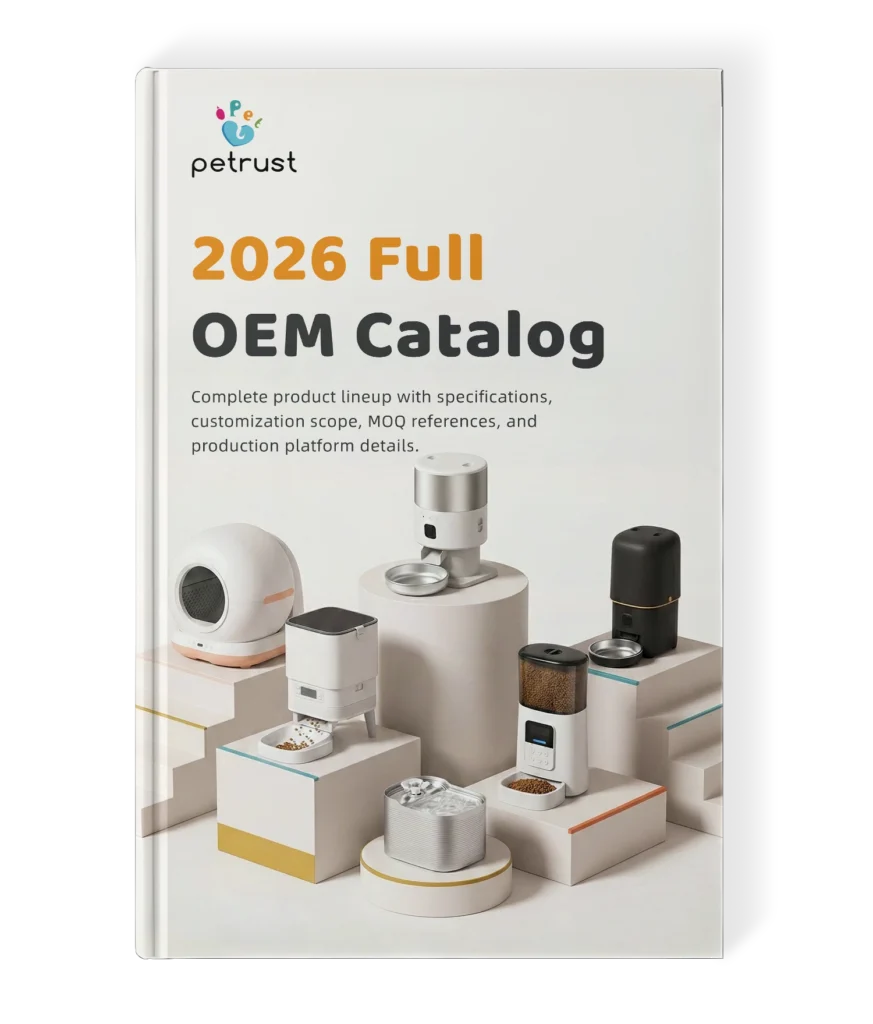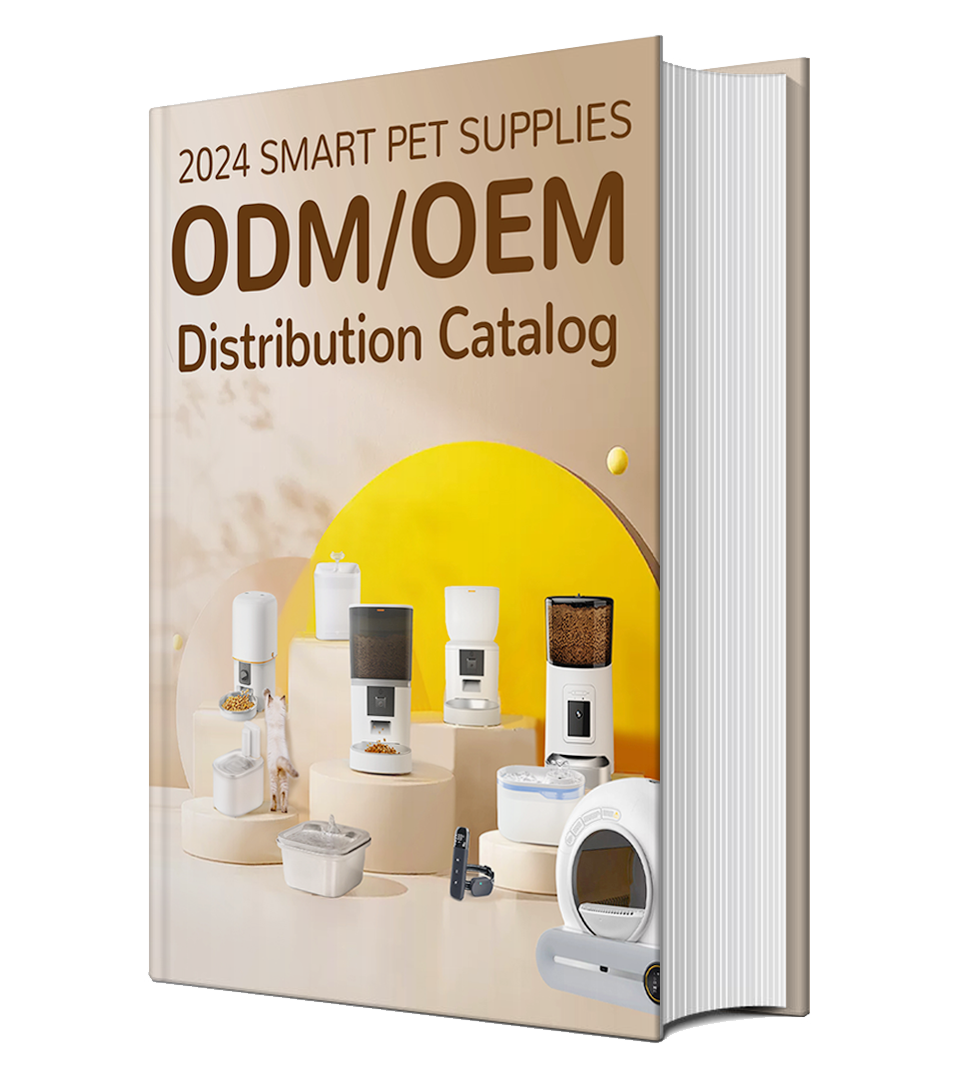
Finding an OEM factory is not the hardest part of building a smart pet product brand.
The harder part starts after you find one.
You may find a manufacturer that can produce your automatic pet feeder, smart water fountain, or self-cleaning litter box. You may receive a competitive quotation, approve a sample, and place your first order.
But none of those steps guarantees a profitable product.
A feature that looks impressive in a specification sheet can increase development costs without giving customers a stronger reason to buy.
A lower factory price can be offset by freight, marketplace fees, advertising, warranty claims, and returns.
A product with your logo on it may still look and feel almost identical to dozens of competing products.
And there is another problem buyers sometimes discover too late: a successful first production run does not automatically mean the next one will be just as predictable.
This is why a smart pet product OEM project should be treated as more than a purchasing decision.
But before deciding what to manufacture, a brand also needs to understand which manufacturing model actually fits its business.
OEM, ODM, and private label are often presented as interchangeable sourcing options. They are not. Each involves different levels of product ownership, engineering responsibility, investment, customization, and long-term control.
For brands still deciding how to work with a manufacturer, it is worth understanding which smart pet product manufacturing model best fits their product strategy and investment capacity. Choosing the wrong model can create unnecessary development costs, limit differentiation, or leave a brand with less control over its product than expected.
At Petrust, we approach product manufacturing through five connected decisions: what customers actually value, how engineering choices affect product economics, where meaningful brand differentiation comes from, how approved requirements translate into repeatable production, and how manufacturing can support the next stage of a brand’s growth.
The objective is not simply to manufacture a product at an acceptable unit price.
It is to build something customers have a reason to buy, a brand has a reason to own, and a manufacturing operation can consistently deliver.
Here are five decisions worth getting right before your first order becomes a much bigger commitment.
1. Start With What Customers Will Pay For, Not What Your Product Can Do
There is a familiar temptation in smart pet product development: if a feature can be added, why not add it?
A camera, another sensor, more app functions, additional feeding modes, voice control, or a more complicated connectivity setup can make a product specification look impressive.
But engineering possibility and commercial value are two different things.
A product can become more technically complicated without becoming more attractive to its target customer. Every additional function also needs to be developed, sourced, integrated, tested, manufactured, explained, and potentially supported after the sale.
The first decision in an OEM project should therefore be about the problem the product is supposed to solve—not the number of features the factory can put into it.
The problem with feature-driven smart pet product development
A long feature list can create the illusion of a better product.
Consider a smart pet feeder with a camera, Wi-Fi connectivity, two-way audio, motion detection, remote feeding, and multiple scheduling options.
On paper, it may look more competitive than a basic automatic feeder. But does every feature deserve a place in the final product?
A camera module introduces more than the cost of the hardware itself.
Depending on the product architecture, it can also involve firmware development, image transmission, app integration, connectivity testing, power considerations, and additional troubleshooting requirements.
More features. More components. More things to validate.
The real question is whether those additional functions give customers a stronger reason to buy.
Take automatic pet feeders as an example. Camera monitoring, portion control, remote feeding, and connectivity may all sound attractive, but their commercial value depends on the customer segment and the actual feeding problems the product is designed to solve.
For a more practical view of this trade-off, brands developing an automatic feeder may benefit from understanding which automatic cat feeder features genuinely influence purchasing decisions.
The distinction matters because a feature that looks impressive in a product specification may add engineering and manufacturing costs without creating a meaningful advantage at the point of sale.
The same issue applies to other IoT-enabled pet products. Connectivity may create genuine customer value, but it also introduces software dependencies and additional conditions that need to work together.
For connected products, the responsibility does not stop at getting the device online. Manufacturers also need to consider cybersecurity capabilities, customer-facing security information, and how relevant security activities are handled throughout the product lifecycle.
The mistake is not adding advanced features. The mistake is assuming that technical complexity automatically creates commercial value.
Customer-perceived value research published in the Journal of Service Research also supports a more balanced way of thinking: customers evaluate the benefits of an offering against the sacrifices involved, rather than simply counting the functions it provides.
A feature should earn its place in the product.
How to identify pet product features customers actually value
Before deciding which functions to develop, start with the customer problem.
For an automatic feeder, the questions might include:
- Does the customer need to feed a pet remotely while away from home?
- Is portion control a meaningful purchase consideration?
- Does a camera solve a problem the target customer actually experiences?
- Is food freshness more important than additional app functions?
- Will customers use two-way audio regularly, or is it mainly an attractive specification?
- Does the intended usage scenario require battery backup?
These questions are more useful than asking how many functions can fit into the product.
We recommend evaluating proposed features through five practical considerations:
| Evaluation point | Question to ask |
|---|---|
| Customer problem | Does this feature solve a real problem? |
| Purchase motivation | Could it influence the buying decision? |
| Usage frequency | Will customers use it regularly? |
| Engineering complexity | What additional development and production work does it require? |
| After-sales exposure | Does it introduce additional failure or troubleshooting risks? |
* This is a practical feature-to-value filter, not a substitute for customer research or market testing. Its purpose is to stop a development team from treating every requested feature as equally important.
When should you add a feature, simplify it, or leave it out?
This is where a feature discussion becomes a real OEM decision.
Imagine a brand considering a Wi-Fi pet feeder with a camera. The camera may strengthen the product proposition for customers who want to check on their pets remotely. But it also changes the component configuration, firmware requirements, app integration, testing scope, and potential support workload.
There are four possible decisions. Adding the feature is only one of them.
| Decision | When it makes sense |
|---|---|
| Keep | Customer value is clear, and engineering, cost, and validation requirements are manageable. |
| Simplify | The core customer need is valid, but the proposed implementation is too costly or complicated. |
| Defer | The feature has potential value, but the current budget, development stage, or market evidence does not justify it yet. |
| Remove | Customers are unlikely to value it enough to justify the additional cost and complexity. |
For example, a brand may decide that remote monitoring is important but that two-way audio is not essential to the first product version. The camera may stay, while another feature is deferred.
Another brand targeting a lower retail price may decide that a reliable feeder without a camera is the better commercial proposition.
Neither choice is universally correct.
The point is to make the trade-off deliberately instead of allowing a growing feature list to determine the product.
At Petrust, we do not treat every requested feature as a confirmed production requirement.
During project discussions, the engineering implications need to be understood: component configuration, firmware requirements, app dependencies, assembly considerations, and validation scope.
A requested function may be technically possible and still be unsuitable for the project’s target cost or intended market.
That distinction matters. A prototype can demonstrate that a feature works. It does not, by itself, prove that the feature belongs in a commercially viable mass-produced product.
Turn customer requirements into a practical OEM product brief
A vague product idea is difficult to engineer and even harder to quote accurately.
This is also where many quotation discussions become inefficient.
A buyer may know the product category, preferred features, and target market, but still leave important requirements undefined. The manufacturer then has to make assumptions about specifications, customization scope, component selection, and development work.
For brands preparing to request an OEM quotation, it is worth understanding how to prepare a clear product brief for more accurate manufacturer quotations. Better-defined requirements help both sides identify what is included, what still needs engineering discussion, and which assumptions could otherwise lead to pricing differences later.
“Make a smart feeder with a camera, app, and good quality” is not a complete development requirement.
A useful OEM product brief should clarify:
- Target customer and intended market.
- Main customer problem the product should solve.
- Required functions and optional functions.
- Product dimensions, capacity, and material expectations.
- Connectivity, firmware, and app requirements.
- Relevant security and compliance considerations.
- Target retail positioning and expected factory price range.
- Expected MOQ and customization scope.
- Packaging, accessories, and delivery expectations.
Not every detail needs to be finalized before the first discussion. But the priorities should be clear enough to identify engineering gaps, estimate development work, and discuss a realistic quotation.
At Petrust, product requirements need to be translated into practical engineering and manufacturing discussions before they become production commitments. That is how a product concept starts becoming a workable OEM project.
Don’t pay to manufacture complexity your customers don’t value.
2. Design for Total Profit, Not Just a Lower Factory Price
Some buyers spend weeks negotiating a few cents off the unit price, then overlook a design decision that could have a much larger effect on the economics of the product.
A competitive factory quotation matters. Of course it does.
But the quotation is not the final cost of running a product business.
The difference becomes especially important when comparing quotations from multiple manufacturers.
Two factories may quote different prices because their material specifications, component configurations, production assumptions, packaging scope, or customization requirements are not identical.
Comparing the final numbers without understanding what each quotation includes can lead to a misleading purchasing decision.
For a deeper understanding of the manufacturing side of this calculation, buyers may find it useful to examine how smart pet product OEM pricing, factory costs, and hidden import expenses affect the final cost structure. A lower unit price is only meaningful when the product scope and the costs behind the quotation are being compared on a consistent basis.
If you only compare the unit prices offered by different factories, you may miss expenses that appear during development, shipping, selling, and after-sales support.
A low quotation is not a margin strategy.
Factory price is only one part of your product economics
These terms are often used as if they mean the same thing. They do not.
| Cost term | What it means |
|---|---|
| Factory Price | The manufacturer's quoted price for the agreed product and commercial scope. |
| Manufacturing Cost | The cost of producing the product, including relevant materials, components, and production operations. |
| Landed Cost | The cost of getting imported goods to the agreed destination, including applicable freight, duties, taxes, and other import-related charges. |
| Total Product Cost | A business-defined view of product-related costs across the relevant stages. |
| Contribution Profit | Revenue remaining after the relevant variable costs have been deducted. |
| Contribution Margin | Contribution profit expressed as a percentage of net revenue. |
* The exact calculation depends on the business model, sales channel, and accounting treatment.
For an importer, landed cost may include international freight, insurance, customs duties, brokerage, and destination handling.
For an Amazon seller, the commercial calculation may also need to account for marketplace fees, fulfillment, advertising, returns, and warranty expenses.
These are not all factory manufacturing costs. But they affect whether the product makes money.
A simple example: where does the money actually go?
Consider an illustrative smart pet feeder business.
The following figures are hypothetical and are included only to demonstrate how product economics can work.
Illustrative Smart Pet Feeder Economics
| Cost item | Example amount |
|---|---|
| Net selling revenue | $100 |
| Factory product cost | $25 |
| Freight and import costs | $7 |
| Marketplace and fulfillment | $18 |
| Advertising | $20 |
| Returns and warranty reserve | $5 |
| Other variable costs | $5 |
| Contribution profit | $20 |
* They are not Petrust customer data, a market benchmark, or a typical industry cost structure.
The calculation is:
Contribution Profit = Net Revenue − Relevant Variable Costs
In this example:
$100 − ($25 + $7 + $18 + $20 + $5 + $5) = $20
Contribution margin is calculated separately:
Contribution Margin = (Contribution Profit ÷ Net Revenue) × 100%
In this example:
($20 ÷ $100) × 100% = 20%
The distinction is important.
Contribution profit is the amount remaining. Contribution margin is that amount expressed as a percentage of net revenue.
Neither figure should automatically be confused with gross profit, operating profit, or net profit. The business needs to define which costs are included and use the same basis when comparing products or scenarios.
Now imagine the factory product cost falls from $25 to $23, while everything else remains unchanged. Contribution profit rises from $20 to $22.
That is useful.
But if a component reduction creates more returns, additional support work, or a weaker customer experience, the apparent saving may not survive the full commercial calculation.
The factory quotation is only one line in the business model.
Understand which costs your manufacturer can actually influence
This is an important boundary in an OEM relationship.
A manufacturer can contribute to the product’s economics, but it cannot control every factor that determines the brand’s profitability.
| Area | What a manufacturer can influence | What remains primarily with the brand or sales channel |
|---|---|---|
| Product configuration | BOM, component selection, material choices | Retail pricing strategy |
| Product engineering | Structure, assembly design, DFM decisions | Customer acquisition strategy |
| Packaging | Packaging dimensions, protection design, packing efficiency | Marketplace fee structure |
| Production planning | MOQ discussions, batch planning, production efficiency | Inventory financing and sales forecasting |
| Product reliability | Product-specific testing and manufacturing controls | Customer support policies and channel execution |
| Commercial performance | Manufacturing cost and product-related risk discussions | Advertising efficiency, conversion rate, and market demand |
Petrust can help evaluate how BOM choices, structure, assembly, packaging, production volume, and product reliability affect the manufacturing side of the equation.
We cannot promise a particular Amazon advertising cost, marketplace commission, retail price, or conversion rate. Those depend on the brand’s commercial strategy and market conditions.
A serious manufacturing discussion should be honest about that division of responsibility.
How product engineering decisions shape manufacturing costs
This is where a manufacturing partner can contribute more than a quotation.
Engineering decisions influence the product’s cost structure from the beginning.
Consider several areas:
- BOM management: Component selection affects material cost, sourcing options, compatibility, and supply stability.
- Product structure optimization: A practical structure can reduce unnecessary parts and simplify assembly.
- Injection molding: Part geometry, material choice, and mold design influence tooling investment and production considerations.
- Assembly efficiency: A design that is easier to assemble can make production more manageable.
- Packaging design: Product dimensions and packaging structure affect protection, storage, and transportation efficiency.
This is the purpose of Design for Manufacturing (DFM): considering how a product will actually be made while the design can still be adjusted.
A design that looks excellent in a rendering may be unnecessarily difficult to assemble. A component that appears inexpensive may create sourcing or quality complications. A small structural change may affect the mold, assembly sequence, or packaging dimensions.
These details need to be considered together.
At Petrust, product structure, component selection, and production requirements can be discussed as part of product development—not treated as completely separate problems after the design has been finalized.
For example, when reviewing a proposed component or structural change, the discussion should not stop at the unit price. It should also consider whether the change affects the product’s intended performance, assembly process, compatibility, validation requirements, or future sourcing options.
The right decision depends on the product, target price, expected volume, customization requirements, and production conditions. There is no honest universal percentage that every DFM project can promise to save.
Reduce cost where it matters, not where it creates more risk
Suppose a buyer wants to reduce the unit manufacturing cost of a smart feeder.
Possible areas to review include:
- Whether the component specification is appropriate for the intended performance.
- Whether the product structure contains unnecessary complexity.
- Whether parts can be designed for more efficient assembly.
- Whether packaging dimensions can be improved without reducing protection.
- Whether the expected order volume justifies the tooling investment.
- Whether a proposed component change affects reliability or testing requirements.
Not every cost-saving idea is a good one.
Reducing the specification of a critical component may lower the quotation while increasing the risk of performance problems. Simplifying a non-essential decorative part may be a much safer way to control cost.
The distinction matters.
A manufacturing partner should be willing to explain the trade-off rather than simply agree to every request for a lower price.
The cheapest product to manufacture is not always the cheapest product to own.
3. Build a Product People Can Recognize Without Looking at the Logo
Putting a logo on an existing factory product does not automatically give you a brand.
It gives you a branded product. That is not necessarily the same thing.
If several sellers offer products with similar appearance, functions, and user experience, a different logo may not give customers a compelling reason to choose one brand over another.
Real product differentiation needs to be considered more carefully.
Why a logo alone does not create product differentiation
Logo customization is often a sensible starting point, particularly for a new brand validating its first product.
But it has limits.
Imagine two brands selling similar smart pet water fountains. Both products have comparable water capacity, filtration arrangements, and pump configurations. The packaging and logos are different, but the customer experience is almost identical.
What makes one product meaningfully different?
Possibly the cleaning experience. Perhaps the filtration arrangement is easier to understand. Maybe the product has a more distinctive appearance, a better-designed water tank, or a more intuitive maintenance process.
The difference needs to exist in the product or the experience—not just in the printed logo.
This does not mean every private label project needs a completely new mold or a major engineering investment. A business should choose a level of customization that matches its market position, budget, and growth stage.
Four levels of smart pet product customization
Product customization can range from simple brand identification to deeper engineering development.
| Customization level | Typical scope | Potential business value |
|---|---|---|
| Level 1: Brand Identity | Logo, labels, and packaging | Establishes recognizable brand presentation. |
| Level 2: Appearance | Colors, materials, and selected exterior details | Creates stronger visual distinction. |
| Level 3: Functional Experience | Functions, firmware, app-related features, and user interaction | Builds product-level differentiation. |
| Level 4: Product Engineering | Structural changes, custom tooling, and deeper product development | Creates more substantial product differentiation. |
The deeper the customization, the more carefully the project needs to consider development time, engineering resources, tooling investment, MOQ, and validation requirements.
For some brands, Level 1 or Level 2 is enough to test market demand.
For others, especially brands with a clearer product strategy and longer-term investment plans, functional or structural customization may make more sense.
The mistake is assuming that deeper customization is always better.
A brand should invest in the level of differentiation that its customers can recognize and its business can support.
Product design, packaging, and user experience are part of your brand
Customers do not experience a product through its logo alone.
They experience the entire product journey:
- How easy is it to open the package?
- Is installation straightforward?
- Can the customer understand the controls?
- Is the product easy to clean?
- Does daily operation feel intuitive?
- Are replacement filters or accessories easy to identify?
- Does the packaging communicate the product's value clearly?
For a smart pet fountain, for example, a well-designed cleaning structure may be more meaningful to everyday users than an additional feature they rarely use.
For an automatic feeder, clear food-loading and portion-setting instructions can matter more than a long list of app functions.
This is why pet product packaging design, industrial design, and usability should be considered together.
Packaging is not simply the final artwork applied after the product is finished. It is part of the customer experience and needs to work with the actual product dimensions, accessories, protection requirements, and target sales channel.
Customization is not the same as brand ownership
There is a commercial question that deserves more attention before a brand invests in deeper OEM customization:
After paying for customization, which parts of the resulting product are actually the brand’s assets—and what rights does the brand have to use them?
A buyer may pay for a customized product and still discover that important ownership or usage terms were never clearly agreed.
For example:
- Who owns the custom tooling?
- Who can use the customized structure, and under what conditions?
- Which design drawings and engineering files will be delivered?
- What software access or usage rights does the brand receive?
- Who is responsible for firmware and app maintenance?
- Does any exclusivity apply, and what exactly does it cover?
- Are future modifications included in the original development scope or separately quoted?
These questions should be discussed before development investment becomes difficult to unwind.
| Project area | What should be clarified |
|---|---|
| Tooling | Ownership, storage, maintenance, access, and permitted use of molds and tooling. |
| Design | Rights to customized drawings, structural designs, design files, and related deliverables. |
| Firmware & App | Software ownership, usage rights, access permissions, source-code arrangements where applicable, updates, and maintenance responsibilities. |
| Exclusivity | Whether restrictions apply by territory, channel, customer, product configuration, or another defined scope. |
A payment for customization does not automatically mean the buyer owns every underlying design, software component, or manufacturing asset.
The actual rights depend on the contract, the pre-existing intellectual property, the newly developed work, the software architecture, and the agreed deliverables.
For example, a project may involve a buyer-owned logo and packaging design, a manufacturer-owned existing platform, and a separately agreed custom structural design. Those are different assets and should not be treated as one undivided ownership question.
At Petrust, customization scope needs to be discussed in practical terms: what is being changed, what development work is required, which files or deliverables are included, and what rights and responsibilities both parties agree to.
Buyers should clarify these terms in the project agreement before committing substantial development or tooling investment.
This is not paperwork for its own sake. It affects how confidently a brand can develop, maintain, and extend its product range.
Choose a customization level your business can actually support
Before requesting custom colors, a new structure, or additional app functions, ask:
- Does the proposed change create a difference customers will notice?
- Is that difference important to the target market?
- What additional development or tooling investment is required?
- How will the change affect MOQ and production lead time?
- Does the brand have enough demand to justify the investment?
- Can the manufacturer support the required engineering and production work?
- Are ownership, usage, and future support responsibilities clearly agreed?
At Petrust, OEM customization can involve different levels of product and brand development, from logo and packaging arrangements to appearance, functional, and structural requirements.
The scope needs to be discussed project by project. A packaging change is not the same engineering commitment as firmware development or custom tooling, and buyers should not be led to believe that they are interchangeable.
A clear customization discussion helps both sides understand what is included, what needs development, what the brand will own or be licensed to use, and what must be validated before production.
A brand is not what you print on the product. It is what customers consistently recognize—and what your business has the rights and capability to keep developing.
4. Protect Your Second Order Before You Celebrate Your First
Your first OEM order proves that a product can be made.
Your second order starts to test whether the manufacturing process can be repeated.
That does not mean a second order alone proves long-term quality. It does mean that the manufacturer and buyer now have to deal with something more demanding than approving a prototype: maintaining agreed product requirements across production runs.
This is where the difference between a promising sample and a controlled manufacturing process becomes important.
Why an approved sample does not guarantee consistent mass production
A sample is an important milestone. It allows the buyer to review the product’s appearance, functions, materials, and general performance.
But a sample is not the same thing as a mass-production process.
During sample development, engineers may make adjustments, select components, and resolve design details. Mass production introduces different operating conditions:
- More production operators.
- Repeated assembly operations.
- Larger quantities of components.
- Incoming material variation.
- Production scheduling pressure.
- Greater dependence on documented specifications and work instructions.
A product that works well as one approved sample still needs to be suitable for repeatable manufacturing.
For smart pet devices, this can involve mechanical parts, electronic components, firmware, connectivity, sensors, pumps, motors, and other product-specific systems.
The more interdependent the product is, the more important it becomes to define what needs to be controlled, how it will be checked, and what happens when a requirement changes.
Where quality problems enter between sample approval and production
Problems can enter at several points.
1. The approved specification is incomplete.
If the buyer and manufacturer have not clearly documented important product requirements, different people may interpret the approved sample differently.
2. Component changes are not properly controlled.
A change in component model, supplier, material, or specification may affect the finished product. The impact depends on the component and its function.
3. Assembly requirements are unclear.
A product may require specific assembly conditions, connection checks, or installation steps. If these are not defined clearly, production consistency becomes harder to manage.
4. Functional testing does not reflect the actual product requirements.
A basic power-on check may not be enough for a connected pet device. The required tests should reflect the functions and risks of the particular product.
5. Engineering changes are not communicated properly.
A design revision that is not reflected in the relevant production documents can create confusion between the approved version and the version being manufactured.
These are practical reasons why product specifications, engineering changes, and production controls need to stay connected.
From approved sample to repeatable production: what Petrust actually controls
Quality control is not just an inspection at the end of the production line.
A finished-product inspection can identify certain problems. It cannot, by itself, replace control of the specifications, components, assembly requirements, and engineering changes that determine what is being manufactured.
For an OEM project, the relevant control system needs to connect at least five areas.
| Control area | Manufacturing control activity |
|---|---|
| Product Specification | Confirm the approved product configuration, important requirements, and applicable revisions. |
| BOM | Identify relevant component models, specifications, and approved changes. |
| Assembly | Define applicable assembly requirements and production instructions. |
| Functional Testing | Establish product-specific checks against agreed functions and acceptance criteria. |
| Engineering Changes | Evaluate, communicate, and document relevant changes before they affect production. |
These are not five documents that should exist just to make a factory look organized. They are five connected areas that help ensure the product being manufactured remains aligned with the product the buyer approved.
But documenting these requirements is only part of the work. The more important question is how they are applied throughout actual production.
A product specification, BOM, assembly instruction, or functional test requirement only becomes useful when it is connected to the manufacturing activities that need to follow it. Otherwise, even a well-prepared quality document can remain separate from what happens on the production floor.
For buyers evaluating long-term manufacturing consistency, it is worth understanding how Chinese OEM manufacturers build quality control into the production system rather than relying on final inspection alone. This becomes particularly important when the same product needs to maintain its approved requirements across multiple production batches.
Different products need different functional controls
A smart water fountain should not be tested in exactly the same way as an automatic pet feeder.
For a water fountain, product-specific checks may include:
- Pump operation.
- Water circulation.
- Leakage checks.
- Noise requirements.
- Power-related checks.
- Sensor or connectivity functions, where the product includes them.
For an automatic pet feeder, relevant checks may include:
- Feeding and dispensing operation.
- Portion consistency against the agreed specification.
- Motor operation.
- Food-path performance.
- Connectivity and app functions, where applicable.
- Power backup operation, if the product includes backup power.
For a self-cleaning litter box, the relevant controls may be different again, potentially involving mechanical movement, sensor response, safety-related functions, waste handling, and operating cycles.
The point is not to apply every possible test to every product.
The test plan should reflect the actual product architecture, agreed specifications, intended use, and project risks.
Acceptance criteria, sampling methods, and inspection levels should be agreed according to the product and project requirements rather than presented as one universal checklist.
Engineering validation is not the same as final inspection
Some projects may use structured development stages such as EVT, DVT, and PVT.
These stages can help organize engineering evaluation, design verification, and production validation. Their exact scope and sequence should reflect the product development process and the validation work actually required.
They should not be presented as mandatory stages that every OEM project follows identically.
What matters is that the necessary questions are answered before production commitments become difficult to change:
- Does the product meet the agreed functional requirements?
- Are the relevant components and configurations confirmed?
- Have important design and manufacturing risks been evaluated?
- Can the assembly process produce the intended result?
- Are the necessary functional checks defined?
- Have relevant changes been reviewed and communicated?
A sample approval is a decision point. It is not a substitute for the validation and production controls required by the project.
What happens after sample approval?
At Petrust, the work after sample approval needs to connect the agreed product requirements with the manufacturing activities used to deliver them.
Depending on the project, this may involve:
- Approved sample and specification confirmation — identifying the agreed product configuration and the requirements that need to be maintained.
- BOM and component configuration review — checking the relevant component requirements and how changes are handled.
- Production assembly requirements — confirming applicable assembly instructions and process expectations.
- Product-specific functional testing — checking the functions that matter for the particular feeder, fountain, litter box, or other smart pet device.
- Engineering change documentation — making relevant revisions visible and communicating their impact before they become production surprises.
The exact records and controls should reflect the project. A particular document or test record should only be presented as evidence when it actually exists and is relevant to that product.
For buyers, this leads to a much more useful question than simply asking whether a factory has QC staff:
Can the manufacturer explain how your approved product requirements are carried into production, checked, and managed when something changes?
That is the difference between talking about quality and demonstrating manufacturing control.
What we would not recommend just to win an OEM order
A manufacturing partner should be commercially flexible. But flexibility should not mean agreeing to every request without explaining the consequences.
At Petrust, these are the principles we believe an OEM manufacturer should be willing to discuss openly:
- We would not remove a critical component requirement simply to make a quotation look cheaper.
- We would not add technical features without considering their engineering and after-sales implications.
- We would not treat an approved sample as proof of mass-production readiness.
- We would not present a production schedule as confirmed before the specifications, customization scope, and manufacturing requirements are sufficiently clear.
- We would not describe logo and packaging changes as deep product engineering.
These are not rules for judging other factories. They are manufacturing responsibilities that we believe should apply to our own work.
A good OEM relationship is not built by saying yes to everything.
It is built by understanding what the project needs, explaining the trade-offs, and agreeing on requirements that can actually be delivered.
A good first batch is a milestone. Repeatable quality is a manufacturing responsibility.
5. Turn Your First OEM Order Into a Repeatable Growth System
Decision 4 is about manufacturing consistency: how to make the next batch match the agreed product requirements.
Decision 5 is about something different.
How does a brand use what it learns from the first product to make better product decisions, plan future versions, and expand without creating unnecessary complexity?
Getting the first order shipped is an important achievement. But once the product reaches the market, the next set of questions begins.
- What are customers finding difficult?
- Which functions are actually being used?
- Are there recurring complaints?
- Does the product need a revision?
- Can the next order be planned with fewer uncertainties?
A brand that wants to grow needs more than a product that can be manufactured once. It needs a way to improve the product and make informed decisions about what comes next.
Turn customer feedback into engineering decisions
Customer feedback is useful when it leads to specific product decisions.
For example, feedback about a smart feeder may reveal that:
- Food loading is less convenient than expected.
- Portion settings are not easy to understand.
- The camera angle does not suit the customer's setup.
- Cleaning takes longer than customers anticipated.
- App instructions are unclear.
Not every complaint requires an engineering change.
A problem with unclear instructions may be better addressed through the user manual, packaging, or customer support. A confusing interface may require an app or firmware improvement. A recurring difficulty with cleaning may point to a structural or product-design issue.
The important step is to classify feedback before deciding what to change.
| Feedback type | Possible response |
|---|---|
| Instructions or setup confusion | Improve the manual, packaging guidance, or onboarding. |
| User interface difficulty | Review app interaction, controls, or firmware behavior. |
| Structural or maintenance problem | Evaluate product geometry, disassembly, cleaning, or material choices. |
| Functional performance issue | Investigate the relevant components, operating conditions, and product requirements. |
| Isolated preference | Monitor whether it represents a broader customer need before changing the product. |
This prevents every customer comment from becoming another feature request.
At Petrust, relevant product feedback can be translated into engineering discussions: what needs to change, what the change would involve, and whether it affects the existing product configuration or manufacturing requirements.
A product revision should solve a defined problem—not simply add another feature because the next version needs to look different.
Manage product lifecycle and version changes
A smart pet product does not remain static after its first production run.
Components may need to be reviewed. Firmware may be updated. Accessories may change. Suppliers may discontinue parts. The brand may introduce a revised model.
Without clear version management, it becomes difficult to know which configuration a customer has purchased, which components are compatible, or which production requirements apply to a particular order.
A growing brand should pay attention to:
- Product specification revisions.
- BOM and component changes.
- Firmware and app versions, where applicable.
- Accessory and replacement-part compatibility.
- Packaging and user-manual revisions.
- Relevant engineering change records.
- Product support and maintenance responsibilities.
A component substitution, for example, should not be treated as a purely purchasing decision if it affects product performance or compatibility.
Likewise, a firmware update may require additional functional checks depending on what has changed.
The objective is not to prevent every change. Products evolve.
The objective is to make changes visible, evaluated, and properly communicated before they become production or customer-support surprises.
For connected products, software support and security considerations also deserve attention beyond the initial launch. The relevant responsibilities depend on the product architecture, software arrangements, and agreed support model.
Expand the product line only when the business is ready
When a product begins selling, expanding the product line can look like the obvious next move.
But more SKUs do not automatically mean a stronger brand.
This is a point worth taking seriously, especially for brands that have just completed their first OEM order.
The next stage of growth is not necessarily about launching more products. It may involve improving the current product, understanding which customer segments are responding, strengthening sales channels, or making the next production decision with better information.
For brands moving beyond their first shipment, it may be worth exploring how to scale a pet brand after its first OEM order without expanding the product line faster than the business can support.
Sustainable growth depends on the relationship between product performance, customer demand, inventory planning, and the manufacturer’s ability to support future development.
A brand that expands too quickly may create additional inventory requirements, component complexity, packaging variations, tooling investment, and production planning pressure without building a stronger product portfolio.
Before developing another SKU, ask:
- Has the first product demonstrated a clear customer need?
- Are recurring product issues understood and addressed?
- Is the existing product's contribution economics acceptable?
- Is there a customer segment that the proposed new model would serve?
- Does the new SKU offer a meaningful difference?
- Can the brand support the additional inventory, marketing, and after-sales requirements?
- Can the manufacturer support the required engineering and production work?
For example, a brand selling automatic feeders might consider:
- A simpler model for customers who do not need a camera.
- A higher-capacity model for a different household requirement.
- Different configurations for distinct price segments.
- Complementary smart pet products that fit the same target customer.
But a second model should not be launched just because the factory can make it.
The decision should be based on demand, product positioning, engineering feasibility, and the brand’s ability to support the additional products.
The same thinking applies to smart fountains and self-cleaning litter boxes. A product line should make sense as a business, not simply look larger in a catalogue.
Build a manufacturing partnership that can grow with your brand
A long-term OEM relationship should be more than repeating the same purchase order.
As a brand develops, its manufacturing requirements may change:
- New product concepts need engineering evaluation.
- Existing products need revisions.
- Custom packaging or product specifications may evolve.
- Production quantities may increase or fluctuate.
- Component availability may require technical review.
- Quality expectations need to remain aligned across orders.
A manufacturer needs to understand not only what is being ordered today, but also the product requirements and production responsibilities that shape future orders.
At Petrust, our role as a smart pet product OEM/ODM manufacturer brings together product development, engineering, customization, and production. This provides a practical foundation for discussing projects beyond the initial quotation.
It does not mean every product can be changed without additional investment, or that every production schedule and price will remain fixed indefinitely. Development scope, MOQ, component availability, and order planning still need to be agreed for each project.
That is part of a realistic long-term partnership.
The objective is to make product development and manufacturing work together as the brand grows—not to create unnecessary complexity along the way.
Your first order creates a product. A repeatable manufacturing system creates the foundation for a growing brand.
The Smart Pet OEM Business Decision Chain
The five decisions in this article are connected. They should not be treated as five isolated tips.
| Decision | The question your business needs to answer |
|---|---|
| Customer Demand | What is worth developing? |
| Product Economics | Can the product make money? |
| Brand Differentiation | Why should customers recognize and choose it? |
| Manufacturing Consistency | Can the agreed product be delivered repeatedly? |
| Repeatable Brand Growth | Can manufacturing support the next stage of the business? |
This is the Smart Pet OEM Business Decision Chain *: a practical decision framework proposed by Petrust to connect customer needs, engineering choices, commercial considerations, brand development, and manufacturing execution.
* It is not a statistical industry standard or a guarantee of commercial success. It is a way to make the major decisions in an OEM project visible before they become expensive to change. The framework also reflects an important responsibility for the manufacturer.
The factory should not simply receive a list of functions and return a unit price.
It should understand what the product is expected to achieve, what engineering work is involved, what manufacturing constraints need to be considered, and what must remain consistent when production scales.
That is the difference between quoting a product and understanding an OEM project.
FAQ About Smart Pet Product OEM
There is no universal answer.
A new brand validating demand may only need logo, labels, and packaging customization. A more established brand may need appearance changes, functional differentiation, firmware or app-related development, or custom structural engineering.
The right level depends on customer value, target positioning, development budget, MOQ, tooling investment, and the brand's ability to support the product.
Deeper customization is not automatically better. It should create a difference customers recognize and a business can sustain.
Start by separating manufacturing cost from the wider commercial cost of selling the product.
Manufacturing cost may include materials, components, and production operations. Landed cost adds relevant freight, import duties, taxes, and destination charges. A sales-channel calculation may also include marketplace fees, fulfillment, advertising, returns, warranty expenses, and other variable costs.
A useful starting point is:
Contribution Profit = Net Revenue − Relevant Variable Costs
Contribution Margin = (Contribution Profit ÷ Net Revenue) × 100%
The costs included should match your business model and accounting treatment. A manufacturer can help evaluate product-related costs such as BOM, structure, assembly, packaging, and production planning, but cannot control your retail price, advertising efficiency, or marketplace fees.
There is no universal answer.
A new brand validating demand may only need logo, labels, and packaging customization. A more established brand may need appearance changes, functional differentiation, firmware or app-related development, or custom structural engineering.
The right level depends on customer value, target positioning, development budget, MOQ, tooling investment, and the brand's ability to support the product.
Deeper customization is not automatically better. It should create a difference customers recognize and a business can sustain.
Start by confirming the approved product configuration and the requirements that need to remain consistent.
Depending on the project, this may involve controlled product specifications, BOM and component requirements, assembly instructions, product-specific functional tests, engineering change records, and agreed finished-product acceptance criteria.
The key is to make sure relevant changes are evaluated and communicated before they affect production.
An approved sample is an important reference, but repeatable manufacturing depends on the controls that carry the approved requirements into production.
An OEM Order Should Build More Than Inventory
A factory can manufacture a product. But manufacturing a product and building a profitable product business are two different things.
The difference is rarely determined by one decision alone.
It starts with choosing features customers actually value. It continues with engineering decisions that protect the economics of the product, customization that gives customers a reason to recognize and choose the brand, and manufacturing controls that help maintain consistency beyond the first shipment.
Then comes the part many first-time buyers underestimate: making the next order more predictable than the last, learning from the market, and deciding what is worth developing next.
At Petrust, we believe an OEM manufacturing relationship should be built around more than unit price and production capacity.
Product requirements, engineering feasibility, customization, ownership arrangements, quality expectations, and production planning all need to work together.
Petrust is a smart pet product OEM/ODM manufacturer with product development, engineering, and manufacturing capabilities. Our work connects the commercial idea with the engineering and production requirements needed to turn it into a manufactured product.
We do not believe every project needs the most complicated design, the deepest customization, or the largest first order. The right manufacturing solution depends on what the product needs to achieve and what the business can support.
A good OEM manufacturer should not only ask, “How many units do you want to order?”
It should also understand what the product needs to achieve, what the engineering requires, what the cost structure can support, and what must remain consistent when production scales.
Petrust understands what it takes to turn a smart pet product idea into a commercially viable, differentiated, and repeatable manufactured product.
That is what turns a product idea into a manufacturing project—and a manufacturing project into the foundation of a growing brand.
You do not need a finished technical specification to start a discussion.
To understand whether your project is ready for OEM development, it helps to know:
- Product: What smart pet product are you developing—an automatic feeder, water fountain, self-cleaning litter box, or something else?
- Customer value: Which functions are essential to your target customers?
- Customization: Are you looking for private label, appearance changes, functional customization, or deeper product engineering?
- Quantity: What is your expected order quantity or initial MOQ target?
- Market: Which country or sales market are you planning to serve?
A product concept and clear business requirements are a useful starting point. We can then discuss the engineering scope, manufacturing considerations, customization requirements, and a realistic production path.