
A moving stream is easy to sell. A good drinking experience is harder to engineer.
For a pet brand, the appeal of a cat water fountain seems obvious: water moves, cats notice it, and the product looks more interesting than a conventional bowl.
But a product that looks attractive in a product render is not necessarily a product that works well in everyday use.
The water needs to reach the intended drinking area.
The outlet must control its direction.
The pump, housing, and water flow affect the operating experience.
Owners need to clean the parts that matter without struggling to put everything back together.
And if the fountain is being developed for an OEM project, these decisions must eventually become specifications that can be validated and reproduced in production.
So, why cats prefer running water is a useful question. It is also only the beginning of a much bigger product-development question: what makes a fountain worth using, maintaining, and selling?
Why Are Some Cats Attracted to Running Water?
Some cats watch a running tap, reach toward a stream with a paw, or investigate a fountain when it starts operating.
Others show little interest, even when fresh water is readily available.
These differences matter.
Water movement can attract a cat’s attention, but an observable reaction does not prove that every cat prefers flowing water or that every fountain will encourage greater water intake.
When considering why cats like running water, it helps to distinguish three things:
- What an owner observes a cat doing.
- What might explain that behavior.
- What a product designer can reasonably turn into a design requirement.
They are related, but they are not interchangeable.
Why Do Some Cats Watch or Drink From Running Taps?
A running tap changes several things at once.
The water moves, makes a sound, reflects light differently from a still surface, and creates a changing point of contact.
For a curious cat, those differences may make the water more noticeable than water sitting in a familiar bowl.
That helps explain why some cats investigate a running tap even when a bowl is nearby.
Movement may attract attention, while the tap’s position, the surrounding environment, and the cat’s previous experiences can influence whether that attention turns into drinking.
Nor does it establish that a more dramatic stream will perform better in a home.
A behavior can inspire a design hypothesis. It cannot replace validation.
For product developers, the practical starting point is to create a usable drinking area rather than assume that visual movement alone will make a fountain successful.
Does Running Water Always Mean a Better Drinking Experience?
No. Running water is one possible design approach, not a universal preference.
The comparison between running water and standing water for cats is often presented too simply, as though movement automatically makes one option better.
A scoping review published in the Journal of Animal Science examined 32 publications on feline water intake, hydration, and related outcomes. It discussed factors including diet and nutrient composition and did not find a consistent effect of static versus flowing water source type on water intake.
That evidence does not justify assuming that every cat will drink more simply because the water is moving .
Some cats may prefer a familiar bowl. Others may investigate a fountain but dislike its sound or placement.
Individual preferences can differ, and owners’ observations still matter.
The practical requirements remain straightforward: provide accessible drinking water, keep the product clean, and follow appropriate maintenance instructions.
A moving stream cannot compensate for neglected cleaning or an unsuitable drinking area.
For a manufacturer, this distinction changes the design brief.
Instead of simply specifying “flowing water,” a team needs to decide what the flow is supposed to achieve, where the water should land, and how the resulting experience will be evaluated.
That is a more useful starting point for OEM development than treating one attractive feature as the answer to every drinking problem.
Not All Moving Water Feels the Same
A fountain can produce moving water in several ways.
Water may emerge as a low stream, bubble through an outlet, or fall from a raised spout into a collection area.
These designs can look very different on a product page. They also create different engineering requirements.
The outlet geometry, pump performance, water level, return path, and shape of the drinking area all influence how water moves through the product.
That is why cat water fountain flow patterns should be treated as design choices, not merely visual variations.
Gentle Flow, Bubbling Water, or a Small Waterfall?
There is no universal winner.
Each flow style should be evaluated against the product’s intended use and positioning.
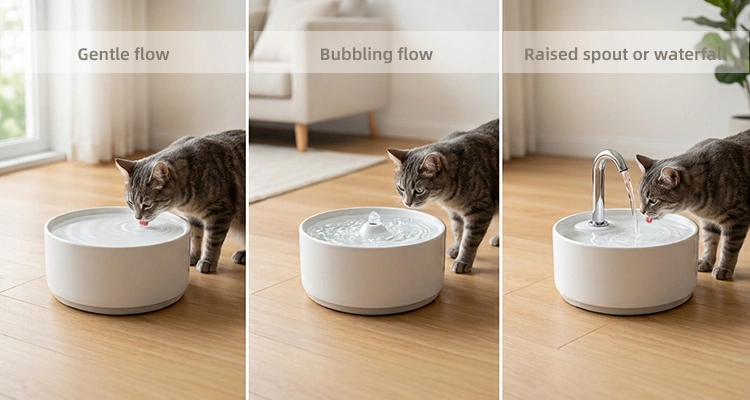
| Flow style | Potential design advantage | What needs to be evaluated |
|---|---|---|
| Gentle flow | A relatively simple, low-profile drinking area | Flow stability, outlet position, and ease of access |
| Bubbling flow | Visible surface movement within a compact structure | Operating sound, splashing, circulation, and consistency |
| Raised spout or waterfall | A more visible stream and a distinctive appearance | Outlet height, falling-water noise, splash control, and cleaning access |
A bubbling fountain may create noticeable surface movement without a raised stream.
The design still needs to account for sound, water disturbance, and consistency during operation.
A waterfall-style cat fountain can create a more prominent visual effect.
That may suit a particular product concept, but it also introduces questions about the height of the outlet, where the water lands, and whether the surrounding structure is practical to clean.
None of these design observations proves that cats will prefer one style over another.
That conclusion requires appropriate behavioral evidence, not a designer’s personal preference.
The better development question is not, “Which flow looks best in a rendering?”
It is, “Which flow supports the intended drinking experience and can be delivered within the product’s size, cost, maintenance, and manufacturing requirements?”
How Water Flow Changes the Drinking Area
The visible stream is only one part of the experience.
The outlet position determines where water lands.
The basin determines how water collects and returns.
The surrounding housing affects how easily a cat can approach the water without encountering unnecessary physical obstacles.
A product may have a visually impressive stream but an awkward drinking area.
Another may have a less dramatic flow that is easier to access and maintain.
This is why cat water fountain flow design needs to be assessed together with the drinking area, rather than as an isolated pump specification.
Flow rate matters, too, but a number alone cannot describe the experience.
It needs to be considered alongside outlet geometry, operating water level, circulation path, and the way the product behaves during use.
Increasing flow without reviewing the outlet and return path may introduce splashing or additional sound without providing a meaningful benefit.
A fountain concept should not be approved simply because water emerges from the outlet.
For an OEM development review, the relevant questions are more specific:
- Where does the stream leave the outlet, and where should it land?
- Does the water return to the reservoir as intended?
- What changes across the product's specified operating water-level range?
- Is the outlet and surrounding structure accessible for routine cleaning?
- Can the intended flow be maintained without unacceptable splashing or noise under the agreed evaluation conditions?
These questions turn a visual feature into a set of engineering decisions.
The exact acceptance criteria depend on the product brief.
A compact everyday fountain and a premium waterfall-style model do not need identical specifications.
They do need requirements that can be evaluated rather than assumptions that survive only in a product render.
For a brand, this matters because a seemingly small decision about the stream can influence the outlet structure, housing, pump arrangement, and product specifications.
Those choices are easier to resolve while the design is still being developed than after tooling or production preparation has begun.
The Spout Is More Than a Visual Feature
The outlet is one of the most visible parts of a fountain.
It also influences water direction, splash behavior, and the relationship between the stream and the drinking surface.
A cat water fountain spout design needs to work with the rest of the circulation system.
Designing the spout for appearance first and considering water behavior later can create avoidable compromises.
Water Height, Direction, and Splashing
A raised outlet changes how water travels before reaching the reservoir.
A lower outlet may create a more contained flow, while a higher one can produce a more visible stream and a greater drop.
Neither arrangement is automatically better.
The appropriate water height depends on the intended product geometry and flow style.
Stream direction influences where water lands, how it interacts with the basin, and whether it creates unwanted splashing.
During concept review, the team should establish:
- The intended landing area for the stream.
- The operating conditions under which the flow should remain controlled.
- The acceptable limits for splashing outside the collection area.
- The intended return path.
- The surfaces and components that need cleaning access.
If a prototype splashes, the cause should be investigated rather than guessed.
The outlet angle, stream height, flow rate, basin geometry, and interaction between components may all be relevant.
This is why splash control belongs in design evaluation, not just in customer support after launch.
Design a Drinking Area That Is Practical to Use and Maintain
The outlet can perform as intended and still be part of an awkward product.
The surrounding structure determines how much space is available around the water, whether the basin can be reached comfortably, and how easily an owner can clean the areas where water collects.
A useful drinking area should be considered in relation to the complete housing, not just the point where water emerges.
Cleaning access belongs in the same discussion.
A narrow opening, an awkward corner, or a component that is difficult to remove can make an otherwise simple product more demanding to maintain.
For an OEM project, the outlet, basin, housing, and removable components should be reviewed together.
Where appropriate, physical prototypes and design comparisons can help the team evaluate water direction, splashing, access, and cleaning reach before the final structure is committed.
If a brand wants to use a particular outlet design as a selling point, it should establish what that design is expected to achieve and how the result will be evaluated.
The point is not to make every fountain look or behave the same way. It is to ensure that the chosen design has a clear purpose and that its practical consequences are understood.
Why a Quiet Pet Fountain Takes More Than a Quiet Pump
Noise can look insignificant on a specification sheet and become very noticeable in a home.
A fountain may sit beside a bed, on a kitchen floor, or in another space where repetitive sound becomes difficult to ignore.
For a brand positioning its product as a quiet cat water fountain, the operating experience of the assembled product matters more than a component claim.
A quiet pump is a useful starting point. It is not proof that the complete fountain will be quiet.
Pump Vibration, Waterfall Noise, and Resonance
The sound a user hears may include several sources.
Pump operation can introduce vibration.
The housing may transmit or amplify that vibration.
Water falling onto a surface can create additional sound, while component fit and assembly influence how those effects are perceived.
A pump that performs acceptably in isolation may behave differently when installed inside the finished housing.
Pump mounting, contact points, reservoir geometry, and water flow all need to be considered when evaluating the assembled result.
Likewise, reducing motor noise will not necessarily eliminate the sound created by a raised stream or a poorly controlled water return.
If quiet operation is a key selling point, the brand and manufacturing partner should agree on the evaluation setup, operating water level, measurement method, and acceptance criteria.
Any published noise figure should identify the conditions under which it was measured.
A bare claim such as “ultra-quiet” gives buyers little information unless the claim can be tied to a defined and reproducible test.
Noise is also only one part of pump performance.
A pump may sound acceptable during an initial demonstration but behave differently as the water level changes, components accumulate wear, or the product is repeatedly cleaned and reassembled.
For brands, overlooking these operating conditions can turn a seemingly minor component choice into a recurring maintenance or after-sales issue.
It is therefore worth examining the common causes of pet water fountain pump failure, from excessive noise and dry running to leaks and reduced service life before finalizing the pump configuration and product specifications.
Why Water Level and Assembly Matter
As the water level falls, the relationship between the water and the pump intake may change.
Depending on the design and operating conditions, this can affect circulation, introduce additional sound, or create operating concerns.
The relevant question is not simply whether the fountain is quiet when first switched on. It is how the assembled product behaves across its specified operating range.
Assembly also matters.
A component that is not seated correctly, a mounting point that transfers unwanted vibration, or a housing fit that differs from the intended design can change the operating experience.
For an OEM project, noise evaluation should therefore be connected to the product’s assembly requirements and agreed test conditions.
The goal is not to promise silence in every home. It is to establish realistic criteria and verify the product against them.
A Good Drinking Experience Has to Last Beyond Day One
A fountain can look excellent when it is new. The more important question is what happens after repeated use, cleaning, and reassembly.
Owners need to keep the product clean, maintain its components, and understand when filters or other replaceable parts require attention.
If those tasks are unnecessarily difficult, the product may be harder to live with than its initial appearance suggests.
Can the Fountain Be Cleaned Without a Struggle?
An easy-to-clean pet water fountain is not simply a product with a removable lid.
The practical questions are more specific:
- Can the reservoir and relevant water-contact components be accessed?
- Can the outlet and areas where water collects be reached for cleaning?
- Can the pump be removed and reinstalled without an unnecessarily complicated process?
- Can the owner reach the relevant surfaces with ordinary cleaning tools?
- Can the components be reassembled correctly?
- Do the instructions explain the intended cleaning procedure and maintenance requirements?
These questions belong in the design brief, not just in the user manual.
A removable pump can support maintenance, but removability alone does not guarantee a good experience.
The pump still needs to be accessible, correctly positioned, and practical to reinstall.
A useful development exercise is to ask someone unfamiliar with the design to follow the intended cleaning and reassembly instructions.
Observe where the process becomes unclear or unnecessarily difficult.
That exercise can expose practical design issues without inventing a failure rate or claiming a reduction in customer complaints that has not been measured.
For brands, the lesson is concrete: if routine cleaning is part of the product promise, the design needs to make that task achievable, and the instructions need to explain how to do it.
Water Circulation Is Not the Same as Water Quality
Water movement can make a fountain look active and well-functioning.
It does not mean that every water-quality concern has been addressed.
Circulation moves water through the intended path.
Filtration depends on the filter media, its condition, the system design, and how the product is maintained.
These functions are related, but they are not interchangeable.
A circulating fountain does not automatically remove every contaminant.
A filter does not eliminate the need for routine cleaning or appropriate water replacement.
A responsible filtration strategy explains what the filter is designed to do, what maintenance it requires, and what it does not replace.
Why Fountain Design Matters More Than Simply Increasing Water Capacity
A brand may begin with a straightforward concept: make the water move, increase the reservoir, add a distinctive outlet, and create a product that looks more advanced than a basic bowl.
But the product still has to work in its intended environment.
A larger reservoir changes the product’s dimensions and the amount of water handled during cleaning.
A raised outlet changes the flow path.
Additional components may create more maintenance steps.
Smart functions can introduce hardware, software, setup, and support requirements.
Research comparing cats in home and controlled environments has found differences in voluntary water intake, while dietary moisture influenced total water consumption. This supports a broader point about interpreting drinking behavior in context; it does not directly establish that one fountain outlet or flow pattern is better than another.
The product-development challenge is not to maximize every specification. It is to decide which specifications support the intended use and product positioning.
Water Capacity, Flow, and Everyday Usability
A large-capacity cat water fountain may reduce how frequently an owner needs to refill the reservoir.
That can be a meaningful benefit in the right use case.
However, more capacity also has practical implications.
A larger reservoir may require more space, more effort to handle during cleaning, and changes to the overall structure.
Capacity alone does not establish whether the water stream is well positioned, whether the pump is easy to maintain, or whether the drinking area is accessible.
A useful capacity assessment considers reservoir size alongside refill needs, physical footprint, cleaning access, and the intended user scenario.
The same applies to flow.
A more visible stream may distinguish the product, but it needs to be evaluated against splash control, noise, circulation, and maintenance.
A compact fountain designed for straightforward daily use does not need to compete with a larger model on reservoir capacity alone.
A premium smart fountain may justify additional features, but those features should solve clear user problems and remain practical to maintain.
The strongest product is not necessarily the one that wins every specification comparison.
It is the one whose design choices support a coherent product promise.
Power architecture deserves the same level of scrutiny.
A cordless fountain may offer more flexibility in placement, but it also introduces battery capacity, charging, power management, and additional validation considerations.
A plug-in design avoids some battery-related requirements, yet it still needs a practical power arrangement for the intended home environment.
For brands deciding whether cordless convenience justifies the additional engineering and product-management requirements, a cordless-versus-plug-in pet water fountain comparison can clarify which trade-offs fit the intended customer and price position.
What Brands Need to Decide Before Developing a Fountain
Good pet water fountain product design begins with a clear product definition.
Before developing a new fountain, a brand should decide what it wants the product to be known for.
Simplicity, quiet operation, easy maintenance, smart functionality, and distinctive appearance can all be valid priorities.
They lead to different development requirements.
| If the brand prioritizes… | Product development needs to clarify… |
|---|---|
| Simple everyday use | Flow style, operating controls, assembly, and cleaning access |
| Quiet operation | Pump mounting, vibration transfer, water impact, and test conditions |
| Easy maintenance | Component access, pump removal, filter replacement, and reassembly |
| Smart functionality | Which user problem each feature solves, plus the additional setup and support requirements |
| Product differentiation | Whether the design advantage can be reproduced consistently in production |
| Larger water capacity | Reservoir dimensions, refill needs, cleaning effort, and product footprint |
These are not just marketing choices.
They influence the design, engineering work, product specifications, and manufacturing decisions that follow.
For example, “make it quiet” is a direction, not a complete engineering requirement.
The development brief needs to define the conditions under which noise will be evaluated and the acceptance criteria that matter for the intended product.
“Easy to clean” also needs clarification.
Which components must be removable? Which surfaces require access? How should the owner clean and reassemble the product? What maintenance does the design assume?
And “smart” should not simply mean adding connectivity because competing products have it.
A smart feature should justify its additional hardware, software, testing, instructions, and support requirements.
Once these priorities are clear, it becomes easier to compare complete fountain platforms instead of choosing a product based on one attractive feature.
A comparison of cordless, smart, and stainless steel pet water fountain platforms and their OEM trade-offs can help brands narrow the options according to their target market, intended selling price, and product requirements.
Before You Approve a Fountain Concept, Ask These Five Questions
A product render can make a fountain look finished long before its important design decisions have been tested.
Before moving a concept forward, take these five questions into the product development meeting.
Define the intended flow and drinking area. Decide how flow behavior will be evaluated under the specified operating conditions, including the relevant water-level range.
Do not rely on a pump specification alone. Agree on the test setup, operating conditions, measurement method, and acceptance criteria for the complete product.
Review access to water-contact surfaces, the outlet, the pump, and any other components requiring routine attention. Consider whether the instructions are clear enough for someone unfamiliar with the design.
Clarify how circulation, filtration, water level, and cleaning work together. Define the role of each function without treating one as a substitute for another.
Identify the product characteristics that matter to the agreed specification and how they will be checked. Requirements should be clear enough to guide both design validation and production quality control.
If the team cannot answer these questions yet, that does not automatically make the concept a bad one. It means the concept still has engineering decisions to resolve.
As a smart pet product OEM/ODM manufacturer, Petrust approaches product development through the relationship between design intent, engineering requirements, production execution, and the finished product.
The useful question is not simply whether a feature appears on the specification sheet.
It is what that feature is expected to deliver, how the result will be evaluated, and which requirements must be maintained when the design moves into production.
For a fountain project, that means clarifying requirements for the intended flow, operating noise, cleaning access, component assembly, filtration, and other functions relevant to the product brief.
The exact validation methods and acceptance criteria should be agreed for the specific project.
A compact everyday fountain and a premium smart model may require different criteria because they serve different product positions and user needs.
A platform approach can help a brand organize its product range and identify which components or design decisions might be shared.
It does not remove the need to assess the final configuration against its intended requirements.
The purpose is not to eliminate every uncertainty before a project begins.
It is to identify the important uncertainties early enough that the team can address them deliberately—before design decisions become more expensive to change.
For an OEM buyer, the next challenge is determining whether a manufacturing partner can support those requirements through development, validation, production, and ongoing quality control.
A supplier’s product catalog or initial sample alone cannot establish that every project requirement is understood or can be reproduced consistently.
Before committing to an OEM project, it is worth reviewing how to evaluate a pet water fountain manufacturer against the project’s engineering, validation, and production requirements.
This shifts the discussion from which supplier presents the most attractive product to which manufacturing partner is equipped to deliver the agreed specification.
From Drinking Behavior to a Better Product Decision
The reason why cats prefer running water makes a useful starting point for understanding fountain design. It does not, by itself, determine which fountain a brand should develop.
A product built around a gentle stream may serve a different purpose from one designed around a raised waterfall, a larger reservoir, or smart controls.
Each choice introduces its own requirements for flow, structure, maintenance, and manufacturing.
For buyers comparing pet water fountain manufacturers, the next step is to compare complete product platforms rather than isolated selling points.
Petrust is a smart pet product OEM/ODM manufacturer with its own manufacturing and engineering capabilities.
Our role is not to declare one design universally superior.
It is to help translate product requirements into a design that can be developed, validated, manufactured, and maintained against the agreed specifications.
That means moving beyond “Which model has the most features?” and asking:
- Which flow style supports the intended product positioning?
- What requirements apply to noise, splash control, and cleaning?
- Which functions genuinely matter to the target customer?
- What needs to be verified before production?
- Which specifications must remain consistent across production batches?
The answers will differ by brand, channel, budget, and customer expectations. That is precisely why a single universal recommendation is not enough.
For brands planning beyond a single SKU, a focused approach to building a pet hydration product line without overcomplicating the first launch can help clarify which product differences deserve investment now and which can wait until customer demand is better understood.
Frequently Asked Questions
No. Some cats investigate flowing water, while others prefer a familiar bowl or show little interest in fountains. Individual preferences, placement, and familiarity can differ. A fountain is one possible way to provide drinking water, not a guaranteed improvement for every cat.
Not necessarily. Greater capacity can reduce refill frequency, but it does not automatically improve flow, accessibility, noise, or cleaning convenience. The appropriate design balances reservoir size with the product's footprint, drinking area, maintenance requirements, and intended use.
Start with the intended customer and the product's primary purpose. Then define requirements for water flow, outlet position, operating noise, pump access, filtration, cleaning, and assembly. A strong product brief translates these priorities into verifiable specifications before mass production and identifies which features genuinely differentiate the product.