
Why are pet water fountain certifications the hidden risk that keeps experienced OEM buyers up at night? When sourcing or customizing a cat water fountain for your brand, the real concern often isn’t the design, price, or even the fancy smart features—it’s the invisible risks that can silently derail your project.
These are the moments that no one talks about until they happen:
- Shipments stopped at customs without warning
- Product listings suddenly removed from major online marketplaces
- Recalls hitting months after a successful launch
Most suppliers reassure buyers with phrases like “All our products are certified.” Yet seasoned buyers quickly learn that having reports does not automatically mean your product is compliant in the markets you serve.
This guide is not a technical encyclopedia of standards. Instead, it’s designed as a decision-making tool to help you navigate the maze of global compliance. You can gain clarity on:
- What certifications truly matter for safety, legality, and market access
- Common misunderstandings that lead to wasted time and money
- How to prevent compliance mistakes before they impact your brand or sales
Pet Water Fountain Certifications: What’s Mandatory vs Optional?
Navigating pet water fountain certifications can feel overwhelming for OEM buyers. Different markets, different rules, and different suppliers all claim “full compliance,” yet the reality often looks very different.
Knowing early which certifications matter and which don’t can save time, money, and legal headaches while keeping your brand reputation intact.
This section lays the foundation for making confident, informed sourcing decisions—helping you understand the difference between what is essential and what is often overhyped.
Mandatory vs Common vs Optional Certifications for OEM Projects
Certifications generally fall into four categories:
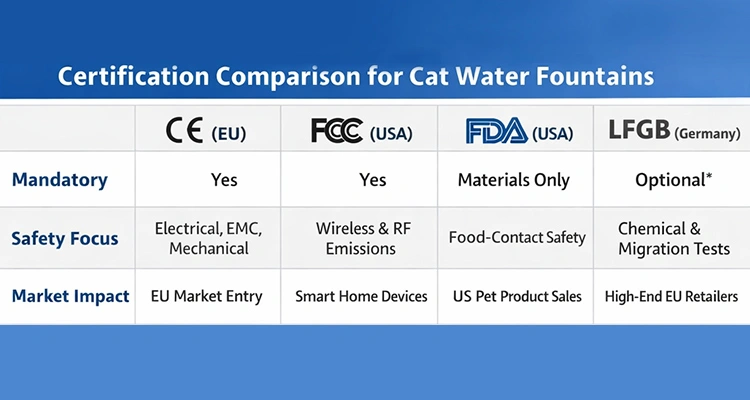
- Mandatory: Without these, your product cannot legally enter or stay in the market
- Common: Frequently requested but often misunderstood or misapplied
- Optional: Not legally required, but demanded by certain retailers or premium brands
- Misused: Advertised, rarely relevant, sometimes misleading
This distinction is critical. Compliance decisions should always be market-driven, not marketing-driven, because overlooking this nuance is where many OEM projects run into unexpected delays or costs.
How OEM Buyers Should Evaluate Pet Water Fountain Certifications
Instead of asking “What certificates do you have?,” experienced buyers focus on relevance and applicability:
- Does this certification apply to my exact structure and components?
- Is it valid for my target market and sales channel?
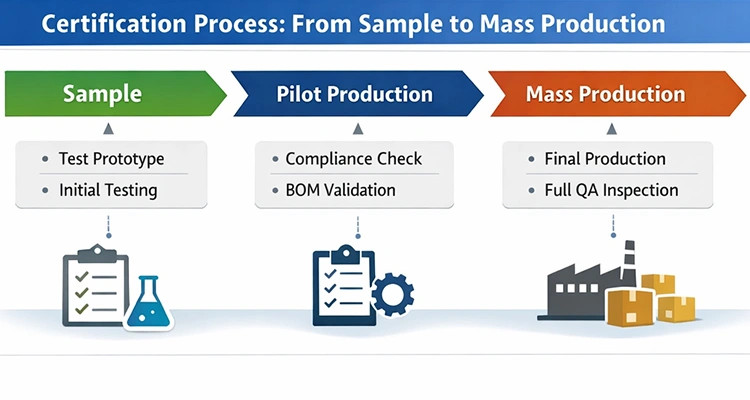
- Does it still match the final BOM used in mass production?
This mindset is core to cat water fountain certification requirements, especially for private label brands, where legal responsibility rests with the brand owner, not the factory.
CE Certification for Cat Water Fountains (EU Market)
For products sold in Europe, CE marking is unavoidable—yet it is often misunderstood or oversimplified. Many suppliers treat CE as a checkbox rather than a reflection of full regulatory compliance.
CE Requirements for Pet Water Fountains: Safety, EMC & Structure
CE is not a single test or document. It represents compliance with multiple EU directives, including:
- Electrical safety standards
- Electromagnetic compatibility (EMC)
- Mechanical and structural safety
For cat water fountains, this usually involves:
- Power supply
- Internal electronics
- Enclosure design
- Water-contacting components
CE marking is more than a logo—it legally signifies that your product meets EU health, safety, and environmental protection requirements. You can refer to European Commission CE Marking Guidance for authoritative reference.
Is CE Mandatory for Pet Water Fountains Sold in the EU?
Yes—but with nuance. The key question is: Does this configuration and market require CE certification?
CE compliance must reflect the final assembled product, not just individual components. This distinction is crucial for cat water fountain certifications for EU projects and exporting cat water fountains to Europe compliance scenarios.
The EU’s General Product Safety Regulation (GPSR), effective December 2024, expands safety requirements and harmonizes compliance expectations across the EU—underscoring why early alignment on certification strategy is essential.
FCC Requirements for Cat Water Fountain Electronics
As pet water fountains increasingly integrate smart features, FCC compliance becomes a common blind spot for OEM buyers. Ignoring this early can mean costly delays or product recalls.
FCC Certification for Pet Water Fountain Wi-Fi Modules
Many suppliers rely on pre-certified Wi-Fi modules. Reality check: FCC focuses on system-level wireless module compliance, not modules alone.
Integration into a new enclosure with a different power layout or antenna environment requires reassessment to ensure the final product meets FCC standards.
Which Parts of a Cat Water Fountain Are Covered by FCC?
FCC requirements typically apply to:
- Wi-Fi or Bluetooth modules
- Control boards and signal lines
- Power management circuits
Using a certified module does not automatically make the final product compliant. This is a frequent cause of failed audits for pet water fountain certifications for global brands.
For products with smart home integration, you can reference cat water fountain FCC compliance for smart home integration to ensure wireless features meet FCC Part 15 emission and certification requirements—preventing surprises after launch.
Pet Water Fountain FDA Compliance (US Market)
FDA compliance is often misunderstood, even by seasoned OEM buyers. Many assume there is a formal approval for finished cat water fountains—but that’s not how the system works.
Understanding the nuances can prevent costly setbacks and ensure your products reach US customers safely.
FDA Approval for Cat Water Fountain: What It Really Means
There is no FDA certificate for finished products. Instead, compliance focuses on processes and materials, including:
- Food-contact materials
- Manufacturing hygiene
- Traceability
- Documentation
Overlooking these requirements is a major pet water fountain compliance risk for US brands.
Many brands assume a simple report is enough, but the reality is that true compliance depends on careful supplier validation and consistent manufacturing practices.
FDA compliance is especially tied to food-contact materials.
For those aiming to fully understand material safety, you can find essential food-grade testing for cat water fountains helpful, as it outlines the critical steps OEM buyers should confirm before production begins.
US manufacturers and importers also need to issue a General Certificate of Conformity (GCC) according to CPSC requirements, making documentation a vital part of the compliance puzzle.
Do Cat Water Fountains Need FDA Approval in the US?
The FDA does not approve products directly—it regulates materials and processes. True compliance relies on:
- Proper material testing
- Supplier declarations
- Consistent manufacturing controls
Brands that align early with these requirements often avoid delays at customs, product recalls, and regulatory headaches. This practical approach keeps your cat water fountains market-ready from the start.
LFGB Certification for Pet Product Materials
LFGB certification is closely associated with premium European pet products. While it is sometimes confused with FDA, it emphasizes stricter material-level assurance for chemical migration and safety.
LFGB vs FDA for Pet Water Fountains: Key Differences
- FDA: Regulatory framework focused on US food-contact materials and manufacturing hygiene
- LFGB: Strict migration and chemical testing standards favored by premium EU buyers
Brands targeting high-end European markets often request LFGB to signal quality and safety to consumers, giving them a competitive edge.
Is LFGB Required for Cat Water Fountains in the EU Market?
Legally, LFGB is not always mandatory. Commercially, however, it is frequently requested for premium positioning.
For mass-market sales, CE compliance may be sufficient, but having LFGB can strengthen your product’s perception of safety and quality.
Pet Water Fountain Certifications for Global Markets
As brands expand internationally, compliance requirements multiply. Navigating these rules requires both strategic planning and practical knowledge of regional certifications.
RoHS Compliance for Cat Water Fountains
RoHS restricts hazardous substances in electrical products and is often confused with CE certification. Its focus is on material composition, not overall safety or EMC.
For brands exporting to Europe, you might find RoHS and CE compliance for cat water fountains exported to Europe helpful when aligning your sourcing strategy.
UKCA Certification for Pet Water Fountains After Brexit
Following Brexit, UKCA has replaced CE marking in many cases.
While the technical requirements are similar, documentation and declarations must be maintained separately for the UK market.
Awareness of this distinction helps avoid shipment delays and ensures smooth market entry.
Common Certification Mistakes OEM Buyers Should Avoid
Even seasoned OEM buyers sometimes stumble over cat water fountain certifications. Small oversights or misinterpretations can lead to delays, unexpected costs, or worse—regulatory trouble after launch.
Misused or Overclaimed Certifications in Cat Water Fountain Projects
Common errors include:
- Treating RoHS reports as CE compliance
- Using outdated or mismatched test reports
- Certifying samples that differ from mass production
Many compliance issues stem from the fact that samples pass, but mass production changes silently. Subtle variations in materials, assembly, or components can invalidate previously held certifications.
You might find cat water fountain sample vs mass production insights helpful when planning your own sourcing strategy, as they reveal the hidden risks before scaling.
How Trusted Manufacturers Manage Pet Water Fountain Certifications
Reliable partners know that execution matters more than credentials. Certifications are only meaningful when integrated into structured processes and enforced consistently across the entire production cycle.
Our Internal Process for Managing Pet Water Fountain Certifications
A trusted approach includes:
- Market-specific compliance planning
- BOM locking before testing
- Sample-to-mass-production consistency controls
These steps ensure that brands managing cat water fountain compliance for private label brands can rely on stability and traceability—because liability cannot be outsourced.
This level of diligence is precisely why global brands work with a reliable OEM cat water fountain partner like Petrust®, who aligns engineering, QC, and regulatory standards from start to finish.
Pet Water Fountain Certifications Checklist for OEM & Global Brands
Pre-Production Certification Checklist for Cat Water Fountain OEM Orders
Before approving mass production, confirm:
- Target market and sales channel
- Applicable safety and material standards
- Test reports match the final BOM
- Documentation supports audits and inspections
Download our full OEM Cat Water Fountain Compliance Checklist PDF to see how every detail aligns with the standards you need.
This checklist clarifies what certifications are required for cat water fountains and helps prevent costly mistakes before they occur.
Remember, certification alone doesn’t guarantee compliance—QC enforcement is what makes it real. You can reference pre-shipment QC testing for cat water fountains to ensure that what leaves the factory meets both the law and your brand promise.
FAQ
Which cat water fountain certifications are truly essential before launching your product? For buyers navigating international markets, the answers are often more nuanced than suppliers admit.
1. Do cat water fountains need FDA approval?
FDA oversight focuses on materials and processes rather than the finished product. Ensuring your components meet FDA standards protects both your brand and end users.
2. Is CE certification mandatory for pet water fountains?
For entry into the European Union, CE certification is required and must match the final product configuration—partial compliance reports rarely suffice.
3. What cat water fountain certifications are required for OEM projects?
Requirements like CE, FCC, FDA, and LFGB vary depending on your target market. You can find it helpful to map certification needs against your launch territories to avoid last-minute surprises.
4. Is LFGB required for cat water fountains sold in Europe?
Legally, LFGB is not always mandatory, but premium brands often pursue it to demonstrate higher safety and quality standards.
5. How to maintain certification validity during mass production?
Lock your bill of materials, verify that test reports correspond with the final units, and implement consistent QC inspections to ensure ongoing compliance.
6. Which certifications are mandatory for US, EU, and UK markets?
- US: FDA (materials/process) and GCC compliance
- EU: CE is mandatory, LFGB optional but recommended for premium positioning
- UK: UKCA certification mandatory after Brexit
Common OEM Mistakes to Avoid Before Conclusion
Certification is only one part of the larger OEM puzzle. Many brands face avoidable setbacks by making recurring mistakes—misreading reports, skipping BOM verification, or assuming suppliers automatically handle compliance during mass production.
A closer look at frequent OEM mistakes in cat water fountain projects might be helpful to understand the full range of potential risks and how proactive oversight can save both time and money. Small steps in preparation often prevent major headaches down the road.
Conclusion — Certifications Are Not Paperwork — They Are Risk Control
Certifications go beyond paperwork—they are a vital part of accountability. Reliable manufacturers clarify what applies, what doesn’t, and why each standard matters, guiding your brand safely through complex regulations.
True expertise lies in preventing compliance issues before production even begins, rather than reacting afterward.
or brands ready to secure long-term success, it can be valuable to contact a trusted cat water fountain manufacturer for certification support and see how experienced partners integrate compliance into every stage of OEM production.