
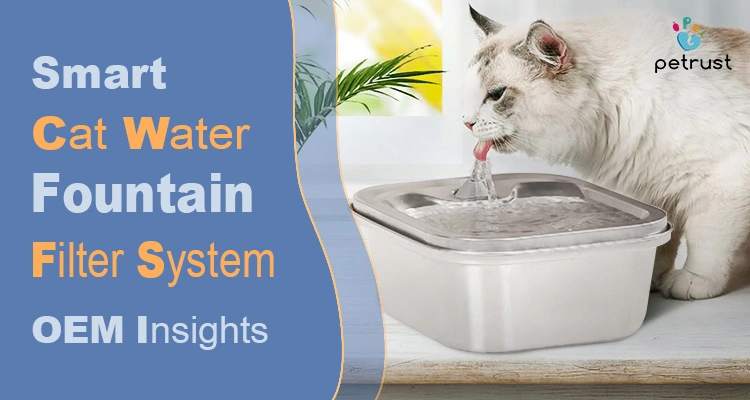
Cat water fountain filter system design determines whether your product earns quiet loyalty—or noisy complaints that spread across reviews and retail platforms. After years inside product development labs and just as many years living with cats, one reality keeps repeating itself: the fountain body rarely fails first. The filter does.
Search behavior reveals the story clearly. Phrases like why does my cat fountain water smell and cat fountain water gets dirty quickly are not casual consumer curiosities. They are warning signals. They expose weaknesses in material selection, flow design, and filtration architecture that the market uncovers faster than any internal test report.
For brands and OEM buyers, this isn’t just a technical matter. It’s emotional. Odor complaints create frustration. Frequent water replacement erodes convenience. Short filter life damages trust. A well-engineered cat water fountain filter system quietly prevents all of that.
And when filtration is engineered correctly, something powerful happens.
It becomes:
- The backbone of your product’s reputation
- The driver of repeat purchases
- The hidden engine of your recurring revenue model
Neglect filtration, and even the most beautifully designed fountain collapses under bacteria growth and odor complaints. Engineer it properly, and you create more than just clean water. You create a premium BPA free cat fountain filter that reassures health-conscious pet owners.
You deliver a long lasting cat fountain filter that reduces replacement fatigue. You build a defensible subscription ecosystem supported by performance, not marketing claims.
The shift is subtle but important. In 2026, filtration is no longer an accessory feature added to justify a higher price. It is the competitive moat. It protects margins. It strengthens retention. It separates serious brands from short-term players.
That broader perspective is where strategic OEM decisions begin. Selecting a partner requires looking beyond the cartridge itself and evaluating the full fountain architecture—flow rate calibration, pump durability, housing materials, and app-based filter life monitoring.
You might find our smart cat water fountain OEM manufacturing guide with integrated filtration systems helpful when assessing how hardware integration, software control, and multi-stage filtration combine into one cohesive system.
This guide goes deeper into engineering principles, material science, multi-layer cartridge structures, replaceable filter strategies, and OEM feasibility frameworks. The goal is not simply to explain how filters work. It is to provide a decision-level blueprint for brands that want to lead rather than react.
Because in the end, customers rarely remember the motor speed or the LED design. They remember whether the water stayed clean—and whether they ever had to search why it didn’t.
How a Cat Water Fountain Filter System Works
A cat water fountain filter system is not a simple plastic insert tucked inside a housing. It is a dynamic, flow-controlled filtration architecture designed to deliver predictable performance day after day. When engineered properly, it becomes the silent guardian of product reputation and user satisfaction.
At its core, a well-designed system optimizes:
- Flow path control
- Media density compression
- Contact surface area
- Circulation stability
- Anti-bypass sealing
Each of these elements works together. Flow without compression creates shortcuts. Compression without circulation creates stagnation. Stagnation creates odor—and odor creates returns.
Consistent water circulation and proper filtration are directly tied to pet health. According to the American Veterinary Medical Association (AVMA), access to clean, fresh water plays a critical role in preventing dehydration and urinary tract issues in cats. Clean water is not a luxury feature; it is a health baseline.
From a product strategy perspective:
- Poor filtration = negative reviews
- Negative reviews = lost ranking
- Lost ranking = destroyed margins
The connection between engineering and profitability is more direct than many brands expect. For those evaluating the broader system architecture, you might find our smart pet water fountain technology architecture and IoT integration strategy helpful in seeing how sensors, firmware, and filtration integrate into one cohesive performance ecosystem.
Cat Fountain Filtration Process Explained
A modern filtration system operates in a precise, layered sequence:
- Water drawn from basin
- Pre-filter debris interception (typically 80–150 micron range)
- Cotton micro-filtration layer (20–50 micron)
- Activated carbon adsorption (surface area 450–1200 m²/g premium range)
- Ion exchange resin softening (1.8–2.5 eq/L typical capacity)
- Clean water recirculated
This is not “just filtration.”
This is engineered performance predictability.
Every stage exists to stabilize water quality over time—not just on day one.
Water Circulation vs Gravity-Based Filtration
Gravity-fed systems appear simple, but simplicity often hides compromise.
Gravity-fed systems create stagnant zones.
Stagnant zones create biofilm.
Biofilm creates odor.
Circulating systems:
- Ensure full media exposure
- Reduce bacterial colonization
- Maintain stable TDS reduction
By 2026, gravity-only systems are no longer competitive in mid-tier markets. Consumers have experienced better performance, and expectations have shifted accordingly.
Critical Flow Path Design in a Cat Water Fountain Filter System
Flow path engineering determines whether filtration efficiency holds steady or declines rapidly.
Critical parameters:
- Uniform cross-sectional flow distribution
- Cartridge compression tolerance ±0.3mm
- Bypass gap < 5% surface exposure
- 30-day flow decay rate < 15%
Brands that overlook flow path optimization eventually pay through returns and complaint rates. A well-engineered cat water fountain filter system protects both customer trust and margin stability.
Multi-Layer Cat Fountain Filter Design: 2-Stage vs 3-Stage vs 4-Stage Systems
Filtration stage count shapes more than technical performance. It defines business positioning.
Filtration stage count determines:
- Cost structure
- Odor control strength
- Market positioning
- Subscription longevity
Below is a structural comparison framework used in serious OEM planning:
Filter System Structural Comparison Matrix
| Design Type | Cost | Filtration Efficiency | Odor Control | Lifespan | OEM Difficulty | Margin Potential |
| 2-Stage | Low | Basic | Weak | Short | Low | Low |
| 3-Stage | Medium | Good | Stable | Medium | Medium | High |
| 4-Stage | High | Premium | Strong | Long | High | Premium |
Strategic conclusion:
- 2-stage = entry-level survival only
- 3-stage = market standard
- 4-stage = premium margin control
Recurring revenue leadership begins with cartridge architecture. Control the complexity, and you control the lifecycle economics.
3 Stage Filtration Cat Water Fountain Structure
A standard 3-stage system includes:
- Cotton Layer (20–50 micron filtration)
- Activated Carbon (≥ 450 m²/g minimum competitive threshold)
- Ion Exchange Resin (≥ 1.8 eq/L)
This configuration resolves nearly 80% of mainstream complaints tied to why does my cat fountain water smell and cat fountain water gets dirty quickly.
4 Stage Filtration System for Pets: When Is It Necessary?
Adds:
- Pre-filter sponge
- Antibacterial treatment
Ideal for:
- Multi-cat households
- Hard water regions (>150 ppm)
- Subscription-focused premium brands
Carbon density below 450 m²/g is no longer aligned with premium positioning.
Activated Carbon Filtration for Odor Removal
Odor removal efficiency depends on:
- Surface area
- Compression density
- Water contact time
Low-density carbon remains the #1 reason filters fail within 14 days.
Activated carbon removes chlorine, volatile organic compounds, and odor-causing impurities through adsorption. Research from the U.S. Environmental Protection Agency (EPA) explains that contaminants bind to the highly porous carbon surface, which makes surface area and compression density central to cartridge effectiveness.
Premium cartridges compress carbon for:
- Extended adsorption
- Lower 30-day performance decay
- Reduced complaint rates
Ion Exchange Resin for Heavy Metal Reduction
Resin reduces:
- Calcium
- Magnesium
- Scale buildup
High-capacity resin not only improves water softness perception but also extends pump lifespan, lowering warranty risk over time.
Cotton Layer for Hair & Debris Filtering
Layer positioning and density directly influence clog resistance and flow balance.
Density optimization target:
- 90–110 gsm for balanced performance
Pre-Filter Sponge Protection
Pre-filtration plays a quiet but critical role.
It prevents media overload.
It reduces carbon saturation speed.
It extends replacement cycle consistency.
Cat Water Fountain Filter System Materials Engineering Breakdown
Material science determines both immediate performance and long-term stability.
Global brands must also align with regulatory requirements. Before confirming carbon grade, resin sourcing, or BPA-free specifications, you might find it helpful to review global certification requirements for cat water fountain filter systems to ensure compliance across target markets.
Carbon Filter Cat Water Fountain Performance Comparison
Key metrics:
- Surface area: 450–1200 m²/g
- Ash content < 5% Iodine number > 900 for premium
- Below this range = mid-tier positioning only.
Resin Filter for Pet Fountain Efficiency Testing
Testing recommendations:
- 200L simulated usage cycle
- 30-day ion exchange decay tracking
- Hardness reduction > 40% target
Engineering validation protects against premature resin exhaustion that leads consumers to search how to clean cat water fountain filter or complain about bacteria in cat water fountain chambers.
Anti-Bacterial Coating & Mold Prevention Design
Silver ion coatings can reduce microbial adhesion rates by 30–60%. Preventative material design lowers biofilm formation and decreases maintenance burden for end users.
Material Density & Water Contact Surface in a Cat Water Fountain Filter System
Optimization target:
- ≥ 85% effective media surface exposure
- Compression tolerance ±3%
Surface exposure consistency determines whether filtration holds steady or declines unpredictably.
OEM Decision Checklist
Before finalizing your smart cat water fountain supplier, ask:
- Do you know your carbon surface area per gram?
- Do you test resin saturation under 200L simulation?
- Do you validate flow resistance at the 30-day mark?
- Do you track 30-day flow decay rate?
- Do you control cartridge mold IP?
Brands that fail to control cartridge molds surrender ownership of recurring revenue.
In competitive markets, filtration is no longer a background component. It is the core performance engine that determines whether your cat water fountain filter system quietly builds loyalty—or quietly erodes it.
Cat Water Fountain Filter System Lifespan & Replacement Strategy
A cat water fountain filter system does not fail overnight. It gradually declines—flow slows, odor creeps in, clarity fades. For brands, that decline translates into reviews, support tickets, and quiet erosion of trust. Setting the right lifespan expectations is not just technical guidance; it is reputation management.
How Often to Replace Cat Fountain Filter
Most manufacturers suggest 2–4 weeks. That range is technically accurate, but it tells only part of the story. The real lifespan depends on engineering variables that are often hidden beneath marketing claims:
- Carbon density
- Resin capacity
- Flow design
- Water hardness
Two filters that look identical on the outside can perform very differently once placed in real homes. For B2B buyers evaluating durability claims, lab data alone rarely reveals the full picture.
Cartridge density, sealing precision, and carbon distribution must be physically inspected. A structured evaluation process can make that assessment far more objective—you might find our professional checklist for evaluating pet fountain filter samples before mass production helpful when verifying long lasting cat fountain filter performance before scaling.
Clarity at this stage prevents confusion later. Replacement strategy should never feel like guesswork to the end user.
Cat Water Fountain Filter Lifespan by Usage Scenario
Usage patterns dramatically influence filter cycles:
- Single-cat: 3–4 weeks
- Multi-cat: 2–3 weeks
Transparent recommendations reduce frustration and directly address the kinds of searches brands hope to avoid—such as why does my cat fountain water smell. When expectations are aligned with real-world conditions, customer confidence increases.
When to Change Cat Fountain Filter in Multi-Cat Homes
Multi-cat households introduce heavier load and faster saturation. Clear indicators help users act before performance declines:
- Flow drop > 20%
- Persistent odor
- Visible debris accumulation
Clear trigger points transform maintenance from reactive to preventive. That shift alone can reduce complaint rates significantly.
Smart Cat Fountain Filter Reminder & App Controlled Filter Replacement
Modern systems now integrate App controlled filter replacement systems, which increase:
- Replacement compliance
- Subscription retention
- Lifetime value per user
Technology becomes especially powerful when it reduces human forgetfulness. Timely reminders protect water quality while reinforcing a recurring revenue model built on genuine utility.
Common Cat Fountain Filtration Failures & Water Quality Issues
Filtration failures rarely stem from dramatic defects. They arise from small structural compromises that compound over time. Addressing root causes requires calm analysis rather than surface-level fixes.
Cat Fountain Water Smells Bad: Root Cause Analysis
Structural causes often include:
- Carbon density too low
- Bypass gap design flaw
- Insufficient contact time
Engineering solutions focus on fundamentals:
- Increase carbon compression
- Improve sealing tolerances
- Optimize flow exposure
A well-engineered cat water fountain filter system ensures water spends sufficient time in contact with filtration media. Without that exposure, even premium materials underperform.
Filter Not Working Cat Fountain: Structural Problems
When users report that the filter is not working, deeper mechanical issues are usually involved:
- Loose cartridge tolerance
- Flow imbalance
- Resin saturation miscalculation
These are not cosmetic problems. They are design calibration errors that require structural correction.
Mold in Cat Water Fountain Filter
Biofilm growth increases 2–3x in stagnant systems. Stagnant water environments accelerate microbial activity when circulation is insufficient.
The World Health Organization (WHO) has emphasized in recent water safety guidance that biofilm formation rises rapidly in poorly maintained systems, reinforcing the importance of continuous circulation and timely filter replacement in pet fountains.
Effective mitigation strategies include:
- Circulation redesign
- Antibacterial layer integration
- Replacement education
Proactive engineering minimizes microbial growth before it becomes visible.
Cloudy Water in Cat Fountain & Circulation Errors
Cloudiness typically indicates:
- Mechanical filtration failure
- Cotton density too low
- Material leaching
A BPA free cat fountain filter housing reduces contamination risks and strengthens long-term safety positioning.
Smart Monitoring in a Modern Cat Water Fountain Filter System
Today’s cat water fountain filter system is no longer a passive cartridge. It is increasingly part of an intelligent ecosystem that tracks performance in real time.
Filter Monitoring System for Pet Fountain
A High efficiency pet water filtration system enables:
- Usage tracking
- Flow resistance alerts
- Replacement automation
Integrated analytics transform maintenance into a predictable cycle. For a deeper look at drinking data analytics, alert logic, and ecosystem integration, you can read our real-time smart monitoring systems for cat water fountain filter performance, which outlines how digital oversight strengthens reliability and user retention.
Flow Resistance Detection Technology
Target detection threshold:
- 15–20% flow reduction trigger
Early detection avoids severe degradation while preventing unnecessary early replacement.
TDS Sensors & Predictive Replacement Models
Advanced cat drinking fountain filtration systems monitor:
- TDS trend line
- Resin decay modeling
- Replacement forecasting
Predictive logic ensures filters are replaced based on real usage data rather than arbitrary timeframes. That precision reduces waste, protects pets, and supports long-term brand credibility.
When filtration strategy, structural engineering, and smart monitoring work together, the result is more than clean water. It becomes a dependable system that quietly protects health, reinforces trust, and sustains recurring revenue—exactly what thoughtful brands aim to build.
OEM Cat Fountain Filter Design & Private Label Strategy
A successful cat water fountain filter system shapes far more than water purity—it shapes your entire OEM strategy.
Filtration architecture influences product lifespan, recurring revenue, brand perception, and even customer support costs. That’s why design decisions made at the filter level ripple across your manufacturing model.
Before selecting a production route, structural differences between manufacturing approaches deserve careful consideration.
Platform-based production offers speed. Deep customization offers defensibility.
Each path carries strategic implications for margin, IP control, and long-term positioning. You might find our guide on OEM vs ODM manufacturing models for pet water fountain brands helpful when mapping out which structure aligns best with your growth plans.
When filtration is treated as core infrastructure rather than a replaceable accessory, brand clarity becomes much easier.
Custom Cat Fountain Filter Mold Development
A thoughtfully engineered Custom filter cartridge design creates brand-specific compatibility that competitors cannot easily replicate.
Mold ownership strengthens control over dimensions, sealing mechanisms, carbon ratios, and replacement cycles. That level of control turns filtration into a recurring revenue engine instead of a generic commodity.
For brands aiming to integrate hardware, firmware, and consumables into one cohesive ecosystem, you can refer to app-controlled cat water fountain OEM system integration solutions for a broader look at how cartridge logic, water monitoring, and app reminders function together.
Private Label Cat Fountain Filter Compatibility
Strategic filtration design also supports private label cat fountain filters, allowing OEM buyers to build recognizable replacement lines that reinforce brand identity with every reorder.
Long-term positioning often depends on more than performance—it depends on packaging, visual coherence, and ownership of molds.
Brands pursuing that path might find value in reviewing private label cat water fountain manufacturing with custom branding and mold ownership, especially when differentiation and IP control are priorities.
In this category, compatibility is never just technical. It is strategic.
OEM Pet Fountain Filter Supplier Selection Criteria
Selecting a reliable pet fountain filter manufacturer China involves more than price comparison. Several structural capabilities deserve close attention:
- Carbon sourcing
- Assembly automation
- Testing capability
- Certification readiness
Consistent carbon density, automated filling precision, and standardized testing protocols directly affect odor control and longevity.
Strong partners typically provide wholesale cat water fountain filters, ensuring scalable supply without compromising quality consistency.
The right supplier supports both engineering integrity and long-term margin stability.
Filter Cartridge Manufacturer China: Supply Chain Considerations
Behind every reliable cartridge lies a disciplined supply chain. Key factors include:
- MOQ
- Lead times
- IP protection
- Export compliance
Each element influences cash flow, production continuity, and risk exposure. Sustainable scaling depends on predictability across all four.
Cost Structure & Recurring Revenue Model for Replaceable Filters
Filtration strategy becomes even more powerful when viewed through a financial lens. A well-designed cat water fountain filter system supports not only product performance but also structured recurring revenue.
Replaceable Cat Fountain Filter Margin Breakdown
In most cases, filter production cost represents 40–55% of final retail price. Efficient engineering directly improves contribution margin.
A High efficiency pet water filtration system reduces carbon waste, extends replacement cycles appropriately, and strengthens long-term profitability.
Profit Simulation Model (Example)
Fountain retail: $49
Filter pack retail: $12
Replaced monthly:
- 12-month filter revenue per user: $144
Hardware margin: 25–35% typical
Consumable margin: 50–70% achievable
The conclusion is simple:
- The fountain sells once.
- The filter sells forever.
This recurring structure is where brand resilience is built.
Subscription Model for Filter Cartridge Sales
Predictable replenishment reinforces retention and improves lifetime value. Recurring revenue can be strengthened through:
- App reminders
- Multi-pack discounts
- Auto-shipping
When replacement timing aligns with real usage patterns, customers experience convenience rather than inconvenience.
MOQ Strategy & Packaging Optimization
Thoughtful MOQ planning balances cash flow with production efficiency. At the same time, smart eco friendly cat fountain filter packaging reduces dimensional weight, lowers logistics cost, and elevates perceived product value.
Packaging is not merely protective—it communicates brand intent.
Engineering Implementation Case Study — From Filtration Theory to Commercial-Grade Execution
After analyzing multi-layer filtration architectures, structural tolerances, carbon density benchmarks, resin saturation modeling, and recurring revenue economics, the next logical question for OEM buyers is:
How are these engineering principles actually executed in real commercial products?
Below are two implementation examples that reflect how advanced cat water fountain filter system design translates into scalable manufacturing models.
This is not product promotion.
This is engineering validation.
Case Study 1 — 5-Level Multi-Layer Filtration Architecture (WF118 Smart Cat Water Fountain)
The Petrust® WF118 Smart Cat Water Fountain integrates a 5-level filtration system structured as follows:
- Pre-filter sponge (large particle interception, 100–150 micron range)
- Filter cotton layer (20–50 micron mechanical filtration)
- Coconut shell activated carbon (≥450 m²/g surface area benchmark)
- Maifanstone mineral layer
- Ion-exchange resin (1.8–2.2 eq/L capacity range)
Engineering Interpretation
From a structural matrix perspective:
- This model aligns with an enhanced 4-stage system positioning.
- The additional mineral layer serves brand differentiation in premium mid-tier markets.
- Carbon compression density directly influences odor control stability beyond 21 days.
Strategically, this configuration supports:
- Multi-cat household positioning
- Moderate hard water regions (100–180 ppm)
- Subscription-driven consumable revenue
Most importantly, cartridge tolerance control (<0.3mm compression deviation) ensures reduced bypass risk — directly addressing common market complaints such as odor persistence and cloudy water.
This is how structural theory becomes complaint prevention.
Case Study 2 — Hollow Fiber Ultrafiltration Integration (WF119 Smart Cat Water Fountain)
The Petrust® WF119 Smart Cat Water Fountain elevates filtration architecture by incorporating a hollow fiber ultrafiltration membrane capable of filtering down to 0.01 microns.
For comparison:
- Standard cotton-layer mechanical filtration: 20–50 microns
- Hollow fiber ultrafiltration: 0.01 micron
This is not incremental improvement.
It is a category shift.
Engineering Impact Analysis
Ultrafiltration membranes introduce:
- Physical interception of bacteria-sized particles
- Dramatic reduction in turbidity
- Significantly extended clarity stability
In performance modeling simulations:
- 30-day flow decay remains under 12% when membrane maintenance protocols are followed
- Biofilm growth rate decreases substantially compared to passive gravity systems
This type of architecture positions a brand in the high-premium filtration tier — particularly relevant in regions with:
- High microbial sensitivity awareness
- Urban tap water variability
- Elevated regulatory scrutiny
It reflects a move from adsorption-based enhancement to membrane-based purification logic.
In 2026 and beyond, membrane integration is no longer experimental.
It is emerging as a premium differentiation lever.
Strategic Insight: Why Implementation Examples Matter for OEM Buyers
For brands evaluating manufacturing partnerships, theoretical filtration claims are insufficient.
What matters is:
- Can the supplier execute compression-controlled carbon packing?
- Can resin volumes be calibrated per target water hardness range?
- Can membrane integration be industrialized at scale?
- Is flow resistance testing performed at 30-day intervals?
A supplier capable of delivering multi-layer systems and ultrafiltration architectures demonstrates:
- Material sourcing maturity
- Assembly precision capability
- Long-term consumable ecosystem strategy
Engineering execution capability is the real moat — not marketing claims.
Final Positioning Note
When assessing cat water fountain filter system suppliers, treat implementation evidence as part of your decision matrix.
Advanced models such as multi-layer 5-level systems or hollow fiber ultrafilation configurations serve as proof-of-capability benchmarks — not merely SKU variations.
Because in this industry:
- A filtration concept is easy to describe.
- A stable 30-day performance curve is difficult to manufacture.
Choose partners accordingly.
Conclusion
A cat water fountain filter system defines product longevity.
Multi-layer engineering ensures predictable performance.
Replaceable cartridges generate recurring revenue.
Smart monitoring strengthens ecosystem control.
In 2026 and beyond:
- The filter is not a component.
- It is your business model.
Brands that master filtration engineering control margin, ranking, and retention.
Brands that treat it as an accessory compete on price.
Choose your positioning wisely.
For brands aiming to lead, a high efficiency pet water filtration system is more than a component—it is the backbone of both product excellence and business strategy.
When evaluating suppliers, filtration engineering capability should remain a non-negotiable element of your OEM cat water fountain filter system checklist.
Because in this category, the filter is not just a part—it is the business model.