
Many buyers assume choosing an automatic cat feeder is mainly about features. Camera or no camera. Basic or connected. Budget-friendly or premium.
But experienced importers, Amazon operators, and private label pet brands know the real decision goes much deeper than that.
The wrong automatic cat feeder model can quietly damage your business through:
- Higher return rates
- Weak Amazon reviews
- Poor customer retention
- Expensive customer support
- Low pricing power
- Difficult brand positioning
- Unstable long-term margins
That’s why more buyers today are comparing not just feeder specifications — but operational fit before placing OEM orders.
In reality, selecting the right feeder configuration is not simply product sourcing.
It is business model design.
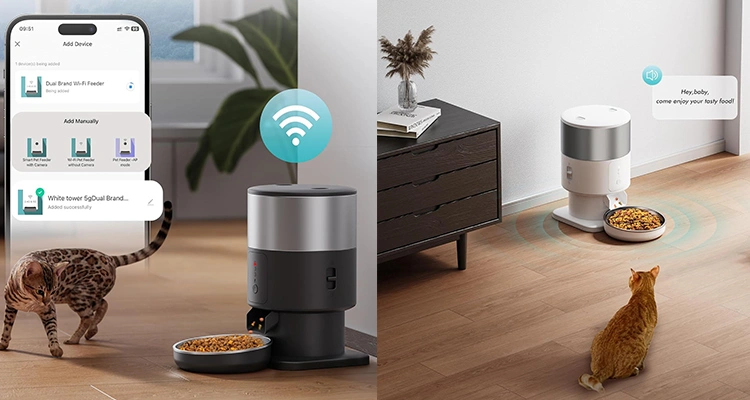
PF07 smart Wifi pet feeder and PF09 smart pet feeder with camera represent two very different business paths inside the smart feeder category.
One is optimized for stable volume sales, lower operational risk, and faster inventory turnover.
The other is built for premium positioning, emotional engagement, and stronger perceived value.
So the real question is not:
“Which feeder is better?”
The real question is:
Which feeder matches your customers, your sales channel, and your operational capability better?
This guide is written for importers, Amazon sellers, distributors, and private label pet brands evaluating which feeder tier makes the most sense in 2026.
After supporting OEM feeder launches across Amazon, wholesale, and DTC channels, one pattern becomes obvious:
The most profitable smart pet products are rarely the ones with the longest feature list. They are usually the products with the fewest operational surprises. And this is exactly where many first-time buyers make a dangerous mistake.
They assume adding more connected features automatically creates a stronger business.
In reality, feature complexity often scales faster than customer support capability.
We’ve seen sellers switch to camera-enabled feeders simply because competitors were launching them.
Three months later:
- Support tickets doubled
- Reviews dropped below 4.1
- Ad efficiency collapsed
- Refund pressure started eating margin
The feeder itself was not necessarily defective.
The business simply was not operationally ready for that level of product complexity.
That is the real procurement world most suppliers never talk about.
Automatic Cat Feeder Model Comparison: PF07 vs PF09 at a Glance
Before diving into detailed business analysis, here’s a quick overview of the biggest differences between PF07 and PF09.
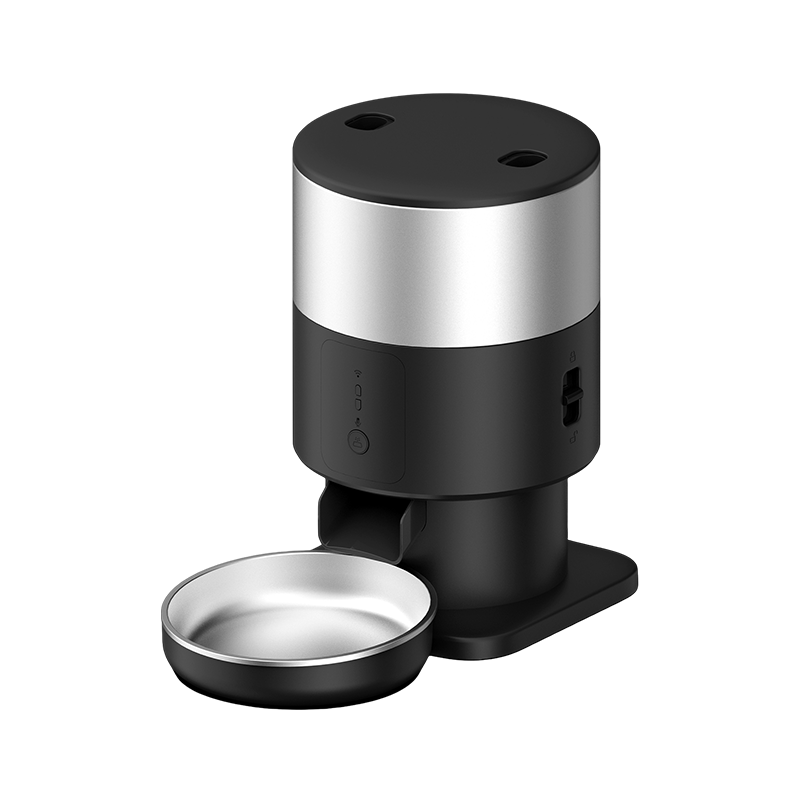
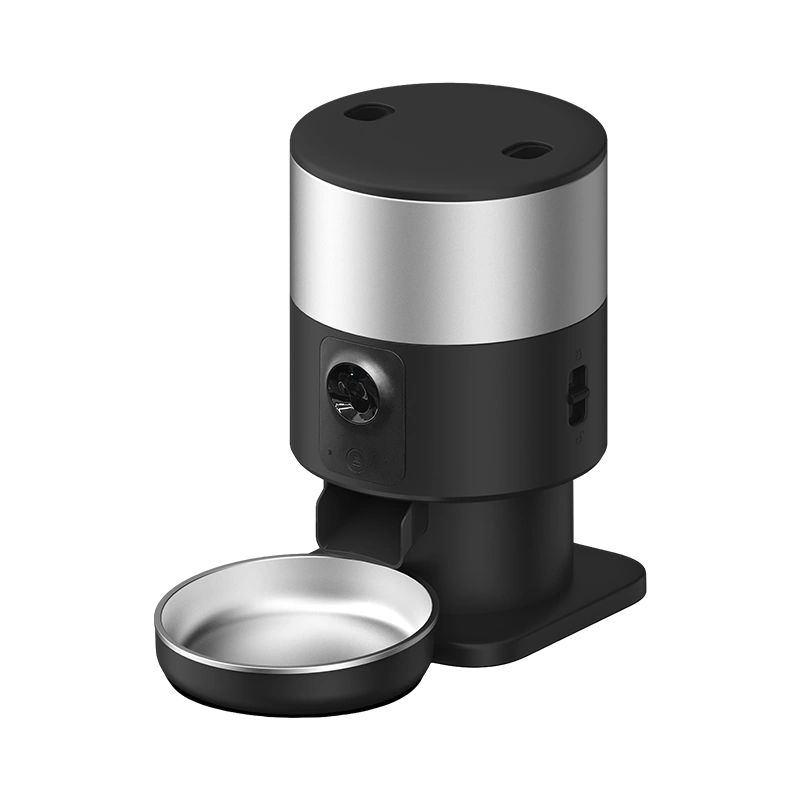
Key Differences Between PF07 and PF09
| Factor | PF07 | PF09 |
|---|---|---|
| Camera | No | Yes |
| App Control | Yes | Yes |
| Target Market | Entry-Level / Mass Market | Premium Smart Pet Market |
| Retail Pricing Potential | Medium | High |
| MOQ Flexibility | Easier | Slightly Higher |
| Support Complexity | Lower | Higher |
| Margin Potential | Stable | Higher Upside |
| Return Risk | Lower | Medium |
| Best For | Amazon FBA, Wholesale | Premium Brands, DTC Brands |
| Customer Experience | Functional | Interactive |
At first glance, both may look like similar connected feeders.
But once you evaluate them through a real ecommerce lens — including return pressure, onboarding friction, customer expectations, and branding potential — the difference becomes much more significant.
This is exactly why experienced importers now conduct deeper OEM feeder comparisons before finalizing product strategy.
If your business model is still unclear, you can refer to Automatic Cat Feeder for Business Models: Amazon, Wholesale & Private Label before selecting a feeder, as choosing the wrong product tier for the wrong channel becomes painfully expensive later.
One of the biggest sourcing mistakes in smart pet products is choosing a feeder based on what looks impressive in a factory showroom instead of what survives real ecommerce operations.
Those are two completely different environments.
PF07 vs PF09 Decision Matrix
This decision framework matters because product selection should match operational maturity — not trend-driven feature demand.
| Business Situation | Better Choice |
|---|---|
| New Amazon seller | PF07 |
| Premium DTC pet brand | PF09 |
| Low support capacity | PF07 |
| Strong content marketing team | PF09 |
| Fast inventory turnover goal | PF07 |
| High AOV strategy | PF09 |
| Price-sensitive markets | PF07 |
| Influencer-driven marketing | PF09 |
| Wholesale distribution focus | PF07 |
| Premium ecommerce positioning | PF09 |
| Lower operational risk priority | PF07 |
| Strong post-sale support team | PF09 |
Many OEM buyers underestimate one uncomfortable reality:
Every additional smart feature also creates an additional support responsibility.
And those problems rarely appear immediately.
Usually they appear after scale begins.
That is when businesses suddenly realize:
The real cost of smart hardware was never the hardware itself.
It was post-sale labor.
Internal Post-Sale Analysis: PF07 vs PF09
Based on post-sale issue analysis from connected feeders shipped to North America and Europe, simpler WiFi feeder series consistently showed lower onboarding friction during early-stage scaling.
Typical Support Pattern Comparison
| Issue Type | PF07 | PF09 |
|---|---|---|
| App Setup Tickets | Low | High |
| WiFi Pairing Questions | Medium | High |
| Camera-Related Complaints | None | Medium |
| Onboarding Time | Short | Longer |
| Return Sensitivity | Lower | Medium |
| Amazon Review Stability | More Stable | More Volatile |
| Support Labor Pressure | Lower | Higher |
This does not mean PF09 is a bad product.
It means premium connected products require stronger operational systems behind them.
That distinction matters enormously.
Especially after scale starts.
Which Customer Segments Fit PF07 and PF09 Better?
Different feeder models attract different types of buyers.
- Price-sensitive Amazon shoppers
- Entry-level private label sellers
- Wholesale distributors
- Supermarket retail programs
- Volume-focused ecommerce stores
- Premium pet brands
- Tech-focused ecommerce brands
- Boutique pet retailers
- Smart home product sellers
- Higher-income customer groups
For buyers supplying distributors or retail chains, understanding this distinction is critical.
A feeder that performs well on Amazon may not perform equally well in boutique retail environments.
Likewise, a premium connected feeder may create stronger branding opportunities while simultaneously increasing onboarding and support expectations.
That is why product selection should match your actual sales channel — not just product trends.
A surprising number of ecommerce brands fail not because the product is bad.
They fail because they imported a product their operations team was never ready to support.
Why PF07 Works Better for Entry-Level Private Label Brands
PF07 is often underestimated because it looks simpler.
But in real ecommerce operations, simplicity is exactly what makes it commercially powerful.
For new importers and fast-scaling marketplace sellers, PF07 often represents a safer entry point into the smart pet category.
In many ecommerce environments:
“Boring but stable” quietly outperforms “impressive but fragile.”
Why This Automatic Cat Feeder Model Is Easier to Scale
Compared with more advanced camera-enabled feeders, PF07 usually requires:
- Less customer onboarding
- Fewer app setup instructions
- Lower after-sales support pressure
- Simpler troubleshooting
- Easier inventory management
For businesses learning how to evaluate feeder lineups, this matters far more than many expect.
A simpler WiFi feeder often produces:
- Better customer reviews
- Faster reorder cycles
- Lower refund rates
- More predictable advertising ROI
Based on support data shared across multiple Amazon-focused OEM launches, simpler connected feeders can reduce customer support tickets by approximately 20–35% compared with camera-enabled units during early scaling stages.
This becomes especially important for brands prioritizing operational stability over feature-heavy positioning.
PF07 is also considered a relatively durable feeder configuration, making it attractive for wholesale buyers focused on repeatability rather than smart-home differentiation.
For many first-time importers, it becomes a safer commercial starting point because it lowers execution risk while still offering connected functionality.
If you are comparing simpler versus feature-heavy feeders from a profitability perspective, Smart vs Basic Automatic Cat Feeder | Profit Margin, ROI & Best Choice Guide for B2B Sellers explains why simpler feeder tiers sometimes outperform premium units in real operations.
In many ecommerce businesses, reducing support workload by even 10% improves profitability more than adding another premium feature.
That sounds counterintuitive until you manage returns at scale yourself.
Many sellers obsess over camera functions.
Six months later they realize the real cost was never the hardware.
It was:
- Support labor
- Refund handling
- Negative reviews
- Marketplace reputation damage
Best Business Scenarios for PF07
Amazon FBA Sellers
Many marketplace sellers prefer simpler connected feeders because they create fewer onboarding frustrations and lower support pressure.
On Amazon, operational efficiency matters almost as much as product quality.
Some sellers also observe that simpler feeder configurations maintain more stable review scores because customers encounter fewer setup failures during first-time use.
Most first-time Amazon sellers do not fail because the feeder is bad.
They fail because they choose a product more complicated than their support system can absorb.
Wholesale & Distribution
PF07 is also effective as an automatic cat feeder for wholesale because distributors often prioritize:
- Stable quality
- Easier customer education
- Lower defect risk
- Faster retail sell-through
Distributors care about repeatability.
A feeder that generates fewer retailer complaints is often more valuable than a feeder with more features.
Entry-Level Private Label Brands
For businesses entering the smart pet market, PF07 offers a balanced combination of:
- Lower sourcing risk
- Easier branding
- Stable pricing structure
- Broad market compatibility
This is why many suppliers consider PF07 one of the safer feeder categories for resale-focused markets.
For buyers still evaluating which feeder lineup is easiest to launch under private label, Which Automatic Cat Feeder Models Are Actually Worth Private Labeling? can help narrow down lower-risk product directions before investing in branding or tooling.
Why PF09 Fits Premium Smart Pet Brands Better
While PF07 focuses on operational efficiency, PF09 is designed for emotional engagement and premium positioning.
This is where many growing brands face a difficult question:
Should you stay volume-focused, or move toward premium branding?
PF09 is built for brands trying to create a stronger customer experience rather than simply selling feeding functionality.
But premium positioning changes your operational reality.
The moment you sell an emotional smart product, customers stop judging only hardware.
They start judging experience.
How Camera Features Change Customer Perception
The biggest difference between PF09 and PF07 is the integrated camera system.
A cat feeder with camera functionality changes how customers emotionally interact with the product.
It creates:
- Higher perceived value
- Stronger emotional attachment
- Better social media appeal
- More premium unboxing experiences
- Greater differentiation from low-cost competitors
This emotional connection is becoming increasingly important in the pet industry.
According to the American Veterinary Medical Association pet ownership research, pet owners increasingly view pets as family members, driving stronger demand for products that improve interaction and monitoring.
Features like camera monitoring and two-way audio also improve engagement for owners spending long hours away from home.
This matters because emotional products usually support higher pricing.
For brands targeting younger ecommerce audiences, camera-enabled feeders often perform better across:
- TikTok
- Amazon listings
- Influencer campaigns
Some premium brands also report noticeably stronger user-generated content performance because customers are more likely to share interactive pet moments online.
However, premium features also introduce new operational realities.
More advanced feeder configurations can increase:
- App setup complexity
- Customer expectations
- Technical troubleshooting
- Connectivity-related returns
This is why many buyers researching connected feeders with camera systems eventually realize the real challenge is not hardware.
It is support infrastructure.
Before choosing a camera-enabled feeder, it is worth reviewing Automatic Cat Feeder with Camera vs Without: Which Model Actually Sells Better?, because many sellers underestimate how camera functions influence onboarding workload, customer expectations, and review volatility.
The more emotionally positioned the product becomes, the more emotionally sensitive customers become to usability problems.
One unstable app update can destroy weeks of review momentum.
One poorly translated onboarding guide can create hundreds of preventable support tickets.
This is the side of smart hardware most sourcing articles never discuss.
Industry Reality Most New Buyers Ignore
Many first-time importers assume:
“If PETKIT and PETLIBRO are pushing camera feeders aggressively, we should too.”
That logic sounds reasonable.
Until you realize those brands also invested heavily into:
- App development teams
- Firmware maintenance
- Customer service systems
- Amazon Vine review management
- Smart home ecosystem integration
Most small and mid-sized private label sellers are not operationally prepared for that level of complexity.
This is where many OEM projects quietly fail.
Not because the product is bad.
Because the backend system behind the product is too weak.
When Automatic Cat Feeder Model PF09 Creates Higher Margins
Many buyers assume premium products automatically create higher profits.
That is not always true.
Premium products only become profitable when branding, positioning, and support systems are aligned correctly.
PF09 can become a very profitable premium feeder tier when used strategically.
For example:
- Higher retail pricing improves margin flexibility
- Better differentiation reduces price competition
- Premium positioning increases customer lifetime value
- Bundling opportunities improve average order value
For brands building premium ecommerce positioning, these advantages matter enormously.
PF09 can also help create stronger brand identity for companies trying to avoid pure price competition.
This is why many businesses evaluating premium OEM feeder projects choose advanced connected models instead of entry-level units.
Some DTC brands also report that camera-enabled feeders support noticeably higher AOV strategies when bundled with accessories, subscriptions, or app-based ecosystem positioning.
However, premium positioning also requires stronger operational maturity.
Without proper support infrastructure, even an excellent feeder can create:
- Refund pressure
- Negative reviews
- App frustration
- Customer trust issues
Brands focused on margin scaling instead of simple order volume should also review How Much Money Can You Really Make Selling Automatic Cat Feeders?, because profitability is often determined more by return rates and positioning than factory pricing.
One hard truth many new premium brands eventually discover:
A premium product without premium support eventually becomes a refund problem.
Which Automatic Cat Feeder Model Is More Profitable in 2026?
Most buyers focus too narrowly on margin.
But real profitability comes from the entire operational structure behind the product.
That includes:
- Advertising efficiency
- Return rates
- Customer support costs
- Inventory turnover
- Customer retention
- Brand positioning
PF07: Stable Volume and Lower Operating Risk
PF07 usually performs better in businesses focused on operational efficiency.
Because it functions as a lower-maintenance cat feeder configuration, it often generates:
- Lower acquisition risk
- Easier onboarding
- Lower support costs
- Faster inventory turnover
For Amazon-focused sellers, this can significantly improve long-term profitability.
Many businesses facing feeder-related return problems eventually discover that simpler product tiers create more stable margins over time.
PF07 may not have the highest ASP.
But it often creates more predictable operational performance.
That consistency is valuable.
Especially in ecommerce.
Cash flow pressure destroys more growing brands than factory pricing ever will.
PF09: Higher Branding Potential but Higher Complexity
PF09 offers stronger differentiation potential.
For brands focused on customer experience and premium positioning, this matters a lot.
Features like video interaction, app-based engagement, and enhanced connected functionality can justify higher retail pricing.
However, premium complexity also increases risk.
Many businesses underestimate issues such as:
- WiFi setup failures
- Firmware update confusion
- Increased support tickets
- Higher customer expectations
This aligns with broader smart device adoption trends.
According to the International Telecommunication Union research on Internet of Things interoperability and connected device ecosystems, connected consumer devices frequently face integration and interoperability challenges that directly affect long-term user satisfaction.
Some ecommerce brands also report that camera-enabled feeders generate more app-related complaints during the first 30 days after purchase — especially when onboarding instructions are unclear or WiFi environments vary between households.
Without proper QC systems and customer education, premium connected feeders may also create more noticeable quality-related complaints.
This is why advanced product tiers require stronger operational maturity.
If you are still unsure which features actually influence reviews and customer satisfaction, 7 Smart Cat Feeder Features That Actually Affect Reviews, Return Rates & Profitability explains which smart functions create real business value — and which ones quietly create operational pressure.
In smart pet products, feature complexity scales faster than most support teams.
That is one of the least discussed — but most expensive — realities in this industry.
Common Mistakes Buyers Make During Automatic Cat Feeder Product Selection
One of the biggest sourcing mistakes is choosing products based only on feature lists.
Real success comes from matching product complexity to operational capability.
Choosing Smart Features Without Customer Support Capacity
Many buyers choose advanced feeder systems simply because the feature list looks impressive.
But a camera-enabled connected feeder also requires stronger support resources.
If your business cannot handle:
- App onboarding
- Connectivity troubleshooting
- Firmware questions
- Smart feature education
then advanced product tiers may generate serious support problems.
This becomes especially dangerous for new sellers entering the smart pet industry without experienced post-sale systems.
After supporting over 120 OEM feeder projects across Amazon, retail, and distribution channels, one recurring pattern becomes obvious:
Businesses usually underestimate support workload far more than manufacturing difficulty.
And that mistake becomes brutally expensive at scale.
We’ve seen ecommerce sellers spend months negotiating $1 lower factory pricing — then lose far more money through refunds, review damage, and overwhelmed support teams after launch.
Using the Wrong Automatic Cat Feeder Types for the Wrong Market
Different markets require different product strategies.
A premium connected feeder may work well for DTC ecommerce brands but fail in discount retail channels.
Likewise, entry-level feeder configurations may struggle inside premium branding environments.
This is why understanding different automatic cat feeder types matters during any serious sourcing decision.
The wrong product-market match can damage:
- Conversion rates
- Reviews
- Repeat purchase rates
- Brand perception
In real sourcing environments, one of the most dangerous OEM mistakes is choosing a product your customer service team is not operationally ready to support.
Ignoring Return Rates When Comparing OEM Automatic Cat Feeder Models
Many importers focus too heavily on factory pricing.
Experienced buyers know return rates often matter more than initial unit cost.
This is especially true in ecommerce environments where customer expectations are highly sensitive to usability and reliability.
Research from the United States Census Bureau on ecommerce customer behavior and online retail growth highlights how online retail environments place increasing pressure on product consistency and post-purchase experience.
When evaluating feeder suppliers or connected feeder lineups, buyers should carefully review:
- Historical defect rates
- App reliability
- Motor durability
- Customer complaint patterns
- Packaging protection
- QC systems
Some suppliers report that onboarding confusion alone contributes to a meaningful percentage of avoidable returns in connected feeder categories — especially when app pairing instructions are poorly localized.
This is where many businesses fail to conduct a serious quality-risk review before ordering.
Ignoring these details often leads to:
- Camera feeder return problems
- Poor customer experience
- Increased refund pressure
- Negative marketplace reviews
Many of these failures are preventable.
You can refer to Automatic Cat Feeder Problems That Quietly Destroy Amazon Ratings before finalizing a supplier, because many operational risks never appear on factory quotations.
A low factory price improves short-term margin. A low return rate improves the entire business.
And one more uncomfortable truth:
Most buyers only start caring about return-rate risk after their first marketplace suspension scare.
PF07 vs PF09: Which Feeder Model Fits Your Business Better?
Prioritize lower return rates | Sell primarily through Amazon FBA | Have a smaller customer support team | Need faster inventory turnover | Want lower operational complexity | Prefer easier onboarding and lower refund risk | Target price-sensitive ecommerce customers | Focus on scaling volume efficiently
Are building a premium pet brand | Focus on higher perceived value | Invest heavily in content marketing | Target younger tech-focused buyers | Can support app-related customer service | Want stronger differentiation in crowded markets | Prioritize higher AOV and branding potential | Have operational systems capable of handling advanced smart features

For many growing brands, this self-assessment framework becomes more useful than simply comparing feature specifications.
The smartest sourcing decisions usually happen when businesses become brutally honest about their actual operational capability.
Not their ambition.
Not their competitor envy.
Their real capability.
Questions Every Buyer Should Ask Before Selecting a Model
If you are evaluating automatic cat feeder lineups in 2026, start by asking:
- Who is your target customer?
- What retail price range are you targeting?
- Do you have customer support capability?
- Are you building a premium brand or a volume business?
- Will camera features improve your actual conversion rate?
- What is your acceptable return rate?
- Are you prioritizing margin or scale?
Successful importers treat sourcing as business system design — not just product purchasing.
The real procurement world is not won by companies with the longest feature lists.
It is usually won by businesses with the fewest operational surprises.
Which Automatic Cat Feeder Model Fits Amazon, Wholesale, or Retail Better?
Different channels require different feeder strategies.
Amazon & Ecommerce
For ecommerce-focused sellers, operational simplicity often matters more than excessive functionality.
Because marketplace algorithms punish operational instability faster than most new sellers expect.
Wholesale & Distribution
Wholesale distributors usually prioritize:
- Stable QC
- Easier onboarding
- Lower support pressure
- Stronger durability
Distributors care less about “smartest product” and more about “fewest retailer complaints.”
Private Label Pet Brands
For companies building branded feeder programs, differentiation becomes more important.
This is where packaging, camera systems, app experience, and emotional engagement start influencing long-term customer retention.
If your long-term goal is building a recognizable pet brand instead of simply reselling products, How to Build a Profitable Automatic Cat Feeder Brand Without Getting Killed by Returns explains how feeder selection directly affects positioning and customer lifetime value.
Still Comparing Automatic Pet Feeder Models? Read the Full Decision Hub
PF07 and PF09 are only two examples inside a much larger sourcing decision.
The real challenge is understanding:
- Which smart features actually matter
- Which feeder tiers reduce return rates
- Which models fit Amazon vs wholesale
- Which designs improve customer retention
- Which suppliers provide stable OEM support
- Which products fit your long-term business strategy
If you are conducting supplier comparison or evaluating OEM feeder manufacturers, you need a broader decision framework than simple specification comparison.
That is exactly why we created:
This complete decision hub helps buyers evaluate:
- Product positioning
- Smart features
- OEM capabilities
- Supplier reliability
- Margin structure
- Long-term scalability
More strategically.
Looking for OEM Cat Feeder Solutions or Private Label Customization?
If you are planning to launch or scale a smart pet brand, choosing the right OEM partner matters just as much as choosing the right feeder lineup.
OEM Automatic Cat Feeder Solutions We Support
As an experienced smart pet product manufacturer in China, Petrust® supports multiple OEM and ODM solutions, including:
- Logo printing
- Custom colors
- App branding
- Gift box design
- User manual customization
- Camera integration
- Voice recording functions
- Packaging optimization
We also support:
- Custom feeder development
- Connected feeder customization
- Branded feeder programs
- Private label smart feeder projects
- Flexible OEM solutions
For growing brands, customization is often essential for differentiation.
MOQ, Lead Time, and Customization Support
When evaluating OEM feeder suppliers, buyers should always verify:
- MOQ requirements
- Production lead times
- FCC and CE certification support
- QC systems
- Packaging standards
- App stability
- Factory communication efficiency
Many experienced buyers now also ask whether the feeder ecosystem is built on mature smart-home frameworks like the Tuya ecosystem or ESP32-based connectivity architecture, because interoperability stability increasingly affects long-term customer satisfaction.
Petrust® provides support for:
- OEM packaging
- Packaging customization
- Product testing
- Export certifications
- Private label production planning
Not sure whether your business is operationally ready for a camera-enabled feeder?
Petrust® can help evaluate:
- Your support capability
- Target sales channel
- Pricing strategy
- Return-risk tolerance
- Brand positioning goals
before recommending the right feeder lineup for your business.
Because the best OEM decision is rarely about choosing the most advanced product.
It is choosing the product your business can scale profitably.
Conclusion
There is no universally “best” automatic cat feeder.
There is only the feeder configuration that best fits:
- Your market
- Your customers
- Your pricing strategy
- Your operational capability
- Your support system
- Your long-term brand positioning
PF07 and PF09 represent two very different business paths.
One prioritizes stability, simplicity, and scalable volume.
The other focuses on branding, emotional engagement, and premium differentiation.
The smartest buyers understand that feeder selection is not just a hardware decision.
It is a business decision.
The wrong product tier can increase:
- Refund rates
- Support pressure
- Inventory risk
- Customer complaints
- Brand inconsistency
The right feeder lineup can improve:
- Customer reviews
- Profit margins
- Brand trust
- Repeat purchases
- Long-term scalability
That is why experienced importers evaluate not only features — but also operational fit, supplier capability, onboarding complexity, and long-term scalability.
Smart pet products rarely fail because of features alone.
They fail when product complexity and business capability become misaligned.
And in real ecommerce operations, that misalignment becomes painfully expensive very fast.
If you are still comparing feeder models, OEM options, or supplier capabilities, continue with our full decision hub:
Or contact Petrust® directly to discuss OEM development, operational fit analysis, feeder recommendations, and private label solutions tailored to your actual business goals — not just feature trends.