
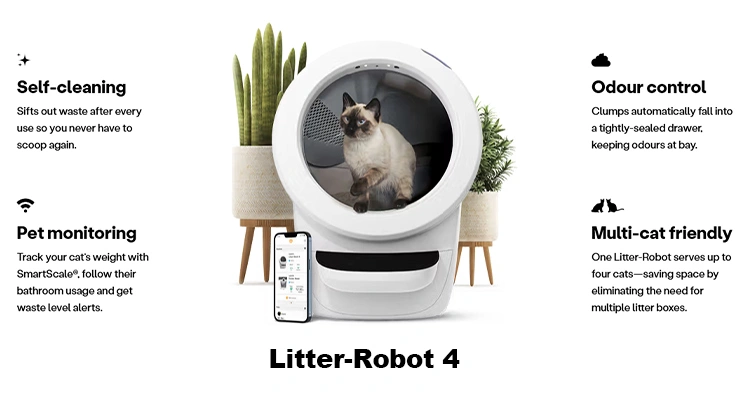
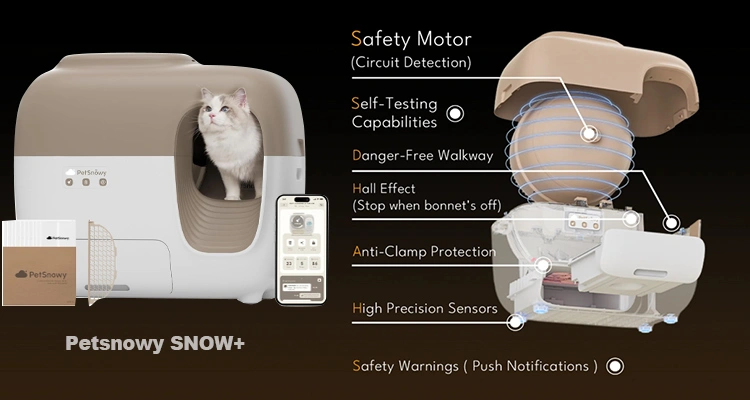
Litter-Robot 4 and PetSnowy SNOW+ solve the same problem in noticeably different ways.
Litter-Robot 4 is built around a mature rotating-globe platform, automated sifting, weight and usage tracking, and a broad ecosystem of accessories and replacement parts. PetSnowy SNOW+ takes a more enclosed approach, putting greater emphasis on litter containment, visual integration into the home, and active odor treatment.
That difference matters more than the feature count.
For cat owners, it affects usable space, litter tracking, odor control, cleaning, maintenance, and how easily a cat accepts the machine.
For pet brands studying the premium automatic litter box category, it reveals something else:
what customers are actually willing to pay for—and which product decisions create complexity after the sale.
This comparison looks at both sides.
First, which one makes more sense as a litter box for your home?
Then, for companies developing their own self-cleaning litter box, what can Litter-Robot and PetSnowy teach you about product architecture, reliability, and OEM specification?
Litter-Robot vs PetSnowy: The Short Answer
There is no universal winner.
The better choice depends on what bothers you most about living with a litter box.
Litter-Robot 4 is particularly strong if you value a mature product ecosystem, multi-cat capability, usage data, parts availability, and a relatively open entrance.
PetSnowy SNOW+ makes more sense if litter containment, enclosure, and its active odor-treatment architecture are higher priorities.
And if you are not buying one unit for your home but trying to create a product under your own brand, this comparison eventually becomes a different decision entirely.
We will come back to that.
Litter-Robot 4 vs PetSnowy SNOW+: Key Specifications
Specification tables are useful, but only if they compare details that actually affect ownership.
A slightly bigger display does not matter much if the machine is unpleasant to clean. One additional sensor means little if the failure logic behind that sensor is poor.
Here are the differences worth looking at.
Litter-Robot currently lists a 15.75 × 15.75-inch entrance, a 22 × 27-inch footprint, and support for up to four cats. Its Whisker app tracks weight and litter-box usage, and its SmartScale system uses weight readings to associate visits with individual pet profiles where possible.
PetSnowy states that SNOW+ works primarily with clumping litter, recommends clay-based clumping litter, and can also accept certain crystal and plant-based alternatives subject to practical limitations. Its FAQ also discusses use by households with up to four cats.
The important point is not to count which column contains more features.
It is to understand what those features mean in daily ownership.
The Biggest Difference Is Not the App—It Is the Product Architecture
At a glance, both machines appear to belong to the same category:
cat enters → cat leaves → machine waits → litter is separated → waste goes into a drawer.
But product architecture determines much more than the cleaning cycle.
It affects:
- how confidently a large cat enters;
- how much litter escapes;
- where urine and dust accumulate;
- how many surfaces need cleaning;
- how odors travel;
- where sensors must be positioned;
- how much torque the motor must handle;
- how easy the unit is to disassemble;
- and how expensive certain failures become.
Litter-Robot 4: accessibility first
Litter-Robot 4 uses a conspicuously large front opening.
That matters.
Cats do not experience the product according to external dimensions. They experience:
entry geometry + internal turning space + head clearance + footing + sound + movement.
The wide entrance makes the machine visually less enclosed and can help cats that dislike narrow covered litter boxes.
Whisker currently describes Litter-Robot 4 as suitable for up to four cats and cats of different sizes.
PetSnowy SNOW+: containment first
PetSnowy’s product philosophy is more enclosed.
That gives the machine a different user experience.
Instead of allowing the shortest possible path from litter bed to room, its structure creates more separation between the cat, the litter chamber, and the surrounding floor.
That can help with:
- visual containment;
- scattered litter;
- some odor migration;
- and integration into interiors where owners do not want a conventional litter box visibly exposed.
But enclosure always introduces a trade-off.
What feels private to one cat may feel restrictive to another.
That is why comparing exterior dimensions alone tells you surprisingly little.
Odor Control: Two Different Engineering Strategies
One of the easiest mistakes in automatic litter box comparisons is saying:
Product A has better odor control.
Odor control is not one feature.
It is a system.
How Litter-Robot 4 approaches odor
Litter-Robot’s basic logic is relatively straightforward:
remove waste quickly → isolate it in a lower drawer → restrict odor leakage.
The waste drawer uses a sealed design and carbon filtration, while Whisker also sells optional OdorTrap products for additional odor management.
This is primarily a waste-isolation strategy.
The strength of the concept is that odor control begins by removing contaminated clumps from the usable litter bed.
How PetSnowy approaches odor
PetSnowy combines waste isolation with a more active treatment option.
Its SNOW+ TiO₂ System is advertised as combining:
- TiO₂,
- UV light,
- and a fan.
That represents a different product philosophy:
contain the litter environment and add an active deodorization subsystem.
Neither approach automatically wins in every home.
The more useful question is:
What maintenance does each odor strategy create?
A carbon filter eventually needs attention.
An active fan and deodorization module add components, airflow paths and surfaces.
A waste drawer seal can accumulate contamination.
An enclosed entrance can retain odors differently from an open entrance.
And none of these systems eliminates the need to clean areas that come into contact with litter, urine or fecal material.
Odor performance is partly an engineering question and partly a maintenance question.
That distinction gets lost in most spec sheets.
Which One Gives Cats More Usable Space?
A large automatic litter box can still feel small.
A smaller machine can sometimes provide a surprisingly usable litter bed.
That is because:
external footprint ≠ usable cat space.
For cats, what matters includes:
- entrance width;
- entrance height;
- litter-bed dimensions;
- headroom;
- turning radius;
- wall angle;
- floor angle;
- entry height;
- and whether any tunnel or enclosure must be crossed.
There is behavioral evidence behind that design concern. A 2025 study published in the Journal of Veterinary Medical Science found that the cats observed showed a preference for litter boxes measuring at least 50 cm, alongside a preference for clumping clay litter.
The researchers also found that a litter environment combining preferred box size and substrate was associated with more normal elimination behavior. In other words, box dimensions are not merely a packaging or floor-space issue—they can influence whether the cat actually finds the toilet environment comfortable enough to use consistently.
Litter-Robot 4’s opening measures approximately 15.75 × 15.75 inches according to Whisker’s current specification.
That generous opening is one of its practical advantages.
PetSnowy’s more enclosed architecture creates a different experience. The trade-off is fairly intuitive: extra containment around the entrance can help control the mess outside the box, but it also makes entry geometry more important.
For a petite cat that prefers covered litter boxes, this may be insignificant.
For a very large cat—or one that dislikes confinement—it deserves more consideration.
When choosing either product, do not ask only:
Will my cat physically fit?
Ask:
Can my cat comfortably enter, turn, posture and leave without feeling constrained?
That is a better question.
Litter Tracking: PetSnowy Has a Structural Advantage
Litter tracking is not solved by software.
It is largely a mechanical and behavioral problem.
When a cat leaves a litter bed, granules can remain:
- between paw pads;
- on fur;
- at the entrance;
- on the step;
- or on surfaces immediately outside the machine.
Litter-Robot 4 includes a fence and step intended to reduce litter tracking. Whisker specifically markets these features as part of its tracking-control design.
PetSnowy takes the idea further structurally.
Its more enclosed exit path gives litter additional opportunity to leave the paws before the cat reaches the surrounding floor.
For households where litter scatter is one of the main reasons for buying an automatic system, that difference should not be dismissed as cosmetic.
It may matter more than an extra app feature.
There is a broader product-development lesson here too:
some of the most valuable smart-pet-product features are not electronic at all.
A good entrance, mat, slope, drawer, seal or cleaning surface can create more everyday value than another sensor added to the specification sheet.
Cleaning and Maintenance: The Part Comparison Tables Usually Miss
Automatic litter boxes remove scooping.
They do not remove maintenance.
That distinction becomes much more obvious after several months.
A new product in a showroom is clean, dry and mechanically fresh.
A real litter box eventually encounters:
- litter dust;
- fine particles inside moving interfaces;
- sticky clumps;
- fur;
- waste residue;
- scratches;
- liner wear;
- odor absorption;
- sensor contamination;
- and repeated mechanical load.
This is where product design starts to matter differently.
With Litter-Robot 4
Owners need to consider surfaces such as:
- the globe;
- liner;
- waste opening;
- drawer;
- drawer sealing area;
- filters;
- sensors and surrounding areas;
- step and fence.
Whisker has an established ecosystem of replacement items and accessories around the platform, which is an advantage if the machine is expected to stay in service for years.
With PetSnowy
The more enclosed construction can help keep litter inside the system, but that also means owners should pay attention to:
- internal tunnel surfaces;
- globe/chamber accessibility;
- waste area;
- odor-system components;
- seams and corners;
- any surfaces exposed to urine or litter dust.
PetSnowy sells a removable replacement globe and describes it as detachable for maintenance and washing, which is an important design consideration rather than a trivial accessory.
Why removable parts matter
For a product that handles animal waste every day, the question is not:
Does the unit look seamless?
It is:
Which dirty part can I actually reach?
Beautiful industrial design can become frustrating if critical contaminated areas require excessive disassembly.
That is one of the most under-discussed differences between a product designed for the showroom and one designed for years of ownership.
What Matters After Six Months—Not on Day One
Most automatic litter boxes look impressive during the first demonstration.
That is the easy part.
A more meaningful question is what happens after repeated exposure to real household conditions.
1. Litter dust
Fine litter particles can migrate into:
- optical sensing areas;
- moving interfaces;
- seals;
- gear-adjacent areas;
- vents;
- and drawer edges.
2. Urine contamination
Cats do not urinate according to CAD drawings.
A cat may aim high, stand sideways, scratch aggressively or repeatedly soil the same area.
Designs need to tolerate behaviors that do not appear in a marketing animation.
3. Litter sticking
Clumping performance varies by:
- litter material;
- moisture;
- urine volume;
- cycle delay;
- litter depth;
- liner surface;
- and ambient conditions.
A system that rotates correctly can still produce a bad ownership experience if clumps repeatedly adhere to the interior.
4. Liner and surface wear
Flexible liners move, flex and get scratched.
Hard surfaces accumulate abrasion.
Seals compress.
These are lifecycle issues, not launch-day issues.
5. Sensor contamination
A sensor does not need to physically “break” for system behavior to deteriorate.
Dust, obstruction, installation tolerance or inconsistent readings can be enough.
6. Motor load
The motor does not rotate an empty showroom globe forever.
It operates with:
- several kilograms of litter;
- changing litter distribution;
- occasional oversized clumps;
- different litter density;
- and sometimes foreign objects.
That difference matters.
7. Replacement parts
Eventually, something wears out.
A brand with a robust spare-parts strategy can sometimes turn a potential whole-unit replacement into a relatively small repair.
That affects both customer satisfaction and business economics.
A self-cleaning litter box rarely fails because it cannot rotate on day one. The harder question is whether it still senses, seals, rotates and cleans predictably after months of litter dust, urine, hair and repeated mechanical cycles.
For anyone comparing premium machines, this matters more than another line in the specification table.
App, Weight Data and Smart Features
Both products belong to a category where “smart” functionality is becoming expected.
But smart does not mean useful.
For litter boxes, useful data generally falls into a few categories:
- when the box was used;
- how often it was used;
- cat weight;
- cleaning history;
- waste drawer status;
- litter level;
- abnormal events;
- maintenance reminders.
There is a reason usage data can be more than an app gimmick. A 2024 peer-reviewed study indexed by Seoul National University monitored 37 healthy cats and 19 cats with disease using a litter box equipped with an automatic sensor, Wi-Fi data transmission, server-side analysis and mobile reporting.
The researchers found significant differences in elimination frequency and time spent in the litter box between the healthy and diseased groups, suggesting that changes in litter-box behavior may provide useful signals worth noticing over time.
That does not turn a consumer smart litter box into a diagnostic device—and owners should not interpret app data as a veterinary diagnosis. But it does explain why reliable usage tracking can have more practical value than simply adding another dashboard to the app.
Litter-Robot 4 currently provides usage information, waste/litter monitoring and cat-weight tracking through the Whisker app. Its SmartScale system analyzes historical weight readings to associate measurements with pet profiles, although cats with very similar weights can be harder to distinguish.
That is a good example of useful smart functionality because the data is connected directly to an owner problem:
“Has my cat’s behavior changed?”
For manufacturers, there is another lesson.
Adding:
- more charts;
- more notifications;
- more screens;
- more cloud features
does not necessarily create a better product.
Every software feature also creates another place where:
- data can be inaccurate;
- onboarding can fail;
- localization may be poor;
- notifications can become annoying;
- firmware compatibility matters;
- customer support tickets can appear.
The best app is not the one with the longest feature list.
It is the one that reliably answers useful questions.
Safety: Sensors Matter, but Failure Logic Matters More
Almost every automatic litter box now advertises safety sensors.
That statement alone tells you very little.
Safety architecture should be examined as a sequence.
What must the system detect?
Potential signals can include:
- cat weight;
- physical presence;
- proximity;
- motor current;
- abnormal resistance;
- position;
- drawer state;
- and other machine-specific states.
But that is only the first layer.
The more important questions are:
What happens after detection?
Does the machine:
- pause?
- stop?
- reverse?
- delay?
- lock out another cycle?
- issue an alert?
- require manual reset?
And then comes the question many comparison articles never ask:
What happens when a sensor gives the wrong reading?
That is where redundancy and fail-safe logic matter.
For example, a good product-development review would ask:
- Is cat presence determined by one sensing method or several?
- Can the cleaning cycle resume unexpectedly?
- How is abnormal motor current handled?
- What happens after power interruption?
- What happens if the drawer is misaligned?
- Is there mechanical pinch protection in addition to software?
- Are error states obvious to the owner?
- What conditions require manual intervention?
This is why simply writing “multiple safety sensors” in a comparison table is not enough.
For an automatic machine operating around an animal, the response to abnormal conditions matters as much as the sensor count.
What Long-Term Owners Complain About
Public owner feedback can be useful, but it should be treated carefully.
A Reddit post is not a laboratory reliability study.
An Amazon review is not proof that every unit has the same defect.
And a happy five-star review does not prove that a product has no long-term maintenance problems.
The useful approach is to look for recurring types of owner concern rather than turn isolated anecdotes into universal conclusions.
For premium automatic litter boxes in general, repeated long-term concerns tend to cluster around areas such as:
- odor that remains after waste removal;
- litter or urine sticking to internal surfaces;
- deep-cleaning difficulty;
- litter scattered outside the unit;
- sensor errors;
- connectivity;
- liner or consumable wear;
- and the cost or inconvenience of repairs.
That does not mean Litter-Robot or PetSnowy necessarily fails in those ways.
It means these are exactly the areas worth investigating before spending several hundred dollars on any automatic litter box.
After-sales support also deserves more weight than it usually receives.
A complicated product will eventually generate questions.
Whisker’s current Litter-Robot ecosystem includes warranty support, parts, filters, liners and a substantial accessories catalog. Litter-Robot 4 also includes a 90-day in-home trial for eligible direct purchases.
PetSnowy currently provides a 30-day direct-purchase home trial and offers replacement parts and warranty support under its applicable regional terms.
That is worth comparing alongside odor and app features.
Litter-Robot vs PetSnowy: Which Should You Buy?
The useful answer is not “Product X wins 7–5.”
It is to match the architecture to the household.
Choose Litter-Robot 4 if…
Litter-Robot 4 is the stronger fit if you prioritize:
- a large, open entry;
- multi-cat use;
- weight and bathroom-usage insights;
- an established accessories and replacement ecosystem;
- a 90-day direct-purchase trial;
- and a mature automatic-litter-box platform.
It may also make more sense if your cat already dislikes heavily enclosed litter boxes.
Choose PetSnowy SNOW+ if…
PetSnowy deserves stronger consideration if you prioritize:
- a more enclosed appearance;
- litter containment;
- a longer physical exit path;
- active TiO₂ + UV + fan odor-treatment options;
- and a product that visually hides more of the litter-box environment.
Its architecture addresses some of the mess around the litter box more aggressively than an open-front design.
Consider neither if…
An automatic litter box is not automatically the right answer.
Consider a conventional box or simpler system if:
- your cat strongly rejects enclosed or moving litter boxes;
- you want the lowest possible mechanical and electronic complexity;
- deep-clean simplicity matters more than automation;
- you do not want to depend on sensors, motors or software;
- or the purchase price is difficult to justify for your household.
And there is another situation where neither consumer product is the correct answer:
you are trying to launch a litter box under your own brand.
That requires an entirely different comparison.
If You Are a Pet Brand, This Is a Different Decision
Buying a litter box and building a litter box business are two different decisions.
A consumer asks:
Which product should I buy?
A pet brand should ask:
Which product decisions should we understand before we decide what to build?
Litter-Robot 4 and PetSnowy SNOW+ are useful benchmarks because both demonstrate that premium customers will pay for something beyond “automatic scooping.”
But copying either product feature-by-feature would be the wrong lesson.
The more useful exercise is to understand which customer problem each design solves particularly well.
What Litter-Robot Gets Right From a Product Strategy View
From a product-development perspective, Litter-Robot demonstrates several important principles.
1. A platform can be more valuable than a model
Litter-Robot is not just a rotating machine.
Around the product is an ecosystem of:
- app functionality;
- consumables;
- filters;
- liners;
- accessories;
- replacement products;
- warranty support;
- and upgrade paths.
This increases switching cost and can extend customer lifetime value.
2. Repairability affects brand value
Customers spending hundreds of dollars on an appliance do not want every fault to mean:
replace the entire machine.
An ecosystem that supports parts, maintenance and component replacement can protect both customer confidence and after-sales cost.
3. Health-related data can raise perceived value
Weight and toilet-use data turns a cleaning appliance into something closer to a pet-monitoring device.
That does not make the product a medical instrument.
But it increases the number of reasons an owner may keep opening the app.
4. Accessibility matters
A large entrance solves a very basic problem:
the cat must actually use the machine.
There is little value in sophisticated automation if the animal refuses the product.
What PetSnowy Gets Right
PetSnowy demonstrates a different set of product lessons.
1. Litter tracking can be solved structurally
Instead of relying only on a small step or separate mat, the enclosure itself becomes part of the litter-containment system.
That is good product thinking.
2. Visual design is a feature
Consumers do not purchase smart pet products only for technical performance.
An automatic litter box is large.
It often sits in:
- a bathroom;
- laundry area;
- hallway;
- utility room;
- or living space.
Making it visually easier to live with has commercial value.
3. Odor control can become a differentiated subsystem
PetSnowy’s optional TiO₂ + UV + fan treatment makes odor management a visible product feature rather than leaving it solely to waste isolation.
Whether a particular household needs that system is another question.
From a positioning standpoint, however, it creates a clear product story.
4. The entrance can solve multiple problems at once
An enclosed entry can contribute to:
- litter retention;
- appearance;
- privacy;
- separation between waste area and room.
That is a useful reminder that strong industrial design often solves several customer problems with one structure.
What Should an OEM Buyer Copy?
Neither product.
Copy the problem-solving logic, not the product.
If you are developing a private-label self-cleaning litter box, Litter-Robot and PetSnowy should be treated as benchmarks—not templates.
A brand should be asking:
Which customer problem are we trying to solve better than the existing market?
That question leads to a very different specification process.
What Buyers Should Benchmark—and What They Should Not Copy
The key word here is benchmark.
A competitor tells you where the market already is.
It should not decide where your product goes next.
Manufacturer's Note: More Features Create More Failure Modes
The feature that looks strongest on a comparison chart is not always the feature that creates the strongest product.
Cameras, UV modules, larger displays, extra motors and additional sensors can all improve differentiation.
They also add:
- components;
- wiring;
- connectors;
- firmware;
- assembly operations;
- BOM cost;
- validation requirements;
- certification considerations;
- and possible after-sales failures.
That creates a simple OEM rule:
Do not ask only, “How many features can we add?” Ask, “Which features can survive mass production and remain reliable after thousands of customer-use cycles?”
A camera may help a premium model sell.
But it also brings:
- imaging hardware;
- connectivity requirements;
- app integration;
- firmware;
- privacy considerations;
- storage decisions;
- additional test items.
UV can differentiate an odor system.
But it also introduces:
- component lifetime;
- mounting;
- electrical design;
- shielding;
- control logic;
- certification implications.
A larger screen looks premium.
But it also adds another supplier, another assembly operation and another component that can fail.
Feature count is a marketing metric.
System reliability is a product metric.
OEM buyers should not confuse the two.
What These Products Reveal About Premium Litter Box Pricing
Why can an automatic litter box sell for several hundred dollars when a basic plastic litter tray costs a fraction of that?
It is tempting to answer:
Because it contains motors, sensors and electronics.
That is incomplete.
Premium pricing is not created by BOM alone.
Customers are paying for a bundle of perceived outcomes:
Convenience
No daily scooping—or significantly less manual work.
Odor management
Less time with exposed waste inside the litter bed.
Litter control
Less mess around the home.
Monitoring
Information about usage, weight or maintenance status.
Aesthetics
A large pet appliance that is easier to accept inside a modern home.
Safety confidence
Trust that the machine will behave predictably around the cat.
Software
Remote visibility and notification.
After-sales confidence
Someone to contact when a complicated product behaves incorrectly.
Replacement ecosystem
The possibility of repairing or maintaining the machine rather than discarding it.
That matters for brands entering the category.
If the target retail price is $599, $699 or more, the product does not become “premium” because the factory adds $25 of electronics.
Premium positioning requires the whole ownership system to feel premium.
Where Smart Litter Box OEM Projects Usually Go Wrong
This is where competitor benchmarking stops being enough.
A beautiful sample can still become a bad mass-production project.
We have seen enough smart pet product programs to know that the problems rarely begin with one dramatic engineering failure.
More often, several small variations accumulate.
1. Sensor tolerance
Prototype:
sensor works.
Mass production:
sensor position varies slightly across assembly lots.
Now the real question becomes:
How much tolerance does the algorithm and mechanical design allow?
2. Litter dust
A prototype may operate for a few days in a clean testing room.
A customer’s litter box may experience dust every day for two years.
Those are different environments.
3. Motor current
An empty mechanical cycle proves very little.
The drive system needs margin for:
- litter weight;
- density variation;
- uneven load;
- stuck clumps;
- wear;
- temperature;
- and abnormal resistance.
4. Drawer alignment
A small dimensional difference may appear harmless at incoming inspection.
But if it changes:
- waste sealing;
- drawer detection;
- odor leakage;
- or sensor behavior,
it becomes a customer complaint.
5. Urine paths
Urine is one of the fastest ways to expose a design that looked perfect on CAD.
Engineers need to ask:
Where can liquid go if the cat does not urinate exactly where we expected?
6. App stability
A Wi-Fi product is not finished because it connected successfully in the factory.
The actual customer owns:
- different routers;
- different phones;
- different operating systems;
- different passwords;
- different network conditions.
Every one of those differences can become a support ticket.
7. Assembly variation
A sample is assembled with attention.
Mass production is an industrial process.
A design needs to tolerate:
- normal component variation;
- operator variation;
- fixture variation;
- supplier variation;
- and long production runs.
8. Packaging
Automatic litter boxes are large, relatively heavy appliances containing aligned structures and electronics.
Transit can introduce:
- impact;
- vibration;
- compression;
- misalignment;
- cosmetic damage.
A product that passes functional testing before packing can still arrive at the customer’s house as a return.
9. Mass-production drift
This is the problem buyers frequently underestimate.
The approved sample can be good.
The first production batch can also be good.
Then a material changes.
A sub-supplier changes.
A tolerance drifts.
A firmware version changes.
A fixture wears.
The product still looks the same.
The risk has changed.
That is why smart litter box quality control cannot stop at sample approval.
From Competitor Benchmark to Your Own OEM Specification
If you are building a private-label self-cleaning litter box, the process should not begin with:
“Can you make something like Litter-Robot?”
A much better OEM brief starts with commercial and engineering decisions.
Target market
- US?
- EU?
- Japan?
- Korea?
- Multiple regions?
Target customer
- Single-cat household?
- Multi-cat household?
- Large cats?
- Small apartments?
- Premium design buyer?
- High-volume ecommerce buyer?
Target retail price
- $299?
- $399?
- $599?
- $799?
This affects how much product complexity the business can support.
Cat size range
What animal weight and physical dimensions need to be accommodated?
Entry philosophy
- Open?
- Semi-open?
- Enclosed?
Litter compatibility
- Clay?
- Tofu?
- Mixed litter?
- Crystals?
Trying to support every litter type can create compromises.
Odor architecture
- Waste isolation?
- Carbon?
- Active deodorization?
- Airflow?
- Combination?
Smart functions
- Wi-Fi?
- Weight monitoring?
- Camera?
- Usage history?
- Multiple pets?
- Cloud storage?
Safety redundancy
Which abnormal conditions must cause an immediate stop?
What happens if one sensor fails?
Waste-drawer target
How frequently should a one-cat household empty it?
Cleaning design
- Which contaminated components are removable?
- Which can be washed?
- Which must stay dry?
Consumables
- Universal waste bags?
- Proprietary liners?
- Filters?
- Odor cartridges?
Return-rate target
This is a question more OEM buyers should put into the development brief.
Because the goal is not:
make a sample that works.
The goal is:
make thousands of units that continue working after they reach customers.
Consumer Product or OEM Platform?
At this point the distinction becomes important.
A consumer brand and an OEM manufacturer are therefore not competing in exactly the same role.
That is why putting Litter-Robot, PetSnowy and an OEM model into one “which product wins?” table can be misleading.
Where Petrust Fits
Petrust is not presented here as a consumer substitute for Litter-Robot or PetSnowy.
Its role is different.
Petrust works with companies developing and sourcing smart pet products under their own brands.
For a self-cleaning litter box project, that conversation can include:
- existing OEM platforms;
- private-label configuration;
- product appearance;
- branding and packaging;
- app configuration;
- camera or non-camera positioning;
- Wi-Fi functions;
- firmware requirements;
- litter compatibility;
- safety logic;
- manufacturing validation;
- quality-control requirements;
- and compliance planning.
The important step comes before model selection.
A buyer should decide what the product needs to achieve commercially and technically.
Only then should the factory decide which existing platform—or which ODM development route—fits that specification.
Do not start with:
“Which model has the most features?”
Start with:
“Who is the product for, what problem must it solve, what retail price must it support, and what failure rate can the business tolerate?”
That produces a much better OEM project.
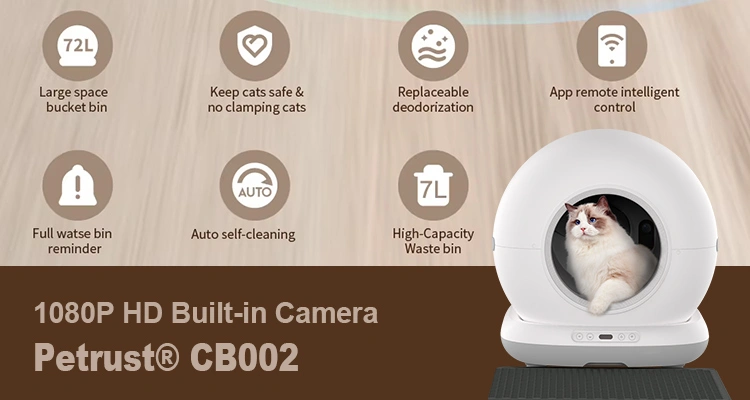
Planning a private-label self-cleaning litter box?
Petrust can review the target market, feature set, customization requirements and production risks before you commit to a model.
How Long Does a Self-Cleaning Litter Box OEM Project Take?
There is no honest single answer such as:
45–60 days.
The timeline depends on what “customization” actually means.
Existing-model private label
Typically involves some combination of:
- logo;
- color;
- packaging;
- manual;
- labeling.
This is fundamentally different from product development.
Configuration customization
May involve:
- App branding;
- UI;
- accessory combinations;
- firmware settings;
- selected functions;
- packaging architecture.
More validation is required.
ODM development
May involve:
- mechanical changes;
- PCB/electronics;
- firmware;
- industrial design;
- tooling;
- new sensors;
- camera integration;
- structural modification;
- reliability validation;
- and new compliance work.
The schedule can therefore increase substantially.
Lead time depends on the customization layer and validation required.
A buyer should be cautious when a supplier gives the same timeline for changing a logo and redesigning a mechanical system.
Those are not the same project.
Compliance: There Is No Single “Smart Litter Box Certificate”
Another common purchasing mistake is asking:
“Does this litter box have CE/FCC/RoHS?”
as though those three acronyms automatically make a product ready for every market.
They do not.
Compliance depends on factors including:
- destination market;
- power architecture;
- wireless technology;
- radio module;
- materials;
- battery configuration;
- electrical design;
- product claims;
- and local regulatory obligations.
For an EU project, for example, the applicable compliance route can involve CE-related requirements under relevant legislation, radio requirements for connected products, RoHS, material obligations, and potentially WEEE or battery responsibilities depending on the configuration.
For a US Wi-Fi product, FCC requirements may be relevant, while electrical-safety expectations can also depend on the product, sales channel and retailer.
So the right OEM question is not:
“Do you have a certificate?”
It is:
“What compliance requirements apply to this exact product configuration in my target market, and what evidence supports them?”
The certificate is only one part of the answer.
To meet regulatory requirements, CE, FCC, and RoHS certifications are essential. For a deeper dive into compliance, you might find the detailed Pet Product Certifications Guide helpful.
Questions Pet Brands Should Ask Before Choosing an OEM Litter Box
Before paying a deposit, ask the factory questions that expose the product behind the specification sheet.
Product architecture
- What cat size was the chamber designed around?
- What litter types were actually tested?
- What is the normal working litter weight?
- What abnormal load can the drive system tolerate?
Safety
- Which sensors prevent movement around the cat?
- What happens if one sensing method fails?
- How is motor overcurrent handled?
- What causes an emergency stop?
- How does the product recover from an abnormal state?
Reliability
- How many cleaning cycles were used in durability testing?
- What failures appeared during testing?
- What was changed because of those failures?
That last question can be more revealing than asking whether the product “passed.”
Cleaning
- Which parts are removable?
- Which parts are washable?
- Where can urine enter?
- How are litter dust and hair managed?
Software
- Which App platform is used?
- Who controls firmware changes?
- What happens if Wi-Fi onboarding fails?
- How are OTA updates managed?
Production
- What are the key CTQs?
- How are motor, sensor and assembly tolerances controlled?
- What final functions are tested before packing?
- How are ECNs controlled after sample approval?
After-sales
- Which modules can be replaced?
- Which replacement parts are stocked?
- What failure data from existing production has changed the product?
This is how you move from:
buying a sample
to:
evaluating a manufacturing platform.
The Bigger Lesson From Litter-Robot vs PetSnowy
Litter-Robot and PetSnowy are interesting to compare because neither became distinctive simply by adding automatic cleaning.
They made different product bets.
Litter-Robot leans heavily into:
- accessibility;
- mature automation;
- monitoring;
- multi-cat use;
- and an ecosystem around the machine.
PetSnowy leans more heavily into:
- enclosure;
- litter containment;
- active odor treatment;
- and integration into the home.
Those differences are more useful than declaring an absolute winner.
For consumers, they help identify which product is likely to fit the household.
For brands, they show something deeper:
premium smart pet products win when engineering decisions solve recognizable customer problems—not when the specification sheet becomes longer.
And that remains true in OEM development.
Do not copy Litter-Robot.
Do not copy PetSnowy.
Understand why customers pay for them.
Then decide what your own product needs to solve.
FAQ About Litter-Robot vs PetSnowy
Related Comparisons and Buying Resources
Instead of opening ten near-identical comparison articles, continue according to the decision you are actually making.
Comparing another premium smart litter box ecosystem?
Read>> Litter-Robot vs PETKIT
Interested in a more open product architecture?
Read>> Litter-Robot vs Neakasa
Choosing a model for your own brand rather than your home?
Read>> Smart Cat Litter Box Manufacturers Compared
For buyers moving deeper into OEM sourcing, continue with Petrust resources covering:
- automatic cat litter box manufacturers in China;
- how to verify a real smart pet product manufacturer;
- sample verification;
- smart litter box quality control;
- pet product certifications;
- and OEM/ODM development.
The next article should depend on the next decision—not simply another keyword variation.
Final Verdict
If you are buying for your home, the difference between Litter-Robot and PetSnowy is easier to understand once you stop counting features.
Litter-Robot 4 is the stronger fit for many buyers who value an open entry, multi-cat positioning, weight and usage intelligence, and a well-developed product and replacement ecosystem.
PetSnowy SNOW+ makes a stronger case for households that prioritize enclosure, litter containment, visual integration and its active odor-control architecture.
Neither is automatically right for every cat.
And neither should be copied blindly by a pet brand.
For OEM buyers, the real lesson from Litter-Robot vs PetSnowy is not which machine gets one more point on a comparison table.
It is this:
Good smart pet products are built around problems customers genuinely care about. Good OEM projects go one step further—they make sure those solutions remain reliable after the sample, after mass production, and after months in the customer’s home.
That is the benchmark worth copying.