
Smart pet market size is one of the first things serious buyers and brand owners look at before entering this space—but numbers alone rarely tell the full story. Behind every growth chart is a more practical question: where is the real opportunity, and where are brands quietly struggling to make margins work?
Spending time researching this industry often leads to two important questions: how big is the smart pet market, and just as importantly, is the smart pet market growing in a way that actually supports sustainable business growth. These are not just data points—they directly influence product decisions, investment timing, and long-term positioning.
Many brands begin by following high-level trends, assuming that fast growth automatically translates into easy success. In reality, that assumption can be costly. Without a deeper view of how demand is shifting across categories, even well-designed products can miss the market.
For those looking to connect broader industry signals with real opportunities, you might find Smart Pet Industry Trends 2026 helpful in framing how the market is evolving beyond the headlines.
That leads to an important reality many founders come to realize only after entering the market:
Growth does not equal profit.
A growing market creates possibilities—but it doesn’t guarantee success for every product or brand. The real advantage comes from seeing where the growth is happening — and where it isn’t, and aligning your strategy accordingly.
This is exactly where most decisions are won or lost. Choosing the right category, identifying gaps in user needs, and avoiding overcrowded segments often matter more than simply entering a “hot” market.
In this guide, we combine data, structural insights, and real buyer cases to help you answer a critical question:
Is smart pet market worth entering — and if yes, where exactly should you position your brand?
Smart Pet Market Size in 2025: Global Snapshot & Key Data
The smart pet market size in 2025 has become a key reference point for founders, investors, and product teams trying to understand where the industry is truly heading—but the numbers only make sense when placed in the context of real buying behavior and shifting consumer expectations.
Behind the statistics, there is a much more practical question many brands quietly wrestle with: where is sustainable demand actually forming, and how can a product realistically fit into it?
Global Smart Pet Market Size by Region (2025 Breakdown)
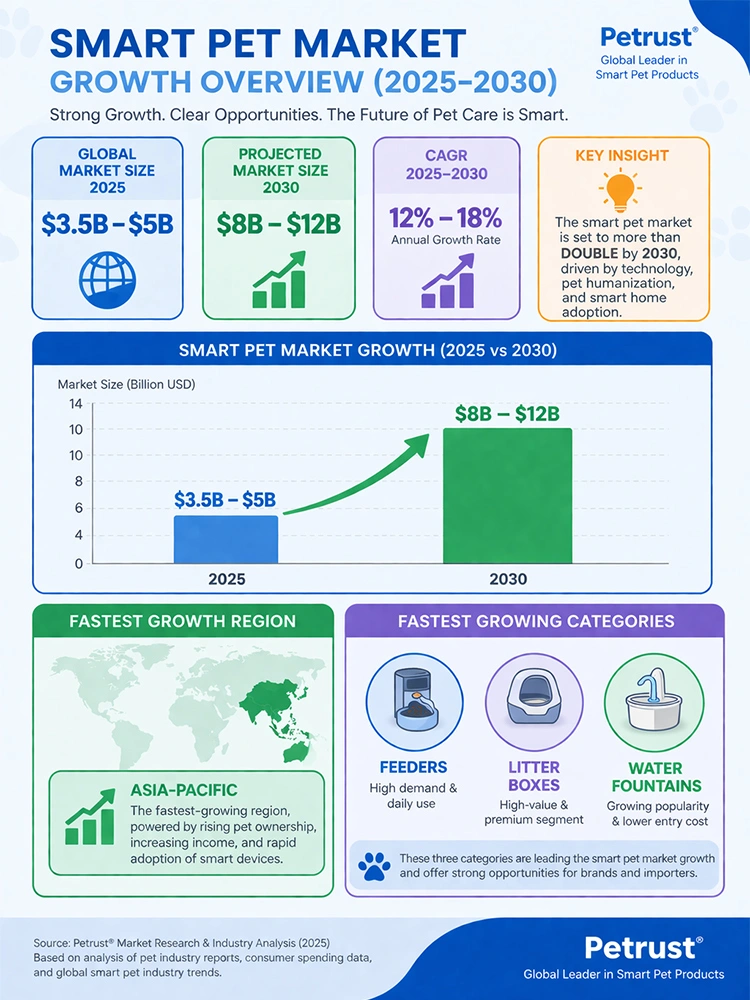
In 2025, the global smart pet market is estimated to sit in the range of $3.5B – $5B, depending on whether analysis focuses on core smart devices or includes the broader pet tech ecosystem.
While the exact figure varies across reports, the direction is consistent: steady, global expansion driven by lifestyle-driven pet ownership.
Regional Breakdown:
| Region | Market Share | Growth Rate | Maturity Level |
|---|---|---|---|
| North America | 35–40% | Medium | Mature |
| Europe | 25–30% | Medium-High | Premium |
| Asia-Pacific | 30–35% | High | Emerging |
This regional movement aligns with broader Pet Tech Industry Statistics (Updated 2026), where Asia-Pacific continues to accelerate while Western markets show more stable, mature growth patterns.
What’s especially important here is how closely this expansion tracks with changes in household spending behavior.
According to the U.S. Bureau of Labor Statistics Consumer Expenditure Survey, pet-related spending has steadily increased over the past decade, reflecting a deeper structural shift in how consumers prioritize discretionary income.
Smart Pet Industry Growth Rate & CAGR Overview
Across most research reports, the smart pet sector is growing at a CAGR of 12%–18%, significantly outperforming traditional pet product categories.
This difference is not accidental—it reflects how quickly pet ownership is becoming more technology-integrated and convenience-focused.
This momentum is driven by several clear forces:
- Increasing pet ownership
- Higher spending per pet
- Rapid adoption of connected devices
At a broader level, this shift is reinforced by global digital infrastructure trends.
The World Economic Forum’s research on the future of the connected world highlights how IoT ecosystems are reshaping everyday living environments, gradually extending into more personalized areas such as pet care automation and home-based monitoring systems.
What This Smart Pet Market Size Means for Buyers
How big is the smart pet market in 2025?
The smart pet market in 2025 is estimated at approximately $3.5B–$5B globally, growing at a CAGR of 12%–18%, with Asia-Pacific being the fastest-growing region.
For B2B buyers and brand builders, this leads to a very grounded takeaway:
Demand exists — but it is not evenly distributed.
In practice, this means success depends far less on entering the market early and far more on understanding what pet products are in high demand and where that demand is still underserved.
Smart Pet Market Forecast (2025–2030): Where Growth Is Actually Coming From
Looking beyond 2025, the direction becomes even clearer—but also more competitive.
Growth continues, yet it concentrates around specific product categories and user behaviors rather than expanding evenly across all segments.
Smart Pet Market 2030 Projection & CAGR Trends
By 2030, the smart pet market is projected to reach $8B–$12B, supported by the continued integration of AI-driven devices and broader smart home ecosystems.
Still, the headline number only tells part of the story. The real transformation is happening beneath it—within how products are designed, connected, and used on a daily basis.
Research from McKinsey & Company notes that IoT and AI-powered automation are fundamentally reshaping how consumers interact with connected environments, creating more seamless ecosystems that naturally extend into pet care and household management.
High-Growth Segments Within the Smart Pet Market
The fastest-growing smart pet product categories include:
- Automatic pet feeders
- Self-cleaning litter boxes
- Smart water fountains
These categories consistently dominate pet product demand forecast for importers because they align with very specific buying motivations:
- Daily usage frequency
- Clear problem-solving value
- High consumer willingness to pay
For a more detailed breakdown of how these categories are evolving, you might find Top Smart Pet Product Trends in 2026 helpful in identifying where momentum is strongest.
Structural Shift Behind Smart Pet Market Size Expansion
What’s becoming increasingly clear is that the expansion of the smart pet market is not simply driven by more products entering the space—it is driven by better product-market fit and more refined consumer expectations.
The market is gradually shifting toward:
- Utility-driven devices (feeding, cleaning, hydration)
- App-connected ecosystems
- Subscription-compatible hardware
This shift also explains why some brands struggle to scale even in a growing market.
Following trends alone is no longer enough—ignoring demand structure often leads to misaligned products and missed opportunities, even in high-growth categories.
Smart Pet Market Size by Product Category (Demand & Growth Breakdown)
When looking at smart pet market size, one of the most practical ways to make sense of it is to break it down by product category.
On the surface, the industry may look unified, but in reality, each segment behaves very differently in terms of demand, competition, and profitability.
For many founders and buyers, this is often where clarity starts to replace guesswork—especially when deciding which product category is worth entering first.
Automatic Pet Feeder Market Size & Demand Trends
Automatic feeders continue to stand out as one of the most stable and scalable segments in the smart pet space.
Their success is not driven by hype, but by consistent, everyday use cases that fit naturally into modern pet ownership routines.
- High repeat demand
- Suitable for multiple markets
- Strong entry point for pet tech products for new brands
This category often appeals to first-time entrants because it balances familiarity with predictable demand patterns.
You might find a deeper breakdown of purchasing behavior and competition dynamics in this Automatic Pet Feeder Market Analysis, especially when evaluating long-term positioning.
Smart Litter Box Market Growth & Adoption
Smart litter boxes sit at the higher end of the market in both complexity and value.
While they require more advanced engineering and stricter certification compliance, they also open the door to significantly stronger margins when executed well.
For brands aiming to move into high margin pet products, this category often represents a strategic upgrade rather than an entry point.
The challenge here is not demand—it’s execution. Products in this segment must consistently meet expectations around reliability, safety, and user experience.
For a more detailed view of adoption patterns and product positioning, you might find Smart Cat Litter Box Market Growth & Opportunities helpful when evaluating whether this category aligns with your capabilities.
Smart Pet Water Fountain Trends
Smart pet water fountains occupy a very different space in the ecosystem. They are often easier to enter and scale, making them especially attractive for emerging brands testing the market.
Key advantages include:
- Lower price points
- Easier market entry
- Broad consumer appeal
Because of this balance, they are often seen among the most promising low competition pet products in early-stage market exploration.
To better understand category positioning and evolving consumer expectations, you can refer to Smart Pet Water Fountain Market Trends, which highlights how demand is shifting across different regions and price tiers.
Pet Camera Market Demand
Pet cameras represent a more mature and competitive category within the smart pet landscape. Demand remains strong, but differentiation has become the real deciding factor for success.
Brands that perform well in this segment typically focus on:
- AI-powered features
- Seamless app experience
- Strong ecosystem integration
Category Comparison Table
| Category | Market Share | Growth Rate | Demand Trend |
|---|---|---|---|
| Pet Feeder | High | Medium-High | Stable |
| Litter Box | Medium | High | Premium |
| Water Fountain | Medium | High | Growing |
| Pet Camera | Medium | Medium | Competitive |
Smart Pet Product Selection Framework (For Buyers)
Choosing the right category is often where long-term success begins when analyzing smart pet market size opportunities. Instead of relying on surface-level trends, experienced buyers tend to use structured evaluation systems to reduce risk and improve decision-making.
Smart Pet Product Evaluation Scorecard
| Criteria | Weight | Feeder | Litter Box | Fountain |
|---|---|---|---|---|
| Demand Stability | 25% | 9 | 7 | 8 |
| Margin Potential | 25% | 7 | 9 | 6 |
| Competition Level | 20% | 6 | 7 | 5 |
| Entry Complexity | 15% | 8 | 5 | 9 |
| Certification Risk | 15% | 7 | 4 | 8 |
Final Score | | 7.6 | 6.8 | 7.4
Key Insight:
- For first-time importers, automatic feeders often offer the most balanced entry point, combining manageable risk with reliable scalability potential.
- This kind of framework is especially useful before committing capital, helping founders move from intuition-based decisions to more structured product evaluation.
Smart Pet Market by Region: US, Europe & Asia
Beyond product categories, geography plays a major role in shaping smart pet market size dynamics. Demand behavior, pricing sensitivity, and product expectations vary significantly across regions.
Smart Pet Market USA: Mature but Competitive
The US market is well-developed and highly competitive. While entry barriers are higher, opportunities still exist for brands that can clearly differentiate through innovation or positioning.
Smart Pet Market Europe: Premium Demand Growth
European demand continues to shift toward quality and responsibility-driven purchasing behavior.
Buyers in this region typically prioritize:
- Design
- Certification
- Sustainability
Pet Tech Market Asia: Fastest Growing Region
Asia currently represents the most dynamic growth opportunity, particularly for:
- Mid-range smart devices
- Mobile-first ecosystems
For a more structured comparison across regions, you might find this Global Smart Pet Market Comparison by Region useful when planning your entry strategy.
Which region is best for new brands?
For most emerging businesses defining their market entry strategy for pet brands, Asia-Pacific often offers the most balanced combination of growth potential and manageable competition.
Why Is the Smart Pet Market Growing? Key Industry Drivers
The expansion of the smart pet market size is not happening by chance—it reflects a deeper shift in how people live, care for pets, and integrate technology into daily routines.
For many founders and importers, this growth can feel both exciting and overwhelming, especially when trying to understand what is actually driving demand behind the scenes.
At its core, the smart pet market is growing due to:
- Pet humanization
- Smart home integration
- Remote care needs
- Digital transformation of pet ownership
Each of these forces is shaping not only what consumers buy, but also what they expect from modern pet products.
Pet Humanization & Spending Shift
One of the most powerful forces behind the rising smart pet market size is the way pets are increasingly seen as family members rather than companions alone.
This emotional shift directly influences spending behavior, especially toward health, comfort, and convenience-focused products.
Pet humanization has become a structural driver of smart pet product adoption, not just a passing trend.
Research from the Human Animal Bond Research Institute (HABRI) highlights that stronger emotional bonds between owners and pets are closely linked to higher spending on pet care, particularly in areas involving health monitoring and technology-enabled solutions.
This is why premiumization in pet care continues to accelerate—owners are not just buying products, they are investing in reassurance, comfort, and daily well-being for their pets.
Smart Home & IoT Integration
Another key driver shaping the smart pet market size is the rapid integration of smart pet devices into broader home ecosystems.
As smart homes become more common, pet care is naturally becoming part of that connected experience.
Devices like feeders, cameras, and monitoring systems are no longer standalone tools—they are part of an interconnected lifestyle where convenience and automation are expected.
This shift is gradually redefining what “normal” pet care looks like for modern households.
Remote Pet Care Demand
Modern work patterns and travel habits have quietly increased the need for remote pet care solutions.
Many owners are not always physically present, which creates consistent demand for automation and real-time monitoring.
This is where smart pet products naturally fit in—offering peace of mind when owners are away, without requiring constant manual involvement.
The emotional layer here is important: it is not just about convenience, but about staying connected even at a distance.
Pet Industry Digital Transformation
The rise of app-connected devices is reshaping expectations across the entire pet industry. What once felt like “advanced technology” is now becoming a baseline requirement for many buyers.
Beyond individual product innovation, the broader pet industry is experiencing steady long-term growth in spending across major global regions.
Insights from the European Pet Food Industry Federation (FEDIAF) confirm continued expansion in pet ownership, premiumization, and overall investment in companion animal care throughout Europe.
For those looking to connect these macro trends with real buying behavior, you might find Consumer Behavior in the Smart Pet Industry helpful in understanding how expectations are evolving at the user level.
Smart Pet Market Opportunities for Brands & Importers
As the smart pet market size continues to expand, the opportunity landscape becomes more nuanced.
Growth alone does not guarantee success—what matters more is identifying where demand is concentrated and where competition is still manageable.
Best Smart Pet Products to Sell in 2026
When evaluating which pet products sell best in 2026, it often helps to focus on categories that balance demand, usability, and long-term relevance:
- Automatic feeders
- Smart litter boxes
- Water fountains
These products consistently appear across both emerging brands and established players because they solve real, recurring pet care needs while aligning with modern lifestyle expectations.
Smart Pet Product Pricing vs Profit Structure Model
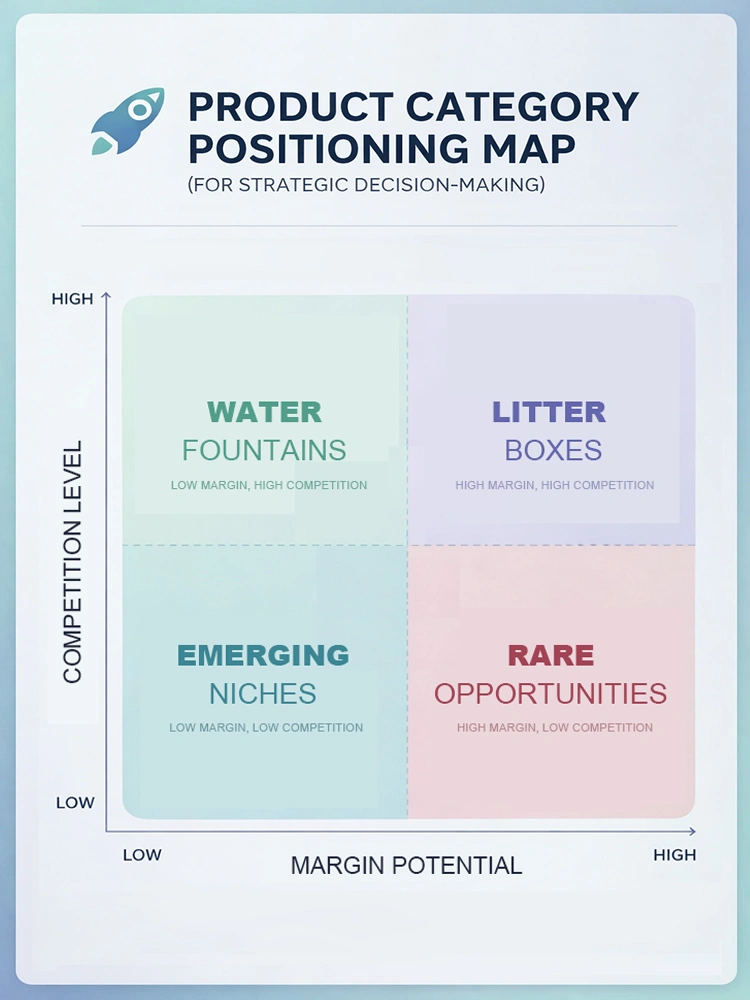
The smart pet product market follows a non-linear relationship between pricing, complexity, and profitability:
| Product Category | Price Range | Margin Level | Risk Level | Scalability |
|---|---|---|---|---|
| Water Fountain | Low | Medium | Low | High |
| Automatic Feeder | Mid | Medium-High | Medium | Very High |
| Smart Litter Box | High | High | High | Medium |
| Pet Camera | Mid | Low-Medium | High (competition) | Low |
Key Insight:
- Profit does not increase linearly with price
- Product complexity rises faster than margin beyond mid-tier products
- Many failed brands enter the “high competition + medium margin” zone without realizing it
This is where careful category selection becomes more important than aggressive expansion.
High-Marin vs High-Volume Product Strategies
There are typically two viable paths when entering the smart pet space:
- High-volume strategy (feeders, fountains)
- High-margin strategy (litter boxes, premium devices)
Each path requires a different mindset—one focuses on scale and repeat demand, while the other prioritizes differentiation and pricing power.
Smart Pet Products Demand by Buyer Type
Different market participants prioritize different outcomes, which directly affects product positioning:
- Retailers → fast-moving products
- Brands → differentiated products
- Importers → stable demand products
For those mapping entry strategies or evaluating positioning, this guide on Smart Pet Market Opportunities for New Brands might help clarify where early-stage brands can compete more effectively.
Key Insight:
The most sustainable opportunities often sit at the intersection of:
- profitable pet product niches
- underserved segments
- region-specific demand
Understanding this balance is often what separates short-term entry from long-term growth in the smart pet space.
Real Buyer Case: From Wrong Product to Winning Category
Behind every successful smart pet market size opportunity, there are also quiet stories of trial and adjustment—especially for brands trying to find the right entry point.
Many founders start with strong ideas, but the real turning point often comes after they see how differently categories perform in the real world compared to expectations on paper.
Case Background: EU Brand Initial Product Failure
A European brand initially entered the market with generic pet cameras, expecting steady demand driven by growing interest in pet monitoring products.
However, early performance told a different story—sales moved slowly, and customer acquisition costs quickly became harder to justify.
The product itself wasn’t necessarily weak, but it blended into a crowded space where differentiation was limited and competition was already well-established.
Strategy Shift Based on Smart Pet Market Size Insights
After reviewing category-level data and reassessing smart pet market size signals more carefully, the brand made a strategic shift toward automatic feeders—an area with clearer functional demand and stronger daily-use behavior.
This wasn’t just a product change; it was a positioning adjustment based on where real user needs were still underserved.
Results: Sales Growth & Market Fit
Within 8 months:
- Sales increased by 230%
- Product-market fit improved significantly
The shift didn’t just improve performance—it also clarified the brand’s direction and reduced wasted acquisition spend.
Many of these decisions are also influenced by broader funding and startup activity. You might find Pet Tech Investment & Startup Trends helpful for understanding how capital flows often shape category momentum.
Risks & Challenges Behind Smart Pet Market Growth
A growing smart pet market size can create excitement, but it also introduces complexity that is easy to underestimate.
Growth often comes with uneven opportunities, and not every category benefits equally from rising demand.
Smart Pet Product Saturation
Many segments are already highly competitive, with multiple brands offering similar solutions and competing primarily on price rather than innovation.
In these areas, standing out requires significantly more effort in branding and product differentiation.
Misleading Smart Pet Market Size Signals
A large market size can sometimes create a false sense of accessibility. Strong demand figures do not automatically translate into easy entry or sustainable profit.
The biggest risks include:
- Product saturation
- Misleading demand signals
- Regulatory barriers
- Unstable supply chains
Certification & Compliance Risks
Different regions apply different regulatory standards, and these requirements can directly impact launch timelines and product feasibility.
Certifications such as CE and FCC often influence not just approval, but also redesign cycles and cost structure.
Supply Chain Instability
Even when demand is clear, execution can be affected by supplier consistency, production quality fluctuations, and lead time variability.
These operational factors often determine whether scaling is smooth or unpredictable.
Hidden Cost Behind Smart Pet Products (Most Buyers Ignore)
One of the most overlooked aspects of smart pet market size opportunities is that real costs extend far beyond manufacturing.
Many first-time importers focus heavily on unit price, but underestimate the ongoing investment required to keep products functional and competitive.
Beyond production, real costs include:
- App development and maintenance (iOS / Android)
- Firmware updates and bug fixing
- Cloud server and data storage costs
- After-sales service and return handling
- Customer support infrastructure
Key Insight:
- In smart pet products, the cost structure does not stop at production — it extends into software, service, and lifecycle management.
- This is exactly why products that look profitable at launch often struggle once operational costs begin to accumulate over time.
Real Buyer Case Studies: Why Smart Pet Product Launches Fail
Real-world cases often reveal the gap between market expectations and execution reality.
Even with strong smart pet market size indicators, success still depends on category selection, differentiation, and cost structure discipline.
Case 1: EU Brand Failed with “Generic Pet Camera”
A European DTC brand entered the smart pet market with a basic WiFi pet camera, expecting steady traction from rising demand.
What went wrong:
- Product was in a saturated category
- No differentiation in AI or ecosystem
- High customer acquisition cost
- Low repeat purchase rate
Result:
The product was discontinued within 10 months due to unsustainable ad spend versus margin performance.
Lesson:
Pet cameras are no longer growth-driven products—they function more as ecosystem retention tools rather than acquisition drivers.
Case 2: US Importer Misjudged Certification Cost
A US importer selected a smart cat litter box without fully evaluating compliance requirements.
What went wrong:
- FCC certification delays
- Unexpected CE redesign requirement
- 4-month shipment delay
- Lost retail listing window
Result:
Retail partnership was canceled due to missed seasonal launch timing.
Lesson:
In smart pet products, compliance is not a formality—it is a market entry requirement that directly affects commercial viability.
Case 3: Startup Chased “Trending Product” (Smart Water Fountain)
A startup shifted into smart water fountains after seeing strong search trends and perceived demand growth.
What went wrong:
- Entered low-entry but highly competitive segment
- No brand differentiation
- Price war with established OEM suppliers
- Weak margin structure
Result:
Revenue increased, but profit remained negative for two consecutive quarters.
Lesson:
High demand does not equal high profit. Smart water fountains are a scale-driven category, not a margin-driven one.
How to Use Smart Pet Market Size Data to Make Better Decisions
Working with smart pet market size data is not just about reading reports or tracking percentages—it’s about turning numbers into clearer judgment calls.
For many founders and importers, the real challenge is not the lack of information, but knowing how to filter what actually matters for their business direction.
As you move deeper into this space, it becomes easier to see that data only becomes valuable when it helps you reduce uncertainty and avoid costly missteps.
That shift—from “interesting insight” to “usable decision”—is where stronger strategies usually begin to form.
Step 1: Identify Real Demand vs Hype
Trends can feel convincing on the surface, especially when certain products suddenly gain attention. But not every rising signal reflects sustainable demand.
A more grounded approach is to separate short-term attention from consistent buying behavior.
This is where many early decisions are either strengthened or weakened—depending on whether the demand is structural or temporary.
Step 2: Choose the Right Product Category
Once real demand becomes clearer, the next step naturally shifts toward category selection.
Instead of chasing what looks popular, focus on validated demand backed by repeat usage, problem-solving value, and stable purchasing patterns.
This is often where long-term performance differences between brands start to appear.
Step 3: Validate Before Scaling
Scaling too early is one of the most common pressure points for new brands.
Testing small, learning quickly, and adjusting before committing to large production runs often leads to more stable outcomes.
At this stage, data stops being theoretical and starts shaping real-world decisions—pricing, sourcing, and even packaging strategy.
Frequently Asked Questions About Smart Pet Market (2025–2030)
Is the smart pet market still worth entering in 2026?
New entrants often perform better when focusing on high-utility categories like smart feeders, smart litter boxes, and smart water fountains, where user needs are clearer and differentiation is still possible.
What are the most profitable smart pet product categories?
- Smart cat litter boxes (high margin, high ticket)
- Automatic pet feeders (stable volume + repeat demand)
- Smart water fountains (low entry cost, scalable)
Profitability is shaped less by market size and more by how a product is positioned, differentiated, and supported after launch.
Which region has the highest opportunity for new pet brands?
For many new brands, Asia-Pacific often provides a more flexible entry point with room to test and iterate before scaling globally.
Why do many pet tech brands fail in this market?
- Entering saturated categories (e.g., generic pet cameras)
- Underestimating certification requirements (CE / FCC / FDA)
- Ignoring supply chain consistency
- Following trends instead of demand structure
These challenges are less about product ideas and more about execution discipline.
What is the biggest risk in the smart pet industry?
A large market—such as $5B+—does not automatically mean easier profits. In many cases, it simply reflects stronger competition within core categories.
How should new importers evaluate product opportunities?
- Daily usage frequency
- Product problem-solving value
- Repeat purchase potential
- After-sales complexity
These factors tend to predict long-term sustainability more accurately than trend popularity alone.
Are smart pet devices a long-term trend or short-term hype?
This is not a short-cycle trend, but an evolving category with expanding use cases.
Conclusion — What Smart Buyers Should Do Next
The direction of the smart pet market size is clear: growth continues, and new opportunities keep emerging. But growth by itself does not guarantee success for every entrant.
The brands that tend to perform better over time are usually the ones that:
- Understand demand structure
- Choose the right category
- Avoid saturated segments
- Build reliable supply chains
Action Plan:
- Define your category
- Analyze demand
- Validate product
- Choose the right supplier
At this stage, success is less about moving fast and more about making informed decisions grounded in real market behavior.
In many cases, the difference between strong and weak outcomes comes down to preparation, not timing.
At different stages, you need different types of support:
- Step 1: Understand the Market
- Step 2: Analyze Top Products
- Step 3: Validate Product Feasibility
- Step 4: Find Manufacturers
- Step 5: Import & Cost Control
- Step 6: Build Your Brand
What Should You Do Next? (Practical Next Step)
For founders and importers evaluating entry into this space, a structured approach often reduces risk significantly:
- Step 1: Shortlist 1–2 product categories
- Step 2: Validate demand using small batch orders
- Step 3: Evaluate supplier capabilities (engineering + compliance)
- Step 4: Request samples before scaling
For those who want a clearer starting point, a product feasibility assessment can often help refine direction before committing to larger investment decisions.