
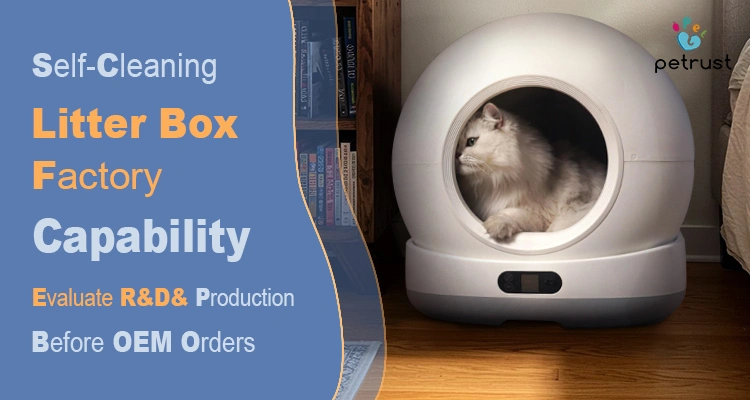
In the competitive world of smart pet products, understanding self-cleaning litter box factory capability is the first step toward avoiding costly post-launch mistakes. Many brands assume that price, MOQ, or even flashy product demos determine success—but the reality is different.
Behind every seamless product is a factory with deep R&D expertise, rigorous production validation, and reliable scalability. When these factors are underestimated, even a well-designed litter box can become a headache for buyers, with returns, warranty claims, and negative reviews piling up within months.
Most OEM failures don’t start with price or MOQ. They start with misjudging factory capability. By systematically evaluating R&D depth, production validation, and scalability, buyers can reduce post-launch failures, protect brand value, and save thousands in wasted orders.
When evaluating self-cleaning litter box factory capability, buyers should look beyond product demos and focus on R&D depth, production validation, and long-term OEM scalability. Taking this mindset seriously can be the difference between launching a sustainable, trusted product line and facing an expensive learning curve filled with surprises.
You might find it helpful to Schedule a Factory Audit Consultation to assess capability before committing to orders, ensuring that your smart litter box project starts on the strongest possible foundation.
What Self-Cleaning Litter Box Factory Capability Really Means for OEM Buyers
For OEM buyers, self-cleaning litter box factory capability often seems abstract until a real production challenge appears.
Many sourcing decisions are still based on surface impressions—an attractive demo, a functional prototype, or a polished sales pitch—rather than the factory’s true structural competence. This gap between expectation and reality can be costly, especially when post-launch issues hit.
Strong capability goes beyond assembling components; it ensures your product will work reliably in homes, not just in controlled testing.
Common Misunderstandings About Factory Capability
- Having a working prototype does not equal real R&D capability
- Having an app does not mean the factory owns a complete IoT system
- Running an assembly line does not guarantee stable mass production
These assumptions often lead to risks of choosing the wrong litter box manufacturer, especially for technically sophisticated products like smart litter boxes.
Subtle differences in R&D depth or validation processes can make the difference between smooth mass production and repeated post-launch headaches.
Why Self-Cleaning Litter Box Factory Capability Is a System, Not a Feature
True self-cleaning litter box factory capability is not just about putting parts together—it’s about designing, validating, and scaling an entire system that works reliably in the real world.
This includes hardware, firmware, algorithms, cloud infrastructure, testing protocols, and OEM support processes. From an OEM litter box factory evaluation perspective, it’s essential to assess the factory end-to-end.
You can use this framework alongside resources like the best automatic litter box OEM manufacturer checklist to understand whether a factory’s claims match operational reality.
Example of Proven Capability: Factories such as Petrust® demonstrate mature end-to-end systems, including in-house firmware development, camera ISP tuning, and multi-cat recognition. This ensures OEM partners can confidently scale products globally while maintaining quality and feature integrity.
Evaluating Self-Cleaning Litter Box Factory Capability from an R&D Perspective
R&D is where factories show whether they can solve problems that don’t appear in demos but inevitably surface after launch. A factory with deep R&D structures reduces long-term operational risks and supports innovation throughout your product lifecycle.
Tip: Factories with robust R&D capabilities not only address edge-case failures but also adapt rapidly to new product iterations, saving both time and cost.
Academic research on advanced manufacturing systems emphasizes that deep innovation capabilities—especially those integrating iterative development and digital transformation—are critical for long-term competitiveness.
Studies on manufacturing innovation capability in the context of Industry 4.0 show that companies embedding iterative and flexible R&D processes are far better at evolving complex product designs over time.
In-House Firmware & Algorithm Development
One of the clearest signs of litter box R&D capability is whether firmware and algorithms are developed in-house.
Factories with real firmware development for self-cleaning litter box systems can iterate quickly, fix edge cases, and provide OEM-level customization. Outsourced firmware often slows updates and limits control over smart litter box algorithm accuracy.
Multi-Cat Recognition & Weight Sensor R&D
Multi-cat households quickly expose weaknesses. Reliable recognition depends on both algorithm logic and precise weight sensor calibration in litter boxes.
Ask how accuracy is tested, which datasets are used, and how edge cases are handled—these details reveal whether R&D claims are operational or theoretical.
Camera Module & ISP Tuning Capability
When dealing with camera-based litter box monitoring, hardware selection is only half the picture. True capability lies in ISP tuning: optimizing day/night pipelines, reducing noise, and improving low-light performance.
Resolution specs alone do not guarantee functional accuracy—ISP expertise does. You might find the camera-enabled smart litter box OEM guide helpful for a deeper technical perspective.
PCB Design & Hardware Iteration Process
Factories with strong R&D follow structured EVT/DVT/PVT cycles (Engineering, Design, Production validation) and track PCB revision history. This discipline minimizes late-stage surprises and directly impacts factory capability vs product quality.
How R&D Depth Reflects Real Self-Cleaning Litter Box Factory Capability
R&D depth is a practical measure of whether a factory can evolve with your product roadmap. Shallow R&D often results in stalled features, while deep R&D enables long-term OEM differentiation.
B2B Insight: Partnering with experienced factories like Petrust®, with over a decade of smart pet product R&D and iterative PCB & firmware validation, ensures your brand can launch new features reliably and minimize repeated rework.
Automatic Litter Box Production Capability & OEM Production Readiness: From Prototype to Mass Production
Even the most innovative design can falter without a factory that’s truly ready to deliver. Evaluating automatic litter box manufacturer capability means looking beyond prototypes—it’s about understanding how concepts evolve into reliable volume production that meets real-world expectations.
For global buyers, the difference between a smooth launch and recurring post-sale issues often starts on the production floor.
Motor Lifetime Testing & Load Simulation
Rigorous motor lifetime testing and variable load simulations reveal hidden weaknesses before they reach customers.
Without these checks, minor design assumptions can escalate into widespread OEM litter box production problems soon after launch, eroding trust and increasing returns.
Sensor Calibration & Consistency Control
The accuracy of sensors is only as good as the production consistency behind them. Standardized calibration processes and documented checks ensure every unit performs reliably, giving end users confidence and protecting your brand reputation.
Mass Production Stability & Yield Rate
Stable mass production capability goes far beyond sheer output. Yield rates, rework ratios, and process control systems define whether production can scale without unexpected failures. High-volume output alone cannot compensate for inconsistent quality.
Aging Test & Reliability Validation
Early-life failures can sink even well-designed litter boxes. Ask whether aging tests are sampled or fully comprehensive. Proper aging protocols provide actionable insights, helping brands proactively prevent post-launch surprises rather than reacting to them.
Supply Chain Control for Key Components
Control over critical components—motors, sensors, and MCUs—is essential. Weak supply chain oversight can force last-minute substitutions that compromise product performance. Strong factories anticipate and mitigate these risks, ensuring continuity for large-scale OEM orders.
A Practical Checklist to Verify Self-Cleaning Litter Box Factory Capability On-Site
A structured litter box factory audit offers far more insight than a guided showroom tour.
For buyers planning an on-site visit, using a structured self-cleaning litter box factory audit checklist turns manufacturer claims into verifiable, actionable facts.
Questions to Ask During Factory Audits
Effective OEM audits often integrate a Manufacturing Readiness Assessment (MRA)—a framework that quantifies the maturity of a factory’s production processes, tooling, and quality systems before large-scale orders.
Rather than asking whether a process exists, inquire about how it is executed and documented. The depth of the response often tells you more than a simple yes or no.
Documents That Prove Real R&D Capability
Marketing slides are easy to produce; test reports, validation logs, and version histories are not. These documents demonstrate real R&D strength and distinguish genuine manufacturing capability from mere presentation.
How to Verify Production Claims On-Site
Many engineering and defense acquisition frameworks employ formal Production Readiness Reviews (PRR) to determine if a design is truly ready for volume manufacturing and whether the factory’s processes can meet both quality and throughput expectations.
Comparing demo units to the live automatic litter box manufacturing process on the floor often uncovers discrepancies that explain common post-launch issues—making on-site verification indispensable.
Common Capability Gaps in Self-Cleaning Litter Box Manufacturers
Many factories might look polished and capable on the surface, but the reality behind the walls can be very different. Gaps in self-cleaning litter box factory capability often only become apparent after launch, when warranty claims, feature limitations, or scaling challenges emerge.
For global buyers, recognizing these gaps early is not just a technical exercise—it’s about protecting brand reputation, ensuring customer satisfaction, and avoiding costly surprises.
“Assembly-Only” Factories vs True R&D Factories
Some factories excel at assembly but rely heavily on third-party partners for design and problem-solving. This limits their responsiveness and reduces the level of control a brand has over critical aspects like motor reliability, app integration, or sensor calibration.
Evaluating R&D depth can help you distinguish between a factory that assembles parts and one that truly innovates and adapts to complex requirements.
Outsourced App Systems & Hidden Risks
When app systems are outsourced, data ownership, firmware updates, and feature expansion often come with strings attached. For any IoT-enabled litter box system, these limitations can slow new feature rollout or restrict integration with your smart ecosystem.
You might find reviewing app integration protocols helpful before signing an OEM agreement, ensuring the factory’s software capabilities align with your long-term vision.
Prototype vs Mass Production Mismatch
It’s common for features that function flawlessly in prototypes to be altered—or even removed—when scaling to mass production.
This mismatch is especially critical for multi-cat systems or camera-heavy designs, where early customer dissatisfaction can ripple into negative reviews and returns.
Detailed insights on such cases can be found in top OEM factors for smart litter boxes, which highlights why early validation and alignment with the factory are essential.
How Self-Cleaning Litter Box Factory Capability Impacts Long-Term OEM Success
Decisions made at the factory level don’t just affect the first production run—they influence every stage of your product’s lifecycle. Strong self-cleaning litter box factory capability ensures quality, reliability, and brand trust remain consistent, even as your product line grows.
Product Quality, After-Sales & Brand Reputation
Gaps in capability often show up as increased warranty claims, higher support costs, and erosion of brand reputation. This is a classic case of factory capability vs product quality in action.
Many successful buyers pair capability assessment with structured pre-shipment checks, such as the smart litter box pre-shipment inspection guide, to catch potential issues before products reach customers.
OEM Customization Scope & Limitations
Knowing a factory’s customization limits early helps set realistic expectations and prevents costly misalignments later. Choosing the right factory model—self-cleaning litter box OEM factory versus ODM—is a common source of confusion.
Guidance on this is detailed in the OEM vs ODM selection guide for self-cleaning litter boxes, which explains how different approaches affect flexibility, IP ownership, and feature control.
ODM Design Ownership & IP Protection
Clear ownership of design and intellectual property safeguards long-term brand value, reduces dependency risks, and allows you to innovate without constraints. Factories with strong IP policies also help protect your investment as your product portfolio expands.
Scalable Production for Brand Growth
Factories with mature smart pet product factory capability can scale from a single SKU to an entire product line without compromising quality or stability. This makes them valuable partners not just for one launch, but for sustained growth across multiple products and regions.
Small Factories vs Mature Factories: A Capability-Based Comparison
| Area | Small Factory | Mature Factory |
| Firmware | Outsourced | In-house |
| Testing | Functional only | System validation |
| OEM Support | Project-based | Long-term roadmap |
| Scale | Limited | Scalable |
This comparison makes it clear how to look beyond surface impressions and evaluate how to evaluate litter box factory capability in a way that protects product quality, supports customization, and ensures scalability for future growth.
Conclusion: Choosing a Factory with Proven Capability Is Choosing Fewer OEM Surprises
OEM success in smart litter boxes rarely happens by accident. Behind every reliable product is a factory that combines real R&D depth, validated production processes, and scalable systems—not just an attractive demo on a table.
When evaluating self-cleaning litter box factory capability, buyers should look beyond product demos and focus on R&D depth, production validation, and long-term OEM scalability.
Once these foundations are confirmed, pricing structures and MOQ strategies become the next critical variables—a topic you might find helpful in automatic litter box MOQ negotiation tips.
Many seasoned buyers also layer in structured validation, such as following automatic litter box sample order evaluation steps, to confirm that prototypes truly reflect mass production outcomes. This approach minimizes surprises, protects brand reputation, and ensures smoother post-launch operations.
A factory equipped with in-house R&D, verified production workflows, and scalable OEM systems is more than a supplier—it becomes a long-term partner that reduces risk, safeguards brand value, and supports growth.
You can also benefit from tools like Download the Full Self-Cleaning Litter Box OEM Checklist PDF or Request a Sample Evaluation Today to solidify your decision-making process.
B2B Highlight: Collaborating with an experienced OEM partner such as Petrust® allows brands to access proven production readiness, dedicated R&D support, and scalable smart litter box solutions—critical advantages for standing out in the competitive pet product market.
FAQ: Self-Cleaning Litter Box Factory Evaluation
What is the minimum R&D capability I should look for?
Ensure the factory has in-house firmware, algorithm development, multi-cat recognition, and PCB iteration capabilities. Outsourced work can slow updates and limit customization potential.
How can I verify production consistency?
Look at motor lifetime tests, sensor calibration routines, aging protocols, yield rates, and compare demo units to actual production samples. These steps help you catch deviations early.
What certifications matter for global OEM buyers?
CE, FCC, FDA, and RoHS compliance are essential depending on your target markets. Confirm that the factory can provide authentic test reports to avoid future surprises.
How do I avoid prototype vs mass production mismatch?
Conduct structured factory audits and request PRR/MRA documentation. This ensures that what you approved in prototypes will scale correctly in full production.
How can I scale from one SKU to multiple products safely?
Choose a mature factory with in-house R&D, validated processes, and proven OEM scalability. This ensures consistent quality as your product line expands.