
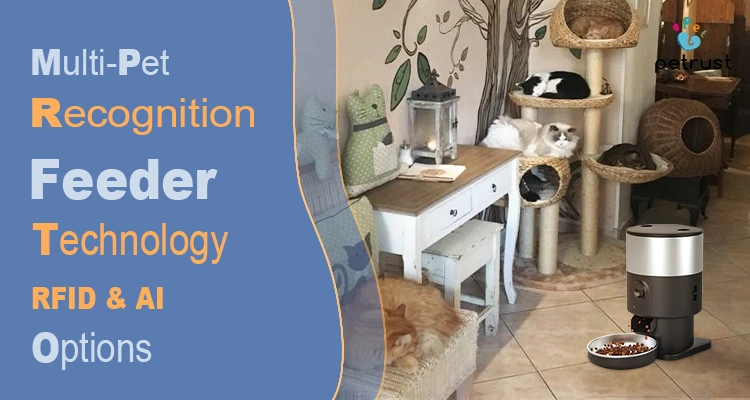
Households with multiple pets are growing faster than many brands anticipate, which makes multi-pet recognition feeder technology a central consideration for any smart feeder OEM.
Feeding in a multi-pet environment is rarely predictable—cats vary in size, appetite, and behavior, and they rarely wait their turn. Some guard their bowl while others dart in at the last second, creating a dynamic that can overwhelm traditional timed feeders.
Insights from the International Cat Care organization show that managing multi-cat households requires more than simply scaling up single-cat solutions.
For OEM brands, the stakes go beyond technology showmanship. Selecting the wrong multi-pet recognition feeder technology can quietly set a product up for higher return rates, inconsistent user experiences, and long-term support challenges that are difficult to correct once the product reaches homes.
This evolving landscape has turned multi-pet recognition from a “nice-to-have” feature into a strategic necessity.
Multi-Pet Recognition Feeder Technology in Real Multi-Cat Households
Feeding multiple pets might seem straightforward on paper, but in practice, it is one of the most failure-prone scenarios for smart pet hardware. The unpredictability of real homes—cats moving, hovering, and interacting unpredictably—creates challenges that lab tests rarely capture.
Why Multi-Pet Recognition Feeder Technology Fails in Real Homes
Most failures occur because real homes are far messier than controlled testing environments. Cats often share similar sizes and fur patterns, while their eating behaviors differ dramatically.
One cat may patiently wait nearby while another rushes to the bowl, creating physical blocking, crowding, or sudden interruptions. These dynamics increase the risk of misidentification, which is rarely visible during early-stage product validation.
This gap between lab validation and household reality is where many multi-pet household feeding solution concepts quietly collapse. The systems that survive are those designed to handle real-world complexity gracefully, rather than merely performing well under ideal conditions.
Pet Feeder Misidentification Issues and Feeding Conflicts
Misidentification doesn’t just reduce accuracy—it drives feeding conflicts. Overfeeding dominant pets, underfeeding shy ones, or creating food-related anxiety are common outcomes.
These multi-cat feeder misidentification issues rank among the top contributors to negative reviews and returns in multi-cat households.
Preventing multi-cat feeding conflict requires more than high-tech recognition—it depends on how the system responds when it fails. Graceful failure can prevent chaos, while poor handling can turn a simple feeding session into a source of frustration.
Research highlighted in the European Pet Food Federation’s 2025 pet ownership and pet trends report emphasizes that reliability under real-world conditions is as important as technical sophistication.
RFID Pet Feeder Technology: Stability Comes Before Intelligence
Among smart multi-pet feeders, RFID-based identification remains widely adopted—not because it is flashy, but because it is predictable and reliable.
RFID Tag-Based Pet Identification in Multi-Cat Homes
RFID tag-based identification relies on a simple principle: each pet wears a tag, and the feeder detects it at close range. This approach sharply reduces ambiguity.
In real multi-cat households, RFID cat feeder accuracy in multi-cat homes often outperforms vision-based systems, particularly when cats are near each other or partially block one another.
The system does not “guess”—it either detects the tag or it does not, providing consistent reliability even under chaotic feeding conditions.
RFID Pet Feeder OEM Solution: Cost, Power, and Scalability
From an OEM perspective, an RFID pet feeder smart pet feeder OEM solution offers practical advantages.
RFID modules require minimal processing power, consume less energy, and reduce firmware complexity. This simplicity translates to easier mass production, more predictable performance, and faster testing cycles.
For entry-level and mid-range brands, RFID remains a solid choice because it balances mass production feasibility with reliability, while keeping pet feeder BOM cost manageable.
You might find our guide on multi-cat RFID feeder implementation tips helpful in understanding how to integrate RFID into high-use homes, test accuracy in real scenarios, and optimize performance for multiple pets.
AI-Based Pet Feeder Recognition and Its Real-World Challenges
Smart feeders promise intelligence, but intelligence comes with trade-offs. In multi-pet households, even the most advanced systems encounter unpredictable behavior, environmental variability, and operational limits that can quietly affect performance.
Choosing the right multi-pet recognition feeder technology requires understanding these nuances, so your OEM solution performs reliably once it reaches real homes.
AI Vision Pet Feeder System in Uncontrolled Home Environments
An AI vision pet feeder system typically uses cameras and algorithms to recognize pets based on visual features.
This approach offers the potential for richer data collection and a more flexible pet identification technology stack. In theory, it sounds perfect—adaptive, smart, and capable of handling multiple pets at once.
Reality, however, is less forgiving. Camera-based pet feeder recognition struggles with everyday household conditions: lighting changes, shifted camera angles, and pets behaving unpredictably. A cat might block the lens while another rushes in, creating scenarios that confuse even the most advanced AI.
You might find our AI feeder camera selection guide helpful when deciding on camera modules, whether considering 2MP, 5MP, or night vision options, as these choices directly impact recognition reliability.
AI Pet Feeder Accuracy Challenges at Night and Under Occlusion
The toughest challenges often emerge after dark.
AI pet feeder accuracy challenges increase significantly during night-time feeding. Infrared limitations, motion blur, and partial occlusion reduce recognition confidence.
Night-time pet feeder recognition remains one of the most difficult problems to solve consistently, even for seasoned OEM partners.
These edge cases frequently contribute to higher pet feeder return rate factors, even when daytime performance seems flawless.
You can also look at our insights on feeder motor and auger failure prevention, which are closely linked to night-time recognition issues and overall system reliability.
Multi-Pet Recognition Feeder Technology: RFID vs AI in OEM Production
Choosing between RFID and AI is not a matter of preference—it’s about operational reality and long-term reliability.
Experienced OEMs like Petrust® demonstrate how multi-pet recognition feeder technology can be implemented successfully in high-use multi-cat households, balancing recognition accuracy with scalable production for global brands.
RFID vs AI Pet Feeder Technology: Reliability vs Complexity
In RFID vs AI pet feeder technology, the key distinction lies in predictability.
RFID provides stable, consistent detection but with limited flexibility. AI introduces adaptive intelligence and richer data but also adds system complexity.
When evaluating RFID vs AI pet feeder reliability, OEMs often find that RFID produces fewer catastrophic failures, whereas AI errors are harder to diagnose and communicate to end users.
RFID vs AI Pet Feeder Cost Comparison and BOM Impact
A realistic RFID vs AI pet feeder cost comparison reveals layers beyond initial hardware costs.
AI systems require cameras, higher-performance processors, ongoing algorithm tuning, and additional maintenance. These components increase pet feeder BOM cost, raise power consumption, and complicate after-sales support, shifting the balance between hardware cost vs user experience.
You might find our OEM-ready feeder hardware insights helpful in evaluating which technology stack aligns with production feasibility, cost constraints, and long-term reliability.
Cost vs Experience: The Hidden Trade-Offs Behind Multi-Pet Recognition Feeder Technology
This is where some uncomfortable truths emerge. A higher hardware cost does not automatically translate into better perceived value. Many consumers struggle to understand why a feeder occasionally misidentifies their pets, no matter how sophisticated the system claims to be.
AI-driven solutions introduce additional layers of long-term responsibility: firmware updates, model fine-tuning, and user education. These factors quietly chip away at margins, especially in price-sensitive segments.
For OEM brands, the real question is not whether AI looks impressive, but whether customers consistently perceive enough value to justify the experience it delivers.
You might find our guide on real-world feeder QC strategies helpful in seeing how thorough quality control can reduce misidentification errors and maintain user satisfaction.
Choosing the Right Multi-Pet Recognition Feeder Technology for Your Brand
Selecting technology should always follow your brand strategy, rather than letting features dictate positioning. The right approach balances cost, reliability, and long-term brand promise.
How Brand Positioning Shapes Multi-Pet Recognition Feeder Technology Choices
For entry-level products, RFID remains the most reliable path. Mid-range brands often combine RFID with logic optimization, while premium offerings explore hybrid approaches that mix AI recognition with traditional identification methods.
AI-driven systems make the most sense when a brand has a clear smart feeder technology roadmap, robust software capabilities, and a long-term plan to leverage individual pet feeding data within a larger smart pet care ecosystem.
You can also consider insights from smart feeder software and cloud setup to understand the infrastructure behind multi-pet feeding analytics. For guidance on selecting the right development path, you can refer to choosing the right OEM vs ODM model.
Smart Cat Feeder for Multi-Cat Households: Market-Based Decisions
A smart cat feeder for multi-cat households must reflect regional expectations and cultural nuances.
For example, a smart pet feeder for US market buyers may tolerate experimentation and early-stage AI features, while Japanese consumers often demand precision, stability, and consistent recognition.
EU buyers face additional compliance considerations dictated by the European Commission’s official animal welfare policy, which outlines standards for cats and dogs, influencing both hardware and data practices.
B2B case in point: Petrust® successfully adapted its multi-cat feeder solutions to satisfy both US and EU regulations while maintaining high RFID cat feeder accuracy, offering practical OEM guidance for brands entering diverse markets.
Market context is as critical as technology itself.
You might find our multi-cat feeder compliance details helpful in planning product deployment across different regions.
When OEM Brands Should Avoid AI-Based Pet Feeder Recognition
Even the most advanced multi-pet recognition feeder technology isn’t a perfect fit for every scenario.
Sometimes, the smartest decision for an OEM brand is to pause and consider the broader context before committing to AI-driven solutions. Understanding where AI may introduce complexity, cost, or operational risk is crucial for preventing setbacks during product development and launch.
Manufacturing Readiness and OEM Feasibility Risks
AI-based systems can be incredibly powerful—but they are not a universal solution. Early-generation products, highly cost-sensitive markets, or brands without a strong after-sales infrastructure often encounter hidden pitfalls.
In such situations, RFID vs AI pet feeder manufacturing complexity alone can delay launch timelines and increase the likelihood of failure. Sometimes, the most strategic and professional choice is to recognize the limits of current capabilities and refrain from pushing a solution prematurely.
This decision is not about avoiding innovation—it’s about protecting brand reputation, ensuring product reliability, and creating realistic expectations for both pets and their owners. Thoughtful OEM planning can turn what seems like a limitation into a foundation for long-term success.
OEM Insights from Mass Production of Multi-Pet Feeder Identification Systems
Scaling a multi-pet recognition feeder technology from prototype to mass production reveals patterns that no simulation or small-batch test can capture. Lessons learned at this stage are invaluable for OEMs aiming to deliver consistent performance and maintain brand trust.
What Experienced Manufacturers Learn from Real OEM Projects
Across numerous real-world projects, patterns emerge.
The most stable multi-pet feeder identification system is not the flashiest—it’s the one that delivers consistency, communicates failures clearly, and aligns with realistic user expectations. Success hinges less on novelty and more on disciplined execution, thorough testing, and market fit.
Experienced OEM partners, such as Petrust®, illustrate how multi-pet recognition feeder technology can be reliably scaled from prototype to mass production. Their expertise provides practical insight into challenges like high-use home deployment and reducing multi-cat misidentification.
For brands seeking a deeper understanding of production strategies and factory-level considerations, you can reference multi-pet feeder OEM production insights, which outline lessons learned from real deployments.
Conclusion: Multi-Pet Recognition Feeder Technology Is a Strategy, Not a Feature
The real question has never been “RFID or AI.”
The essential consideration is whether your multi-pet recognition feeder technology aligns with your brand positioning, cost structure, support capabilities, and long-term vision.
Technology choices are only meaningful when manufacturers can execute them at scale with reliability and predictability. This makes selecting experienced trusted multi-cat feeder OEM partners a strategic decision rather than a simple sourcing task.
For OEM brands planning the next generation of smart feeders, approaching technology selection with honest discussion, careful evaluation, and a focus on execution is crucial—long before the first mold is ever opened.
Because in the end, feeding is not about recognition.
It is about trust—earned meal after meal.