
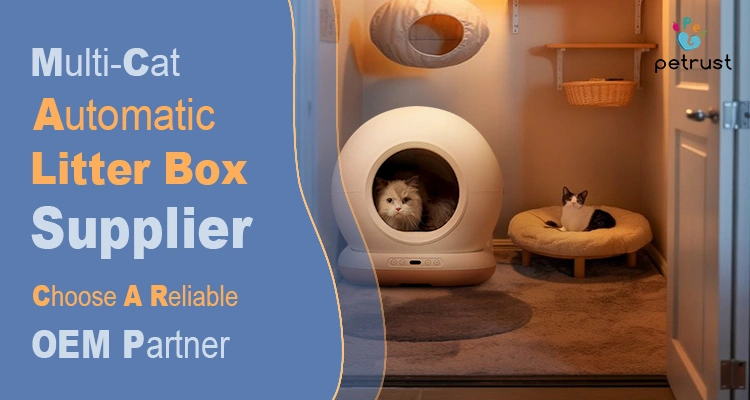
Finding a trustworthy multi-cat automatic litter box supplier can feel like navigating a maze filled with hidden pitfalls, especially when high-use households push devices to their limits. Most buyers assume that “multi-cat” simply means a few cats sharing one device, but the reality is far more complex.
Multi-cat environments create unpredictable, overlapping usage patterns that challenge sensors, motors, and cleaning cycles—just as research on cat group size and wellbeing in domestic environments demonstrates.
For OEM buyers, recognizing these stress factors early can save substantial time, money, and brand credibility. In a shared litter box environment, cats rarely follow predictable patterns. They may enter simultaneously, leave mid-cycle, or trigger sensors unintentionally. This isn’t merely a scaled-up version of a single-cat setup—it’s a rigorous system test that exposes design weaknesses immediately.
Many products marketed as “multi-cat compatible” falter under real-world conditions. The uncomfortable truth is that numerous designs still operate on single-cat assumptions, leaving OEMs exposed to costly redesigns, product recalls, or negative customer feedback.
This article is not a generic supplier selection guide.
It is a risk filter—designed to help you avoid costly OEM mistakes before they reach mass production, customer reviews, or brand damage.
For a broader perspective on selecting reliable smart litter box factories and understanding multi-cat design considerations, you might find our detailed guide on choosing the right smart litter box manufacturer for multi-cat homes and high-use OEM solutions helpful in shaping your sourcing decisions.
Why Multi-Cat Homes Break Standard Automatic Litter Box Systems: High-Use Challenges for OEM Buyers
Multi-cat households reveal vulnerabilities that single-cat testing rarely exposes. When brands realize a self-cleaning litter box fails in multi-cat homes, the impact is often immediate: frustrated owners, product returns, and long-lasting dents in brand trust.
The high-use environment of multi-cat households is not just a scale-up—it’s a stress test that exposes both design gaps and assumptions hidden in quieter, single-cat scenarios.
Multi-User Entry Detection Logic Failures in High-Use Homes
Most automatic litter boxes are built on a simple premise: one entry triggers one cleaning cycle. This assumption quickly breaks down in a multi-user litter box system.
In real homes, simultaneous cat entry detection becomes critical. One cat may still be exiting while another enters moments later.
Without entry logic designed for overlapping events, the system can either postpone cleaning indefinitely or initiate unsafe cycles—findings supported by feline social interaction studies in multi-cat households published in Frontiers in Veterinary Science.
Real-world example: One multi-cat household reported repeated motor lockouts and missed cleaning cycles, causing customer complaints and product returns within the first month of use.
These challenges are where many brands first encounter multi-cat litter box reliability problems—often not due to weak hardware, but because the entry logic was never engineered for high-traffic behavior.
Solutions like Petrust® CB002 showcase how advanced multi-cat detection algorithms can safely handle overlapping entries, including partial exits and quick re-entries, establishing a practical benchmark for high-use multi-cat homes.
Multi-Cat Weight Recognition Accuracy Under Overlapping Usage
Weight sensors perform reliably when usage is isolated, but in multi-cat environments, residual weight, partial exits, and overlapping presence can distort readings.
These multi-cat litter box sensor accuracy issues often result in:
- Incorrect user identification
- Missed clean cycles
- Unsafe activation
The issue is rarely the sensor itself; it’s the absence of logic that accounts for overlapping usage cycles.
False Trigger Prevention in Multi-Cat Litter Boxes
False triggers are more than a nuisance. In multi-cat homes, automatic litter box false triggers frequently lead to:
- Cycle interruptions
- Motor stress
- Safety lockouts
Each false trigger amplifies system instability, increasing wear and raising failure rates in high-frequency usage.
Cleaning Delays, Cross-Contamination, and Brand-Level Consequences
When cleaning cycles are delayed by constant re-entries, waste accumulation and odor intensification are inevitable. Cross-contamination risks grow, and users notice.
At the brand level, system-level failures can tarnish reputation. Once negative reviews portray a product as unreliable in multi-cat homes, regaining customer trust becomes a significant challenge.
Why a Multi-Cat Automatic Litter Box Supplier Requires a System-Level Design
A true multi-cat self-cleaning litter box supplier does more than stack features on a standard device—they rethink the entire system to handle real-world challenges. Multi-cat households push every component to its limits, and a well-engineered solution addresses these stress points from the ground up.
Sensor Fusion for Multi-Cat Environments (Weight, IR, Entry State)
Reliable operation in a busy household depends on sensor fusion. Drawing from professional engineering resources, sensor fusion combines data from multiple sensors to create a more accurate, context-aware understanding of the environment.
In intelligent litter box designs, this approach ensures smooth operation even under high-traffic litter box design conditions, where raw sensor readings alone can be misleading.
Key takeaways:
- Weight sensor alone → insufficient accuracy
- IR + entry state fusion → reduces false triggers
- Combined sensor logic → consistent multi-cat operation
Leading OEMs, including Petrust®, integrate weight, IR, and entry state fusion to reduce false triggers and maintain dependable operation for multi-cat households. You might find this approach helpful when evaluating high-use automated litter box designs for your brand.
Algorithm Logic for Overlapping Entries and Partial Exits
Multi-cat households are rarely orderly. Cats may enter and leave mid-cycle, return unexpectedly, or overlap in use. Behavior-based litter box algorithms detect these patterns, distinguishing aborted sessions from completed use, allowing the system to reset safely without initiating premature cleaning.
These algorithms are tailored for overlapping usage cycles, a key factor in sustaining reliability and preventing user complaints. You can also refer to our insights on OEM vs ODM models for multi-cat litter boxes to understand how algorithm customization impacts your product strategy and supplier selection.
Motor Duty Cycle Design for Multi-Cat Automatic Litter Boxes
Heavy, frequent use takes a toll on motors. Without proper duty cycle engineering, motors risk overheating, torque loss, and shortened lifespan. A true OEM self-cleaning litter box for high-use environments is built for continuous operation, not just a demonstration.
Suppliers that validate their firmware and motor designs with high-use testing provide the assurance brands need to scale multi-cat solutions safely and sustainably.
Waste Bin Capacity for Multi-Cat Homes and High-Frequency Use
Managing waste volume is as critical as handling frequency. Smaller bins lead to blockages, incomplete cleaning, and cross-contamination. Petrust® addresses this with oversized, multi-cat waste bins designed to maintain uninterrupted cleaning cycles, demonstrating B2B-grade reliability even in the busiest homes.
A system-level approach treats waste management not as an afterthought but as a core factor in overall product performance—ensuring that every component, from sensors to motors to bins, works together seamlessly.
Multi-Cat Automatic Litter Box Supplier vs Standard OEM Factory
Not every factory is equipped to handle the unique demands of multi-cat environments. While many OEMs can produce a basic litter box, few have the experience, systems, and testing processes necessary for sustained, high-frequency use.
Choosing the right multi-cat automatic litter box supplier is less about flashy marketing and more about real-world capability and foresight.
Why Single-Cat Algorithms Fail in Multi-Cat Environments
Standard OEM factories often rely on single-cat logic and simply label the product “multi-cat compatible.” The consequences are predictable: sensor errors, incomplete cycles, and frustrated pet owners.
A self-cleaning litter box manufacturer for multi-cat homes must design usage algorithms specifically for shared environments, rather than retrofitting single-cat logic after the fact. This intentional design prevents repeated failures and protects both pets and the brand’s reputation.
High-Frequency Usage Durability Testing vs Demo-Level Validation
Demo videos and short-term trials rarely reflect real household dynamics. Multi-cat products need extended stress testing under conditions that mirror actual usage patterns, including overlapping cycles, multiple entry points, and irregular schedules.
A credible multi-cat litter box factory with OEM services provides hard durability data and transparency, not just polished marketing footage.
You might find our insights on assessing self-cleaning litter box factory R&D and production capabilities helpful for evaluating which suppliers can consistently deliver robust, multi-cat solutions.
Continuous Use Cycle Stability in Multi-Cat Households
Extended operation uncovers subtle, cumulative issues—sensor drift, timing mismatches, and logic instability—that single-cat products rarely face. Only factories experienced in multi-cat validation can address these challenges systematically, ensuring long-term reliability and minimal intervention for pet owners.
Key OEM Capabilities Required for a Multi-Cat Automatic Litter Box Supplier
Selecting the right multi-cat automatic litter box supplier hinges on demonstrable capabilities, not marketing claims. The nuances of multi-cat living—overlapping cycles, shared litter surfaces, and high-density usage—require precise engineering, thoughtful algorithm design, and rigorous validation.
OEM Algorithm Customization for Multi-Cat Homes
Brands benefit from algorithm-level customization tailored to the specific behaviors of multiple cats. A reliable multi-cat automatic litter box OEM supplier provides adjustable logic that accommodates usage density, overlapping cycles, and varying cat habits, turning potential chaos into predictable performance.
Firmware Optimization for High-Use Litter Boxes
Firmware must handle frequent interruptions, resets, and safety checks without compromising function. For an automatic litter box supplier for multi-cat households, optimized firmware ensures that devices perform consistently under heavy use, maintaining trust with both owners and pets.
Multi-Cat Stress Testing Standards and Validation Protocols
Stress testing for multi-cat setups must reflect real homes, including multiple cats, irregular schedules, and shared usage. Validation protocols should clearly document failure thresholds, recovery behavior, and long-term reliability.
Before scaling production, you might find guidance on requesting and evaluating multi-cat litter box samples helpful for ensuring that your OEM partner meets these critical standards.
How to Evaluate a Multi-Cat Automatic Litter Box Supplier Before Mass Production
This is the point where most purchasing decisions either pay off or become costly lessons. In multi-cat households, minor design assumptions can quickly turn into major operational headaches.
Every decision at this stage directly affects reliability, user satisfaction, and brand reputation. High-use households push systems to their limits, revealing issues that single-cat scenarios never surface.
Taking the time to scrutinize a supplier before committing to mass production is not just prudent—it’s essential for avoiding costly redesigns, recalls, and negative customer feedback.
The most successful OEM buyers approach this process with curiosity, empathy, and a clear understanding of what multi-cat environments demand.
Questions Every Buyer Should Ask a Multi-Cat Automatic Litter Box Supplier
The right questions reveal a supplier’s true capabilities. Consider asking:
- Can your system identify two cats entering within 30 seconds?
- How does your algorithm reset after partial exits?
- What’s the MTBF under 6–8 uses per day?
- Can you show real multi-cat stress test data—not demos?
Suppliers prepared for multi-cat realities answer confidently with concrete data. Those who dodge specifics may leave hidden risks unchecked. To verify every OEM factor thoroughly, you can refer to our self-cleaning litter box factory audit checklist for structured guidance.
Multi-Cat Use Case Validation Data You Should Demand Before Scaling
Before committing to large-scale production, ask for long-term validation data from actual multi-cat homes. Simulations provide limited insight; real behavior uncovers the nuances that make or break reliability.
Collecting and analyzing this data ensures the system performs consistently under the unpredictability of real life.
What Reliable Multi-Cat Automatic Litter Box Suppliers Do Differently
Top-tier suppliers distinguish themselves through engineering rigor, not marketing hype. Every process—from design to testing—reflects a commitment to real-world performance.
How Proven Multi-Cat Automatic Litter Box Suppliers Validate Real-World Usage
Proven multi-cat self-cleaning litter box suppliers focus on long-term data collection, real-home trials, and iterative refinement.
They model genuine cat behavior, adjust algorithms alongside hardware, and treat multi-cat stability as a disciplined engineering challenge rather than a bullet on a spec sheet.
This method allows some suppliers to quietly outperform competitors without making loud claims, offering systems that stand the test of everyday high-frequency use.
For brands considering expansion beyond single-cat setups, you might find our insights on evaluating top automatic litter box OEM partners helpful in shaping a robust supplier strategy.
Conclusion: Choosing a Multi-Cat Automatic Litter Box Supplier Is a Risk Decision, Not a Feature Comparison
Multi-cat compatibility is more than a label—it’s an engineering achievement. Suppliers who cannot clearly articulate how their systems handle multi-cat logic, overlapping usage, and intensive stress are not yet ready for mass production.
Selecting the wrong partner isn’t just a feature risk; it’s a business risk that can affect both customer satisfaction and brand reputation. You can download our Multi-Cat Self-Cleaning Litter Box Supplier Checklist to ensure your next OEM partner meets the demands of high-use households.