
When it comes to sourcing smart pet products, MOQ and material choice affect manufacturing costs far more than many brands anticipate. Small decisions—like adjusting your minimum order quantity or selecting one type of material over another—can ripple through your entire production process, influencing unit cost, efficiency, and ultimately your profitability.
Many buyers discover too late that a seemingly minor material change or a slightly higher MOQ can unexpectedly inflate costs and complicate supply chain planning. Understanding the interplay between unit cost, production scalability, and material selection can make the difference between a smooth product launch and costly delays.
This is especially true for brands navigating OEM partnerships, where every decision—from prototype validation to final batch production—carries financial consequences. You might find our insights on OEM cost reduction strategies for pet products helpful for balancing quality with savings while staying aligned with production timelines.
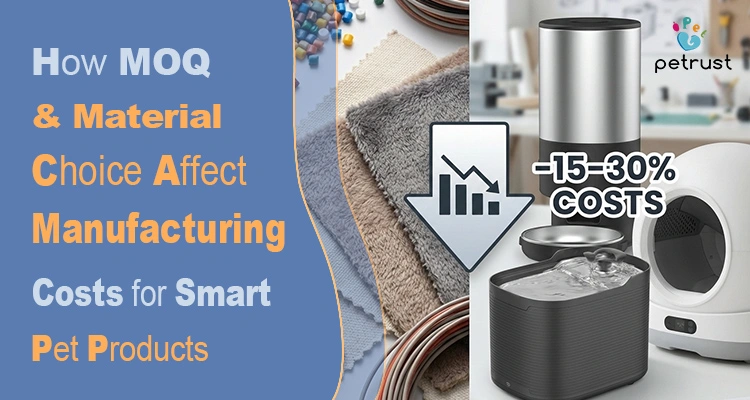
In this guide, we will break down exactly how minimum order quantity and material selection influence overall manufacturing costs, illustrate these effects with real-world case studies, and share practical strategies that can help buyers reduce expenses by 15–30% without compromising product quality.
By the end, you’ll have clear, actionable insights to optimize your procurement strategy and make decisions like an experienced global OEM buyer.
Why MOQ and Material Choice Affect Manufacturing Costs — And Why Buyers Often Underestimate It
Many global buyers assume that ordering smaller batches automatically saves money. In practice, MOQ and material choice affect manufacturing costs in ways that aren’t immediately obvious.
Beyond unit price, these decisions influence tooling expenses, labor efficiency, production timelines, and even supply chain flexibility. Overlooking these factors can quietly inflate costs or lead to unexpected delays.
For those seeking deeper insights into cost structures at the factory level, you might find our detailed smart pet product manufacturing cost analysis helpful—it illustrates how strategic planning around MOQ and materials translates directly into savings and efficiency.
Minimum Order Quantity — How It Influences Unit Price and Tooling Cost
Grasping how minimum order quantity affects production cost is crucial for optimizing procurement. Take tooling as an example: a mold for an automatic cat feeder might cost $5,000.
Producing only 500 units means the tooling adds $10/unit, while scaling to 2,000 units drops the tooling cost to $2.50/unit—a significant difference in your bottom line.
A practical tip: adjust the batch size strategically and leverage factory insights. This approach is especially effective for smart pet feeder MOQ optimization, allowing brands to balance cost with inventory flexibility. You can also consult smart pet product tooling & mold cost insights to see how different tooling strategies influence unit pricing.
Real-World MOQ Case Study: Smart Feeder vs Cat Litter Box
Understanding how MOQ impacts cost is easier with concrete examples:
- Smart feeder: MOQ 1,000 units → $15/unit
- Cat litter box: MOQ 500 units → $20/unit
Reviewing OEM MOQ cost breakdown and low MOQ vs high MOQ unit price clearly illustrates the hidden savings achievable by scaling orders. You might find it helpful to see how Petrust® optimized a cat feeder order from 500→1,500 units and reduced cost by 27%—get your personalized simulation today.
Additional strategies for cost reduction can be found in bulk order discounts and cost-saving strategies, which provide actionable methods to save without sacrificing quality.
How Material Choice Changes Cost — Beyond Raw Material Price
Selecting materials is about far more than the raw cost per kilogram. How material affects durability and cost significantly shapes production efficiency, defect rates, shipping weight, and long-term after-sales performance.
Savvy buyers consider these factors when sourcing eco-friendly and high-performance materials for OEM smart pet products.
For a closer look at efficiency and waste in manufacturing, you can reference factory efficiency and waste impact guide, which details how material choices influence operational and environmental outcomes.
Plastic vs Stainless Steel and ABS vs PP Cost Comparison
Comparing materials for smart pet products highlights substantial cost differences:
- ABS: lower cost, shorter molding cycle, ideal for feeders’ outer shells
- PP: slightly higher cost, improved chemical resistance, reduces defective rates
- Stainless steel: highly durable, increases unit weight and shipping cost
These comparisons emphasize material selection tips for smart pet products to achieve a balance between cost-effectiveness and perceived quality.
Research published in Materials journal further demonstrates a systematic approach to optimizing materials for cost, performance, and environmental impact—insights that can guide OEM decisions effectively.

Sustainable / Eco-Friendly Material Cost Considerations
Eco-conscious markets increasingly demand sustainable materials. Choosing materials for cost-effective OEM production requires careful evaluation of sustainable / eco-friendly material cost considerations.
Although eco-friendly options may have higher upfront costs, they can reduce returns, enhance brand reputation, and generate long-term savings through durability and regulatory compliance. Smart buyers recognize that these investments support both profitability and brand integrity.
MOQ and Material Choice Affect Manufacturing Costs — Cost Trap or Strategic Advantage?
MOQ and material choice affect manufacturing costs far more than many buyers anticipate. Choosing a low MOQ with high-spec materials can quickly become a cost trap, inflating unit prices and limiting flexibility.
Conversely, a well-considered MOQ paired with optimized materials can turn cost management into a competitive advantage, freeing up budget for design enhancements, marketing, or expanded production runs.
You might find our guidance on negotiating transparent OEM pricing tips helpful when discussing pricing structures with suppliers.
Subtle adjustments at this stage often have an outsized impact. By balancing batch size, tooling costs, and material selection, you can control production efficiency and unlock savings without compromising quality—a lesson many first-time OEM buyers learn the hard way.
How MOQ and Material Choice Affect Manufacturing Costs in Real Scenarios
Practical insights often speak louder than theory. Take a look at how different combinations of MOQ and material choice influence unit costs:
| Product | MOQ | Material | Unit Cost |
| Smart Feeder | 500 | ABS | $22 |
| Smart Feeder | 1,500 | ABS | $16 |
| Cat Litter Box | 300 | Stainless Steel | $28 |
| Cat Litter Box | 1,000 | PP | $20 |
By reviewing smart pet product unit cost optimization, you can see how strategic decisions on MOQ and materials create tangible savings.
Beyond cost, long-term environmental impact matters: applying life-cycle assessment (LCA) helps buyers understand the footprint from raw material extraction to end-of-life, enabling more sustainable and profitable choices.

Common Mistakes Buyers Make That Drive Up Cost
Many brands inadvertently increase expenses through simple oversights:
- Choosing a low MOQ without accounting for tooling costs
- Selecting premium materials for non-critical components
- Overlooking factory-level insights and process recommendations
Grasping how material and MOQ decisions affect unit price helps buyers avoid these pitfalls. Transparent negotiation and proactive factory engagement are critical, particularly as tariffs, labor costs, and energy expenses grow more significant—highlighted in a 2025 survey of manufacturing leaders.
For additional hidden cost considerations, you might find hidden costs in smart pet product imports helpful.
How OEM Buyers Can Optimize MOQ and Materials Without Sacrificing Quality
Seasoned OEM buyers know that cost optimization is a careful balance, not a compromise. MOQ and material choice affect manufacturing costs, but thoughtful trade-offs allow you to reduce expenses while preserving performance and durability.
Components That Require High-Spec Materials vs Areas to Reduce Cost
- Use premium materials only for critical components
- Lower-spec, durable materials are acceptable for shells, packaging, and non-functional parts
These practices are examples of material selection and manufacturing cost strategies, demonstrating how to reduce manufacturing cost through MOQ and material choice without risking quality.
Factory-Level Optimization: How Experienced OEMs Help Buyers Save 15–30%
Top OEMs, including Petrust®, offer actionable insights for buyers:
- Adjusting MOQ to balance tooling cost and unit price
- Selecting cost-effective yet durable materials
- Reducing rework and defective rates through material choice
By leveraging factory-level cost analysis and focusing on key OEM cost drivers—MOQ and materials, buyers can save 15–30% while maintaining high-quality standards.
Partnering with an experienced OEM like Petrust®, with over 12 years of expertise, ensures that every optimization lever—from batch size to material selection—is applied effectively, maximizing ROI for your smart pet products.
You can also request a personalized simulation based on Petrust®’s proven optimization strategies to plan your next smart pet product order, or request a customized cost breakdown from your OEM today for actionable insights tailored to your production goals.
Key Takeaways and Actionable Next Steps
MOQ and material choice affect manufacturing costs in multiple ways—beyond what’s immediately visible in a quote.
Every decision, from tooling setup to batch size, and even material durability, can ripple through your production plan. Paying attention to defect rates, mold longevity, and shipment weight can save more than just money—it protects timelines and brand reputation.
- Consider tooling requirements, batch size, material durability, and defect rates before finalizing orders.
- Ask your factory these three key questions before negotiating price or MOQ—you might find this helps uncover hidden cost drivers.
- Request a cost breakdown based on your target MOQ to make data-driven procurement decisions and forecast your ROI with confidence.
A thoughtful approach here sets the stage for smoother manufacturing and fewer surprises down the line. By connecting each step, from material selection to order size, buyers can translate small insights into meaningful savings.
FAQ — Common Questions About MOQ and Material Choice in Pet Product Manufacturing
1. What is the minimum order quantity for smart pet products and why does it matter?
It directly determines unit cost and tooling amortization. Producing smaller batches often costs more per unit, which can add up across multiple SKUs.
2. How do different materials affect unit cost and production efficiency?
Material choice influences molding cycles, defective rates, shipping weight, and long-term durability—factors that all feed into your total landed cost.
3. Can I reduce cost without sacrificing product quality?
Yes. By combining optimized MOQ with strategic material choice and guidance from experienced factories, buyers can maintain quality while improving profitability.
4. How can OEM manufacturers help optimize my cost structure early?
Experienced OEMs can assist in redesigning components, selecting cost-efficient materials, and setting optimal MOQs before tooling begins, helping prevent downstream production issues.
5. How do I negotiate MOQ discounts for eco-friendly materials?
Collaborate with your OEM early to identify high-impact components suitable for eco-friendly materials, then adjust batch sizes strategically to reduce cost without compromising your sustainability goals.
6. What’s the best approach to balance MOQ and shipping costs for global orders?
Evaluate total landed cost by combining MOQ, material weight, and shipping logistics. Guidance from experienced OEM partners, like Petrust®, can help optimize both production and delivery efficiency.
Conclusion
Every procurement decision—MOQ and material choice affecting manufacturing costs—has a direct impact on unit cost, production timelines, and overall profitability.
By understanding key cost drivers, leveraging factory expertise, strategically selecting materials, referencing lifecycle and transparency methods, and working with trusted OEMs like Petrust®, buyers can realistically reduce total production costs by 15–30%.
Start taking control of your costs today—request a free cost simulation or OEM consultation and make your pet product sourcing smarter, more strategic, and more profitable.