
How to start a pet brand has become one of the most searched questions among entrepreneurs entering the booming pet industry—and for good reason. The opportunity is real, but so are the challenges.
Behind every successful pet brand is not just a great idea, but a series of smart, well-timed decisions that turn that idea into a scalable business.
Stepping into this space today means entering a market shaped by rapid pet care industry growth and the ongoing pet humanization trend. Pet owners are no longer simply purchasing products—they’re choosing solutions that improve their pets’ health, comfort, and daily lives.
This shift creates incredible opportunities for new brands, but it also raises the bar for what customers expect.
At the same time, many founders begin their journey to start a pet business with enthusiasm, only to encounter unexpected roadblocks. The reality is that a significant number of new brands never move beyond their first product launch.
Not because the idea lacked potential, but because the execution path wasn’t fully thought through.
Common challenges tend to surface quickly. Some founders underestimate the true startup cost pet business, while others misread demand or partner with the wrong suppliers.
In many cases, the core issue comes down to a lack of clarity around product-market fit, which leads to slow sales, excess inventory, and increasing pressure on cash flow.
These are not rare mistakes—they’re part of the learning curve that nearly every brand faces at some point. The difference lies in how early those risks are identified and how strategically they are managed.
This is why this guide goes beyond a typical pet business startup guide. It’s designed with real-world challenges in mind, helping you move forward with clarity and confidence.
This guide is built to help you:
- Avoid costly mistakes
- Make smarter sourcing decisions
- Understand real costs and risks
- And ultimately, build a pet brand that actually scales
Pet Industry Growth Snapshot (2024–2026)
Momentum in the pet space is no longer subtle—it’s visible across every major market.
Recent data from the American Pet Products Association shows that U.S. pet industry expenditures surpassed $147 billion in 2024, setting yet another record.
This steady climb is mirrored globally, with insights from the American Veterinary Medical Association confirming that pet ownership continues to expand across households year after year.
This growth isn’t just about more pets—it reflects a deeper shift in how people care for them. Spending is becoming more intentional, more premium, and more experience-driven.
Why this matters for you:
- The pet care industry growth is not slowing down
- Consumers are shifting toward premium pet products
- Smart devices are becoming a new standard
Taken together, this signals something bigger than a temporary spike. It’s a structural evolution of the market—one that continues to open doors for brands that position themselves thoughtfully and act early.
How to Start a Pet Brand: Understanding the Real Opportunity in 2026
Entering the market today isn’t just about timing—it’s about clarity.
Founders exploring how to start a pet brand in 2026 are stepping into a landscape shaped by both innovation and rising expectations.
The opportunity is real, but it rewards those who align product strategy with where the industry is actually heading.
Pet Industry Trends and Smart Pet Product Opportunities
Across global markets, the direction is becoming increasingly clear.
Data from the European Pet Food Industry Federation highlights a strong shift toward premium, health-focused solutions, especially in European regions. At the same time, technology is reshaping how pet care products are designed and used.
The rise of smart pet technology is one of the most defining changes. Products like automatic feeders, smart litter boxes, smart pet water fountain, and connected pet cameras are no longer niche—they’re becoming part of everyday pet ownership.
Alongside this, demand for premium pet products continues to grow as pet owners invest more emotionally and financially in their pets’ well-being. Products are no longer just functional—they’re expected to reflect lifestyle, care, and trust.
This creates a unique window of opportunity:
- Functional innovation (smart devices)
- Emotional branding (premium lifestyle positioning)
Brands that combine both tend to stand out faster and build stronger customer loyalty.
You might find it helpful to evaluate emerging categories more strategically—this breakdown of Smart Pet Product Opportunities for Startups offers a clearer picture of where innovation and margin potential intersect.
Profitable Pet Business Ideas vs Saturated Markets
One of the most common challenges when learning how to start a pet brand is choosing the right product category. Not all opportunities carry the same potential, and entering the wrong niche can slow growth before it even begins.
Some segments—like generic toys or low-cost accessories—are already highly saturated, making it difficult to compete without aggressive pricing. Meanwhile, other categories continue to expand, especially those tied to health, convenience, and technology.
When evaluating ideas, it helps to focus on:
- Problem-solving products
- Recurring-use items (high repeat purchase rate)
- Products with strong emotional value
These categories tend to create more stable revenue streams and stronger brand differentiation over time.
For a more structured way to filter ideas, you might find Pet Business Ideas for Entrepreneurs useful, especially when compared alongside Best Pet Product Niches in 2026 to identify where real demand still exists.
Step 1 – How to Start a Pet Brand by Choosing the Right Niche
The first real decision in how to start a pet brand often feels exciting—but also a little overwhelming. With so many directions in the pet industry, it’s easy to feel pulled toward whatever looks popular in the moment.
The truth is, your niche quietly determines almost everything that comes after: your costs, your competition level, and even how easily your brand connects with customers.
Best Pet Product Niches and Trending Pet Products in 2026
A strong niche usually sits at the intersection of opportunity and clarity.
The most sustainable categories tend to share a few key traits:
- Demand is growing
- Competition is not fully optimized
- You can build differentiation
In 2026, several directions continue to gain momentum:
- Smart feeding systems
- Health monitoring products
- Eco-friendly pet supplies
Beyond selecting a category, there’s a deeper layer that many first-time founders overlook: How to Enter the Pet Market in a way that actually positions your brand for long-term relevance.
This is where a structured Pet Product Market Entry Strategy becomes especially valuable. It helps you look beyond surface-level trends and evaluate competition, pricing gaps, and positioning before committing budget or production.
How to Validate Demand Before You Invest
Before placing an order, taking a moment to validate demand can make a meaningful difference in your outcome.
Many early-stage founders skip this step, especially when they come across attractive pricing or a supplier offering flexible MOQ (minimum order quantity) terms.
A more grounded approach starts with simple but reliable validation methods:
- Amazon keyword analysis
- TikTok trend tracking
- Competitor review analysis
The goal is not perfection—it’s clarity. Confirming real demand before committing capital often prevents the kind of inventory pressure that slows down new brands in their early stages.
Want to validate your niche with real market data?
Before you move forward, it’s worth checking:
- Smart Pet Market Insights → understand where demand is growing
- Smart Pet Industry Rankings → see which products and brands are winning
These insights can help you avoid entering categories that are already saturated or slowly losing momentum, giving you a clearer starting point for how to start a pet brand with confidence.
Step 2 – Validate Your Product and Avoid Costly Startup Mistakes
Once a niche feels promising, the next step is turning that idea into something tangible.
This is often where expectations meet reality, and where careful validation becomes especially important for anyone learning how to start a pet brand in a sustainable way.
How to Test Product-Market Fit with Low Risk
Reaching product-market fit doesn’t require large upfront commitments. In fact, many successful brands start small and refine based on real feedback rather than assumptions.
A more cautious approach usually includes:
- Small test orders
- Pre-orders or crowdfunding
- Low-volume production with a low MOQ pet product supplier
This method reduces financial exposure while allowing real customer behavior to guide your next steps.
Case: A Failed Pet Product Launch Due to Poor Validation
A European startup decided to move quickly and placed an order for 3,000 smart feeders from an OEM pet product manufacturer China without validating demand.
On paper, the numbers seemed reasonable, and the production timeline looked efficient.
- Unit cost: $28
- Total order value: ~$84,000
- Lead time: 45 days
What they didn’t fully account for was the market environment at the time:
- Market saturation
- Weak differentiation
- Poor customer feedback on similar products
Once launched, the challenges became clear:
- Low conversion rate (<1.5%)
- High customer acquisition cost
- Negative reviews on competing products
The outcome was difficult to recover from:
- Over 70% inventory remained unsold after 6 months
- Severe cash flow pressure
- Forced discounting that weakened brand positioning
Situations like this are more common than many expect, especially when early momentum feels urgent.
This is exactly why understanding How to Launch a Pet Product Brand step-by-step before scaling can significantly reduce avoidable risk.
Still unsure if your product idea is viable?
At this stage, taking a closer look at product development details can be especially helpful. You might find it useful to explore our Smart Pet Product Development section, where you can learn more about:
- How products are designed and tested
- Common product failure risks
- Engineering considerations before mass production
A little extra clarity here often saves months of trial, error, and avoidable cost later in the journey.
Step 3 – Build a Pet Brand That Customers Trust
Trust is often the quiet factor behind every successful pet brand.
It doesn’t show up immediately in spreadsheets, but it directly shapes whether customers come back, recommend your products, or move on after a single purchase.
When thinking about how to start a pet brand, building trust early is not just helpful—it becomes the foundation everything else depends on.
Pet Brand Positioning Strategy: Premium vs Mass Market
Positioning is where your brand story starts to take shape, and it directly influences how much customers are willing to pay.
There are two common directions:
- Mass market (price-driven)
- Premium (value-driven)
Premium brands tend to grow faster in the long run because they align closely with the pet humanization trend, where pet owners prioritize quality, safety, and emotional connection over price alone. It’s less about being the cheapest option and more about being the most trusted one.
For founders still refining direction, a structured Pet Brand Positioning Strategy can be helpful in avoiding the common trap of competing only on price, which often leads to thin margins and low brand loyalty.
Branding for Pet Products: Emotional Value Drives Pricing
Pet products sit in a unique space where emotion plays a major role in every purchase decision.
Customers are rarely just buying a product—they’re choosing something they feel comfortable trusting for a beloved companion.
That emotional layer directly impacts:
- conversion rate
- Customer loyalty
- Long-term profitability
Strong branding helps bridge that emotional gap. It gives customers confidence before they even try the product, which often matters more than technical specifications.
To build that foundation early, you might find How to Build a Pet Brand helpful, especially when shaping your identity, messaging, and customer perception from day one.
Step 4 – How to Start a Pet Brand with the Right Manufacturing Strategy
Once positioning is clearer, attention naturally shifts toward how products are actually made. This stage often determines scalability, cost structure, and even product quality consistency over time.
For many founders learning how to start a pet brand, manufacturing decisions quietly become one of the most impactful turning points.
Private Label Pet Products vs OEM vs ODM Explained
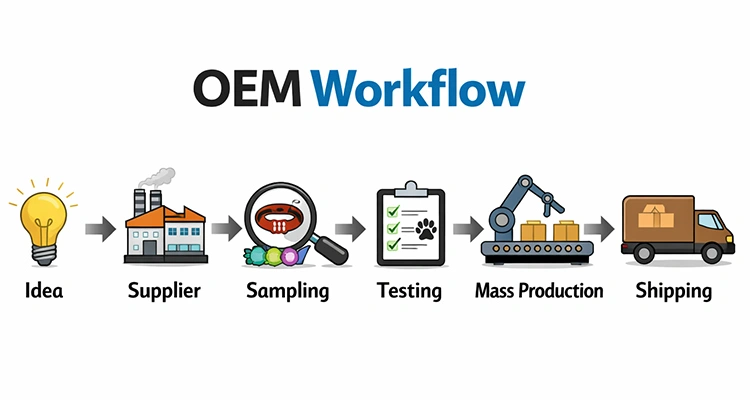
Understanding OEM vs ODM pet products helps you choose the right production path based on your goals and timeline.
- Private label: fastest launch
- OEM: customized manufacturing
- ODM: ready-made designs
For many early-stage brands, Private Label Pet Products for Startups offer a balanced entry point—faster to launch, easier to control, and less risky while validating market demand.
How to Find Pet Product Manufacturers and Suppliers
Supplier selection is rarely just a procurement task—it often determines whether a brand can scale smoothly or struggles with constant issues.
The right partner can support growth, while the wrong one can quietly slow everything down.
Key factors to evaluate:
- Experience and specialization
- Transparent lead time
- Flexible MOQ
- Proven quality inspection processes
For a more structured approach, you might find How to Find Pet Product Manufacturers helpful in avoiding costly missteps during early sourcing decisions.
When speaking with potential suppliers, it often helps to ask questions like:
- Are they a reliable OEM pet product manufacturer China?
- Do they offer scalable production?
- Can they help optimize costs?
Many founders underestimate this stage, which is why supplier mismatch remains one of the most common challenges in global sourcing.
Research from the World Trade Organization also highlights how transparency and supplier reliability are essential for maintaining stability in international supply chains, especially for smaller brands.
Choosing the right supplier is where most brands succeed or fail.
Before making a decision, it’s worth taking a step back and reviewing:
- Pet product manufacturer guides
- Factory audit checklists
- OEM/ODM decision frameworks
These resources can help bring clarity to a process that often feels overwhelming at first, while reducing the risk of avoidable and expensive supplier mistakes.
Step 5 – Product Development, Sampling, and Quality Control
Turning an idea into a real product is often the point where excitement meets reality.
Many founders realize that when they begin working through how to start a pet brand, success depends less on the idea itself and more on how smoothly it moves through development, testing, and refinement.
This stage shapes not only your product—but also your brand reputation from day one.
From Idea to Prototype: Pet Product Development Process
Every successful product goes through a structured product development cycle, even when it looks simple from the outside.
Each stage plays a role in reducing risk and improving usability:
- Concept design
- Engineering
- Sampling
- Testing
This is often where communication with your supplier becomes especially important. A responsive and detail-oriented partner can shorten iteration cycles and help you avoid costly redesigns later.
Many founders find that early collaboration here directly influences how smoothly the rest of the launch unfolds.
Quality Control Checklist for Pet Product Manufacturing
One of the most underestimated risks in early-stage sourcing is pet product quality control issues.
These issues don’t just affect one shipment—they can quietly damage customer trust and brand perception over time.
A simple but consistent quality system usually includes:
- Pre-production inspection
- In-production checks
- Final shipment inspection
Quality isn’t just a checkpoint at the end of production—it’s a continuous process that protects everything you’re building.
When customers open your product for the first time, that experience becomes your brand in their eyes.
Costs often feel straightforward at the beginning, but they tend to become more complex as more variables appear.
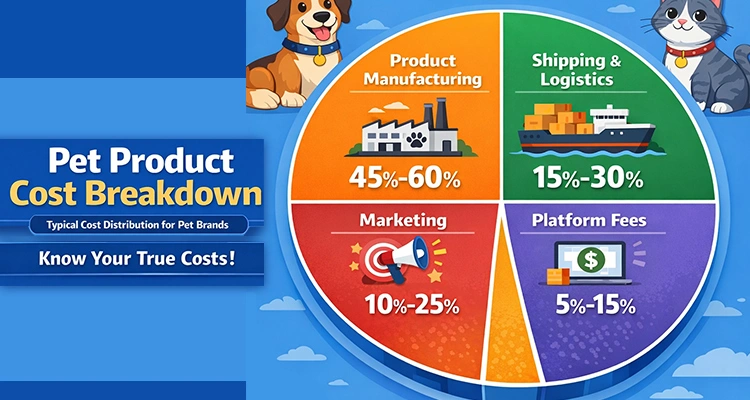
Based on aggregated sourcing data and industry benchmarks, a typical cost breakdown pet products looks like this:
| Cost Component | % Range |
|---|---|
| Product Manufacturing | 45% – 60% |
| Shipping & Logistics | 15% – 30% |
| Marketing | 10% – 25% |
| Platform Fees | 5% – 15% |
This structure aligns with insights from the U.S. Small Business Administration, which notes that underestimating operating expenses is one of the most common reasons early-stage businesses struggle to sustain growth.
Insight: Most founders focus heavily on product cost alone, but long-term profitability depends on the full landed cost and how each expense layer interacts with your pricing strategy.
Step 6 – Pet Product Pricing Strategy and Cost Breakdown
Once costs are clearer, pricing becomes the next critical decision point.
Many founders exploring how to start a pet brand find this stage more challenging than expected, because pricing is not just math—it directly shapes how customers perceive value.
Cost to Start a Pet Brand: Real Breakdown (Product + Shipping + Marketing)
One of the most common and practical questions at this stage is:
how much does it cost to start a pet brand?
A realistic cost breakdown pet products usually includes:
- Product cost
- Packaging
- Marketing
- Logistics (including shipping cost from China pet products)
Looking at costs holistically at this stage helps prevent pricing decisions that feel right on paper but become restrictive later when scaling begins.
Profit Margins in Pet Products: What Most Startups Get Wrong
Profitability challenges often come from underestimated variables rather than obvious expenses.
Common blind spots include:
- Customer acquisition cost
- Platform fees
- Return rates
To maintain stability as you grow, pricing should support sustainable profit margins pet products, not just short-term sales goals.
Many founders find that reviewing a structured Pet Product Pricing Strategy before finalizing retail prices helps avoid margin pressure later on.
Want to understand your real landed cost?
Visit our Import & Sourcing Guides to learn:
- Shipping cost breakdown
- Hidden import fees
- Cost negotiation strategies
These are often the areas where early-stage brands quietly lose margin without noticing it—until growth starts feeling harder than expected.
Step 7 – How to Sell Pet Products Online (Amazon + DTC Strategy)
Once your product is ready, the next challenge becomes just as important as the idea itself—getting it in front of the right customers.
For many founders learning how to start a pet brand, this is the stage where strategy begins to directly shape revenue.
Selling online is not just about listing products; it’s about choosing the right ecosystem to support your long-term growth.
Amazon Pet Business vs DTC Pet Brand Strategy
At this point, most brands naturally move toward two main paths:
- Amazon: faster launch
- DTC: stronger brand control
Each path serves a different purpose. Amazon offers speed and immediate exposure, which can be helpful when testing demand.
DTC, on the other hand, gives you more control over branding, pricing, and customer relationships—something that becomes increasingly valuable as your business matures.
Many successful brands eventually adopt a hybrid approach, balancing the reach of marketplaces with the independence of direct-to-consumer channels.
Choosing the right channel is not just a tactical decision—it shapes how your brand is perceived from day one.
If you're starting on marketplaces, these Amazon Pet Brand Growth Strategies might help you build traction more efficiently while avoiding common early-stage mistakes.
Early Traffic Strategies: Reviews, Influencers, and Paid Ads
Once your store is live, visibility becomes the real challenge.
Growth typically relies on a combination of trust-building and traffic generation:
- Reviews (trust)
- Influencers (awareness)
- Paid ads (scaling)
Each plays a different role in building momentum. Reviews help reduce hesitation, influencers introduce your product to new audiences, and paid ads allow you to scale what already works.
A well-structured pet ecommerce marketing strategy is essential to grow pet business online, especially in competitive niches where attention is limited and customer trust is earned quickly.
Over time, many brands also shift toward more controlled, long-term systems.
A strong DTC Pet Brand Marketing Strategies approach can help you retain ownership of your audience, improve margins, and build a more predictable revenue base.
Traffic, at this stage, is not just growth—it becomes the foundation of survival and scalability.
Ready to scale your brand beyond the first product?
Explore more in our Pet Business Growth section:
- Brand scaling strategies
- Multi-channel marketing frameworks
- Repeat purchase optimization
This is often the point where small product ideas begin turning into sustainable businesses with long-term potential.
Step 8 – How to Start a Pet Brand That Scales (Not Just Launches)
Launching a product is an important milestone, but scaling is where a real business begins to take shape.
Many founders focus heavily on getting to market, only to realize later that growth requires an entirely different level of structure and planning.
For anyone exploring how to start a pet brand, this is the stage where strategy becomes even more critical than execution.
How to Expand Your Pet Product Line Strategically
Scaling is not about adding more products for the sake of expansion—it’s about building a connected ecosystem that supports customer needs over time.
A more sustainable approach focuses on:
- Complementary products
- Cross-selling opportunities
- Increasing customer lifetime value
Each new product should serve a purpose within your brand, whether it enhances usage, solves a related problem, or naturally extends the customer journey.
Growth becomes far more stable when expansion is intentional rather than reactive.
You might find structured guidance helpful when planning your roadmap, especially through Expanding Your Pet Product Line, which focuses on growing without increasing unnecessary operational pressure.
Supply Chain Optimization and Repeat Purchase Growth
Long-term success in how to scale a pet brand depends heavily on operational consistency.
Even strong products can struggle without a stable backend system supporting them.
Key areas to optimize include:
- Inventory
- Supplier relationships
- Delivery speed
Each of these directly affects customer experience and profitability. However, one metric often determines sustainable growth more than any other: repeat purchase rate.
Real Case Study: From Startup to $1M Pet Brand
Every successful brand story starts somewhere far from certainty.
For many founders learning how to start a pet brand, the early stage feels like balancing ambition with limited information—trying to make the right calls before the market fully responds.
This case reflects that journey clearly. A startup entered the pet industry with a smart feeder, aiming at premium pet owners who value convenience and quality.
Instead of trying to compete broadly, they narrowed their focus and built around a specific user need.
Product Selection and Supplier Strategy
From the beginning, their approach was intentionally structured.
They:
- Chose a reliable supplier
- Focused on branding
- Controlled quality
Rather than rushing to scale, they prioritized consistency—especially in product experience, which later became a key driver of customer trust and repeat purchases.
Mistakes, Lessons, and Growth Turning Points
The early stage wasn’t without friction. Like many founders entering the space, they faced decisions that didn’t fully align with real market behavior.
Their early mistakes included:
- Overestimating demand
- Weak initial positioning
These are common patterns seen across common pet business startup failures, where enthusiasm often moves faster than validation.
The turning point came when they slowed down, reassessed their assumptions, and refined their strategy based on actual customer feedback rather than expectations.
Once adjustments were made, growth became more stable and predictable, eventually leading them toward a $1M trajectory.
Behind every visible success story, there are many unseen attempts that never reach traction.
Across multiple startup case studies and industry reports, failure tends to cluster around a few recurring issues:
- No product-market fit
- Poor supplier decisions
- Incorrect pricing strategy
- Weak go-to-market execution
Research from CB Insights reinforces this pattern, showing that most startups don’t fail due to lack of ideas, but because of misaligned demand, execution gaps, and operational inefficiencies.
What this really means is simple but important:
- Success is not random
- Failure is predictable—and avoidable
For founders learning how to start a pet brand, this perspective often becomes a turning point in how decisions are made early on.
Common Mistakes When Starting a Pet Brand (And How to Avoid Them)
Early-stage decisions shape everything that follows. Small missteps in sourcing, pricing, or demand validation can quietly compound into larger challenges later.
Product Selection and Supplier Strategy
When supplier evaluation is rushed or incomplete, the impact is usually felt quickly:
- Delays
- Quality issues
- Reputation damage
This is why understanding how to choose pet product manufacturer is not just a sourcing step—it’s a foundation for long-term brand stability.
Overestimating Demand and Underestimating Costs
Another frequent challenge comes from optimistic projections that don’t fully reflect market reality.
Many founders:
- Order too much inventory
- Ignore hidden costs
This combination creates one of the most common financial pressures in early-stage brands, especially when cash flow hasn’t stabilized yet.
Pet Brand Startup Checklist (From Idea to First Sales)
Structure often makes the difference between confusion and clarity when building a brand from scratch. A simple but disciplined approach can help turn ideas into measurable progress.
How to Start a Pet Brand Step-by-Step Checklist
- Validate product demand
- Choose niche
- Select supplier
- Test product
- Launch and optimize
Each step builds on the previous one, creating a more grounded path from concept to execution.
Pre-Launch and Post-Launch Action Plan
Before launch:
- Confirm supplier
- Test product
After launch:
- Optimize ads
- Improve reviews
Over time, these small but consistent actions help shape not just initial sales, but long-term brand credibility and customer trust.
FAQ: How to Start a Pet Brand and Scale Successfully
How much does it cost to start a pet brand?
What often surprises new founders is not just the upfront cost, but the ongoing expenses that come with scaling responsibly—inventory, testing, and customer acquisition all add up over time.
A more realistic approach is to think in stages rather than a single budget, adjusting spending as validation improves and demand becomes clearer.
Is private label pet products profitable?
Success usually depends on two things: how well the product is positioned in the market and how tightly costs are managed behind the scenes.
Brands that invest in branding, quality consistency, and reliable sourcing tend to perform significantly better than those competing only on price. Over time, trust becomes a stronger driver of profit than margin alone.
How to start a pet brand with manufacturers?
It also reduces unnecessary layers in the supply chain, which can improve both cost efficiency and communication.
Many founders at the early stage share similar concerns when learning how to start a pet brand, especially when trying to balance limited resources with big ambitions.
These are some of the most common questions that naturally come up along the way:
How to start a pet brand with low budget?
Start with a focused niche, validate demand before production, and work with low MOQ suppliers. Many successful brands begin with under $5,000 by prioritizing testing over scaling.
Can I start a pet brand without inventory?
Yes. Models like dropshipping or print-on-demand allow you to launch without holding stock. However, margins are lower and brand control is limited compared to private label.
Is dropshipping pet products profitable?
Dropshipping can be profitable in the short term, but it is highly competitive and difficult to scale. Most long-term successful brands transition to private label or OEM for better margins.
How to build a pet brand on Amazon?
Start with a validated product, optimize your listing with keywords and reviews, and invest in ads early. Strong branding and differentiation are key to long-term success on Amazon.
How long does it take to launch a pet product?
Typically, it takes 2–4 months from idea to launch, depending on product complexity, supplier lead time, and testing process.
Each of these questions reflects a different entry point into the same journey—building something sustainable in a competitive but opportunity-rich market.
Conclusion: Start Smart, Scale Faster, Avoid Costly Mistakes
Building a successful pet brand is rarely about finding a single winning product. It’s more about making consistent, informed decisions across every stage of the journey.
From choosing a niche to working with suppliers, from setting prices to planning for scale—each decision quietly shapes where the brand ends up.
What many founders eventually realize is that the early stages matter the most. A small misstep in sourcing or positioning can create challenges that take months to fix later on.
The encouraging part is that these risks are manageable with the right structure and guidance.
At different stages, you need different types of support:
- Market validation → Smart Pet Market Insights
- Product strategy → Smart Pet Industry Rankings
- Development & engineering → Smart Pet Product Development
- Supplier selection → Pet Product Manufacturer Guides
- Cost control → Import & Sourcing Guides
For founders refining their idea or preparing to launch, getting a second perspective can often reveal blind spots before they become costly problems.
Starting from the stage that feels most relevant is usually the most practical next step—or simply reaching out for a quick evaluation can help bring more clarity before moving forward.