
Most buyers compare CB001 and CB002 the wrong way.
They ask:
Which one has more features?
That is not the best question.
CB001 and CB002 are not simply basic vs premium.
They are two different smart hygiene platform routes.
A CB001 vs CB002 smart cat litter box comparison should not start with camera, APP functions, or which model looks more advanced in a product video.
It should start with the buyer’s launch route.
CB001 is better when your brand needs stable self-cleaning performance, lower support complexity, easier product education, and scalable OEM production.
CB002 is better when your brand needs camera monitoring, dual-band WiFi, health-related usage data, APP control, and premium connected positioning.
That difference matters.
Because the wrong model does not only affect the product page.
It affects reviews.
Returns.
Support tickets.
Certification planning.
MOQ decisions.
Packaging claims.
And whether your team can support the product after launch.
The real question is not which model looks more advanced.
The real question is which Petrust smart litter box platform your brand can sell, support, certify and scale.
Quick Decision: Should Your Brand Choose CB001 or CB002?
Not every buyer should start with CB002.
Not every buyer should choose CB001 either.
The right answer depends on your sales channel, price band, support capacity, certification needs, and whether this is your first launch or a premium line extension.

This table is not a final answer for every project.
It is a starting point.
A buyer choosing CB001 is not automatically choosing a lower-end product.
A buyer choosing CB002 is not automatically choosing the better product.
The better platform depends on channel, price band, support capacity, certification requirements, and how much connected-product complexity the brand can handle after launch.
For a private label smart cat litter box project, CB001 may reduce early support risk.
For smart cat litter box for Amazon sellers, CB001 may protect review stability.
For premium smart pet brands, CB002 may support a stronger connected story.
For smart home distributors, CB002 may fit the channel better.
For a global OEM importer, the answer may be both.
That is why this is not a simple product comparison.
It is a product platform fit decision.
CB001 and CB002 Are Two Different Smart Hygiene Platform Routes
A normal product comparison asks:
- Which one has camera?
- Which one has more functions?
- Which one looks more premium?
A better smart cat litter box platform comparison asks:
- Which model fits the business route?
- Which model creates fewer avoidable complaints?
- Which model matches the channel?
- Which model can the brand explain clearly?
- Which model can the support team actually support?
That is the real difference between self-cleaning cat litter box vs camera smart litter box.
CB001 and CB002 are both part of the Petrust® smart litter box platform family, but they are not trying to solve the same business problem.
CB001 is built for stable self-cleaning growth.
CB002 is built for premium connected differentiation.
Both can be the right answer.
Both can be the wrong answer.
The model only becomes “right” when it matches the buyer’s business route, product route, channel expectations, and after-sales capacity.
CB001 Is Built for Stable Self-Cleaning Growth
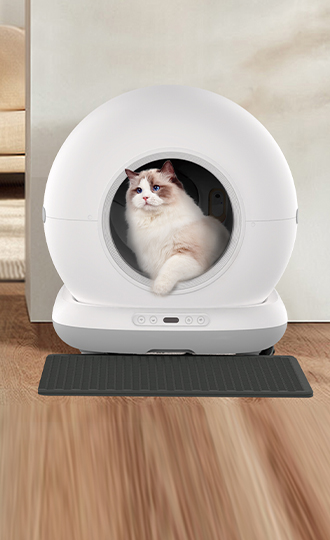
The CB001 self-cleaning cat litter box is built for buyers who need a stable self-cleaning hygiene platform before adding more connected complexity.
That matters more than many first-time buyers realize.
A brand can survive with fewer features.
It cannot survive repeated complaints about cleaning reliability, odor control, safety, waste-bin handling, or confusing daily use.
This is why CB001 should not be dismissed as the simpler route.
In real homes, cats do not care how impressive the product page looks.
They care about whether the litter space feels usable, whether the environment stays clean, and whether daily use feels predictable.
Research published in the Journal of Veterinary Medical Science also points to how litter box size, litter type and the broader litter environment can influence cat elimination behavior and user satisfaction.
That is why a stable self-cleaning hygiene platform must protect the basics before adding more connected complexity.
For many buyers, CB001 is the stronger route because it protects the basics that customers notice every day.
Does it clean reliably?
Does it control odor well enough?
Is the operation easy to understand?
Does it feel safe around cats?
Can the brand support the product without creating too many tickets?
Can the buyer scale orders without turning every shipment into an after-sales headache?
This is why CB001 is often a strong fit for a self-cleaning cat litter box OEM project, especially when the buyer is building a private label smart cat litter box line, preparing a retail program, entering Amazon, or working with wholesale channels.
CB001 is not the lower ambition choice.
For many buyers, it is the more disciplined first launch.
A first launch does not need to prove that the brand can sell every smart feature.
It needs to prove that the brand can ship a stable product, support real customers, and build trust without repeated complaint patterns.
That is what CB001 is designed to help protect.
CB002 Is Built for Premium Connected Differentiation
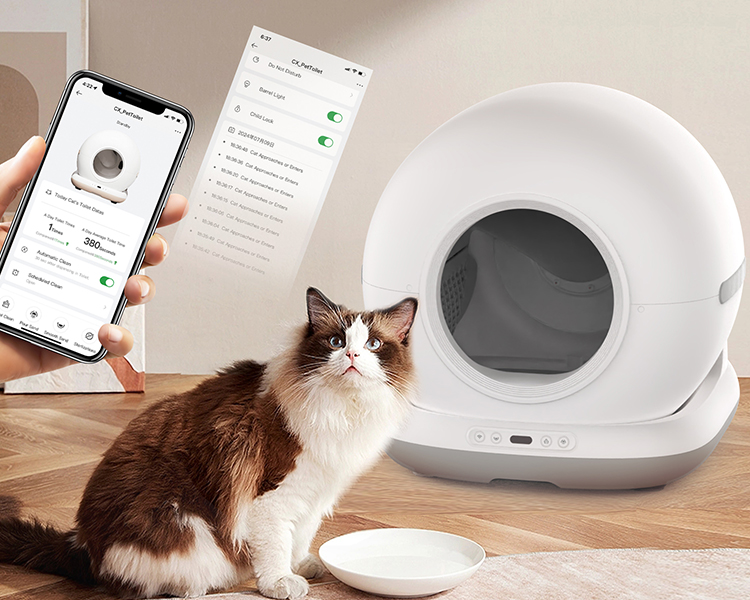
The CB002 smart cat litter box with camera is built for buyers who need premium connected differentiation.
The camera is important.
But the camera is not the whole story.
CB002 changes the product promise.
The buyer is no longer selling only self-cleaning convenience.
The buyer is selling visibility, APP-controlled smart litter box experience, dual-band WiFi, usage data, health-related observation, smart message push, and a more premium connected hygiene platform.
That can support a stronger price position.
It can also create more support pressure if the brand is not ready.
A premium camera smart litter box creates higher expectations from customers. They expect the APP to connect. They expect the camera to work. They expect the alerts to make sense. They expect the product to feel premium after purchase, not only on the product page.
That is why CB002 is not automatically better.
It is better when your market, price band and support system can carry the premium promise.
CB002 is a stronger fit for premium smart pet brands, smart litter box for smart home distributors, high-end eCommerce brands, and a global OEM importer building a premium line extension.
It is also a better fit when the buyer needs a smart cat litter box with camera OEM route and has the support capacity to handle camera, WiFi, APP and user education after launch.
If the buyer cannot support those expectations, CB002 may expose the weakness faster than CB001.
That does not make CB002 risky by itself.
It means the buyer must be ready for the route.
CB001 vs CB002 Feature Comparison: What Actually Matters
A normal feature table is not enough.
Feature count does not tell you which model fits your channel.
It does not tell you which model creates more APP/WiFi risk.
It does not tell you which model has lower support pressure.
It does not tell you whether your brand should choose CB001 first, CB002 first, or a dual-platform strategy.
So the better question is:
What does each feature protect?
And what does each feature expose?
This is why CB001 vs CB002 smart cat litter box should not be judged by feature count alone.
The buyer should ask what each feature protects or exposes.
CB001 protects launch stability.
CB002 supports premium differentiation.
Both can be good platforms.
Both can also be wrong if they are matched with the wrong channel, price band or support capability.
A camera can help premium positioning.
It can also create more support tickets.
A simpler self-cleaning platform can be easier to scale.
It can also be too conservative for a high-end connected pet-care brand.
That is the real comparison.
Not more features.
Better fit.
Which Buyers Should Choose CB001?
CB001 is usually the better starting platform when the buyer’s biggest risk is launch stability.
This does not mean CB001 is “basic.”
It means the product route is more disciplined.
For many buyers, the first commercial goal is not to look the most advanced.
It is to avoid the complaint patterns that destroy trust early.
Private Label Brands That Need a Stable First Launch
Private label buyers often want the strongest-looking product first.
That is understandable.
A product with more features feels easier to sell.
A product page with camera, APP and smart data feels more premium.
But a first smart litter box launch should not try to prove everything.
It should prove that the brand can deliver a stable product, explain it clearly, support it after launch, and avoid repeated complaint patterns.
For many private label smart cat litter box projects, CB001 is the better starting point because the buyer can focus on cleaning reliability, odor control, cat-safe operation, packaging clarity and stable user experience before adding camera-led complexity.
A first launch should not try to prove everything.
It should avoid the complaint patterns that kill review stability.
That is why a smart cat litter box private label buyer should think carefully before jumping straight into a camera model.
Logo customization and packaging customization matter.
But they do not fix a wrong platform choice.
If the route is wrong, the box design will not save the product.
If the support pressure is too high, the logo will not save the reviews.
CB001 helps many first-time private label buyers build trust first.
That is not conservative.
That is how a brand earns the right to launch a more advanced connected model later.
Amazon Sellers That Need Fewer Public Complaints
For smart cat litter box for Amazon sellers, the most dangerous issue is not missing one premium feature.
The dangerous issue is a complaint pattern that repeats in public reviews.
Odor problem.
Cleaning failure.
Confusing setup.
Waste-bin complaints.
Safety concerns.
APP questions.
If these issues appear repeatedly, the listing becomes harder to recover.
Amazon does not punish brands for having fewer features.
It punishes brands for repeated complaint patterns.
That is why CB001 may be a stronger starting point for Amazon sellers who need stable reviews, lower support pressure and a more controllable Amazon first launch.
A camera can help conversion.
But if the brand is not ready for APP, WiFi, privacy and camera-related support, it can increase return rate, bad reviews, and customer frustration.
For many Amazon sellers, CB001 can reduce the number of reasons customers complain.
That matters.
Because review stability is often more valuable than one extra feature.
CB002 can still work for an Amazon premium listing.
But only if the brand can support the premium promise.
Retail and Wholesale Buyers That Need Lower Support Complexity
Retail and wholesale buyers usually think less emotionally than startup brands.
They care about whether the product can move through the channel without creating unnecessary support friction.
A smart cat litter box for retail chains must be easy to explain, easy to package, easy to certify, easy to stock, and less likely to come back as a return.
A retail-ready smart litter box needs clear packaging, certification readiness, stable supply, low return risk, and fewer customer education problems.
A smart litter box for wholesale buyers has a similar logic.
Wholesale buyers often want products that can be explained quickly and reordered confidently.
They do not want every order to create new support problems.
Retail buyers usually do not want the most complicated product first.
They want the product that can be explained, certified, stocked, supported and reordered.
For these buyers, CB001 can be easier to place, easier to support and easier to reorder.
Which Buyers Should Choose CB002?
CB002 is the better route when the buyer is not simply trying to launch a self-cleaning litter box.
The buyer is trying to build a premium connected hygiene product.
That is a different job.
A CB002 premium platform can support a stronger price band, a more advanced product story, and a more differentiated product line.
But it requires more support readiness.
Premium Pet Brands That Need Camera-Led Differentiation
CB002 is a better fit when the buyer needs more than stable self-cleaning.
A premium smart pet brand may need camera monitoring, usage visibility, APP control and a stronger connected hygiene story to justify a higher price point.
In that case, CB002 smart cat litter box with camera can support camera-led differentiation.
CB002 makes sense when camera is not just decoration, but part of a real premium product story.
That story must be supported by the full experience.
The APP must be understandable.
The WiFi pairing process must be clear.
The camera function must match customer expectations.
The product page must explain health-related usage data responsibly.
The support team must be ready for questions after launch.
This is why premium smart pet product OEM buyers should not treat CB002 as “CB001 plus camera.”
CB002 is a smart cat litter box with camera OEM route.
That route can be powerful.
But the premium story must be real.
If the brand sells premium but cannot support APP, WiFi, camera questions and user education, CB002 may expose the weakness faster than CB001.
Smart Home and Connected Product Channels
Smart home distributors usually need a stronger connected product story.
For them, a smart litter box with dual-band WiFi, APP control, camera monitoring and usage data can fit better than a simpler self-cleaning route.
A smart home pet product is not only judged by whether it performs one task.
It is judged by whether it feels connected, modern, easy to use, and consistent with the rest of the smart home ecosystem.
For smart home channels, the product is not only a litter box.
It is part of a connected pet-care ecosystem.
That is why CB002 can be a strong fit for a connected pet product OEM project.
But connected channels also create higher expectations.
The buyer must think about APP stability, WiFi pairing, privacy messaging and smart device support before treating CB002 as the obvious answer.
If the connected experience is weak, the channel will notice.
If setup is confusing, customers will notice.
If the APP feels unstable, support pressure rises.
CB002 is worth it when the brand can support the connected experience after launch.
Global OEM Importers Building Premium Line Extensions
For a global OEM importer, CB001 and CB002 do not have to compete against each other.
They can sit in the same product line.
CB001 can support volume, stable supply and lower support pressure.
CB002 can support premium connected positioning, camera-led differentiation and a higher price band.
For larger importers, the best answer may not be CB001 or CB002.
It may be CB001 for volume and CB002 for premium extension.
This dual-platform strategy is often stronger than forcing one model to serve every market.
A CB001 and CB002 product line can help buyers serve different channels:
CB001 for mainstream self-cleaning demand.
CB002 for premium connected demand.
CB001 for lower-complexity programs.
CB002 for premium line extension.
That is a stronger smart cat litter box OEM project strategy than trying to make one model do everything.
CB001 or CB002 by Sales Channel
A product can be strong and still wrong for the channel.
That is why sales channel matters.
Amazon, retail, wholesale, private label and smart home channels punish different mistakes.
A model that works for premium eCommerce may create too much support pressure for a first Amazon launch.
A model that works for retail may not offer enough differentiation for a high-end connected pet-care brand.
Channel fit matters.
This is why buyers should not choose CB001 or CB002 only by product appearance.
A wholesale importer may prefer CB001 because the product is easier to explain and support at scale.
A premium brand may prefer CB002 because the connected features support a higher price band.
A retail buyer may choose CB001 because safety, certification readiness and low return risk matter more than camera.
A smart home distributor may choose CB002 because the connected story is the main selling point.
This is not about which model is better.
It is about which model fits the channel.
OEM Customization: What Buyers Can Customize on CB001 and CB002
This is where many buyers move too fast.
They ask:
- What is the smart cat litter box MOQ?
- Can we add our logo?
- Can we change the packaging?
- Can we customize the APP?
- Can we adjust firmware?
- Can we get samples?
These are normal questions.
But they become more useful after the platform route is clear.
A buyer should not customize the wrong route.
A buyer should not build premium packaging around a platform the brand cannot support.
A buyer should not ask for APP changes before understanding the after-sales pressure those changes may create.
Logo, Packaging and Private Label Customization
Both CB001 and CB002 can support private label planning, but the customization logic should be different.
CB001 packaging should make stable self-cleaning, odor control, safety and easy daily use clear.
CB002 packaging should explain camera monitoring, APP control, dual-band WiFi, usage data and premium connected value without overpromising.
Logo customization and packaging customization matter.
But they should support the right platform route.
A buyer should not build premium packaging around the wrong product platform.
For a custom smart cat litter box project, the buyer should think about what the package is promising.
If CB001 is selected, the message should focus on stable hygiene automation.
If CB002 is selected, the message should explain premium connected value responsibly.
OEM customization is not decoration.
It is how the product promise is shaped before launch.
That is why the OEM customization plan should match the business route.
APP, Firmware and Connected Feature Customization
APP and firmware customization require more care than logo or packaging changes.
This is especially true for CB002.
When camera monitoring, dual-band WiFi, APP control, usage data and smart alerts are involved, small changes can affect APP stability, WiFi pairing, user instructions, privacy messaging and support pressure.
APP customization and firmware customization should not be treated as decoration.
Small changes can affect user experience, support pressure and certification planning.
Some customization requests should be handled by engineering review, not only by sales discussion.
That is how a smart cat litter box OEM customization project avoids creating problems after launch.
A connected feature that sounds small in a meeting can become a support issue after launch.
A message push change can confuse users.
A firmware variation can affect testing.
An APP flow change can create more questions.
A camera feature adjustment can change user expectations.
That is why connected feature customization should be discussed with engineering discipline.
Not only with marketing ambition.
MOQ, Sampling and Launch Timeline
MOQ matters.
Sample lead time matters.
OEM launch timeline matters.
But these questions become more useful after the buyer knows the platform route.
Before asking for MOQ, buyers should know whether they are sampling a stable self-cleaning platform, a premium camera platform, or a dual-platform strategy.
Before asking for a quote, buyers should prepare:
- target market;
- sales channel;
- price band;
- expected order volume;
- customization needs;
- certification requirements;
- launch timeline.
That information helps Petrust® evaluate whether CB001, CB002 or a dual-platform strategy fits the project better.
Without that information, MOQ is just a number.
With that information, MOQ becomes part of a real launch plan.
That is the difference between casual sourcing and serious smart litter box sampling.
Certification and Export Readiness: Why CB002 Needs More Attention
CB001 and CB002 both require certification planning for export markets.
But CB002 usually needs more attention because camera, WiFi, APP control and connected features make the final configuration more sensitive.
This is not only a certification paperwork issue.
The FCC’s 2024 Internet of Things cybersecurity labeling framework is a useful reminder that wireless consumer IoT products carry security and user-trust expectations, which is exactly why a camera smart litter box should be treated as a connected product configuration, not just a pet product with one extra feature.
For OEM buyers, this means the camera version, wireless module, APP function, firmware version and final production configuration should be treated as one connected system.
Buyers should confirm whether CE certified smart cat litter box, FCC certified smart cat litter box, RoHS compliant smart cat litter box, UL smart cat litter box, TELEC certified smart litter box or other certification requirements apply to the target market.
They should also check whether the tested configuration matches the final product version, especially when wireless module, adapter, firmware or APP-related features change.
A certificate is not just a file.
It must match the product the buyer actually plans to sell.
That is especially important for WiFi smart litter box certification and camera smart litter box certification.
A CB002 configuration with camera, APP control and dual-band WiFi may need more careful test report verification than a simpler configuration.
Buyers should also confirm certification document verification before finalizing packaging claims, marketplace submissions or customs preparation.
This is part of export readiness.
Not paperwork at the end.
A certificate that does not match the final production configuration can create delays, marketplace issues or buyer-side compliance risk.
That is why certification should be discussed before production version confirmation.
Not after mass production.
The Mistake: Choosing the Model Before Choosing the Business Route
This is the mistake we see too often.
The buyer compares CB001 and CB002.
CB002 looks more premium.
The camera looks easier to sell.
The product page looks stronger.
The boss likes the higher price.
So the buyer chooses the premium-looking route before checking the business route.
Then launch begins.
APP questions increase.
WiFi setup becomes a support topic.
Camera expectations become harder to manage.
Return risk rises.
Support cost starts eating margin.
The wrong model usually looks attractive before launch and expensive after launch.
This is the part many buyers underestimate.
The wrong platform does not only create a product issue.
It creates a business cost.
It affects the support team, the review profile, the reorder confidence, and the margin that looked healthy before launch.
That is why model choice should follow business route, not the other way around.
A wrong smart cat litter box platform does not always look wrong during sampling.
Sometimes the sample looks good.
The product page looks strong.
The selling story looks better than the stable model.
But sample vs launch is not the same thing.
And sample vs mass production is where many buyers learn the real cost of platform mismatch.
A model can be correct for one buyer and wrong for another.
CB002 can be strong for a premium smart pet brand.
It can be too much for a first Amazon launch.
CB001 can be strong for retail.
It can be too conservative for a premium connected channel.
The problem is not the model.
The problem is choosing the model before choosing the business route.
Buyer Route Summary: CB001, CB002 or Both?
- a safer first smart litter box launch;
- lower support complexity;
- stronger focus on cleaning reliability, odor control and cat-safe operation;
- easier private label packaging;
- better review stability for Amazon or retail;
- scalable OEM production before adding camera complexity.
- premium connected positioning;
- camera monitoring as part of the product story;
- dual-band WiFi and APP-controlled experience;
- health-related usage data;
- a stronger smart home or premium eCommerce route;
- enough support capacity for APP, WiFi, camera and user education.

- CB001 for volume;
- CB002 for premium line extension;
- different products for different channels;
- a dual-platform strategy instead of forcing one model to serve every market.
CB001 is not the weaker route.
CB002 is not the automatic upgrade.
The right answer depends on launch route, channel, support capacity and brand positioning.
How Petrust® Helps Buyers Choose Between CB001 and CB002
Petrust® is not a third-party ranking site.
We are not standing outside the industry handing out abstract advice.
Petrust® manufactures smart pet products ourselves.
That means this framework is not only for buyers.
It is also a responsibility system we use to check whether a project truly fits a platform before sampling begins.
As a smart pet hygiene product manufacturer, Petrust® does not treat CB001 and CB002 as a simple price ladder.
We treat them as different platform routes for different business risks.
The goal is not to push the model with more features.
The goal is to reduce mismatch between product promise and business capability.
This is also why Petrust® may sometimes slow the conversation down when a buyer starts with “What is the MOQ?”
MOQ matters.
But MOQ does not tell us whether the buyer is choosing the right platform.
Before we talk seriously about sampling, packaging or APP customization, we want to understand whether the buyer is building a stable self-cleaning route, a premium connected route, or a dual-platform strategy.
That is not sales resistance.
That is project responsibility.
What Petrust® Checks Before Recommending a Platform
Before making a platform recommendation, Petrust® checks:
- target market;
- sales channel;
- price band;
- first launch or line extension;
- private label needs;
- APP support capacity;
- certification requirements;
- packaging and logo needs;
- expected MOQ;
- launch timeline;
- after-sales readiness.
This is not a formality.
It is part of OEM evaluation.
A buyer planning a first launch on Amazon does not have the same risk profile as a global importer building a premium line extension.
A buyer selling through retail does not have the same support model as a smart home distributor.
A buyer asking for camera does not always need camera first.
A buyer asking for CB001 may sometimes need CB002 later.
That is why project fit matters.
Petrust® does not treat CB001 and CB002 as a simple price ladder.
We treat them as different platform routes for different business risks.
This is part of our manufacturing responsibility system.
We use it to avoid recommending a platform that looks attractive at sampling but creates unnecessary pressure after launch.
When Petrust® May Recommend CB001 First
Petrust® may recommend CB001 first when the buyer is entering the category for the first time, building a private label project, targeting Amazon review stability, preparing a retail program, or trying to reduce support complexity.
This does not mean CB001 is less valuable.
It means CB001 fits the launch risk better.
If CB002 creates more support burden than the buyer can handle, recommending CB001 first is not conservative.
It is responsible.
A stable first launch can be more valuable than an overcomplicated first launch.
A brand can always add a premium connected model later.
But recovering from bad reviews, high support cost and early return pressure is much harder.
When Petrust® May Recommend CB002 Is Worth It
Petrust® may recommend CB002 when the buyer has premium connected positioning, enough price room, a smart home channel, a premium line extension strategy, or enough APP/WiFi support capacity.
In that situation, CB002 is not just a camera model.
It becomes part of a connected hygiene platform strategy.
CB002 is worth it when the buyer is not only buying camera, but building a connected hygiene product line that can support the promise after launch.
The buyer should be ready to explain camera value, support APP questions, manage WiFi setup issues, position health-related usage data responsibly and maintain a premium user experience.
When that readiness exists, CB002 can be a strong premium route.
When it does not, CB001 may be the better first move.
FAQ About CB001 vs CB002 Smart Cat Litter Box
Do Not Choose the Model First. Choose the Route First.
CB001 and CB002 should not be compared as basic vs premium.
They should be compared as two different smart hygiene platform routes.
CB001 is stronger when your brand needs stable self-cleaning performance, lower support complexity and scalable OEM production.
CB002 is stronger when your brand needs camera monitoring, dual-band WiFi, health-related usage data and premium connected positioning.
For some buyers, CB001 is the right first launch.
For some buyers, CB002 is the right premium move.
For larger buyers, both platforms may belong in the same product line.
The real question is not which model has more features.
The real question is which platform fits your market, channel, support capability and brand position.
Do not choose the model first.
Choose the route first.
If your team is comparing CB001 and CB002 for a private label, Amazon, retail, wholesale or premium OEM project, Petrust® can help evaluate your target market, channel, price band, customization needs, certification requirements, MOQ expectation and launch timeline before sampling begins.
The inquiry does not need to start with a perfect specification sheet.
It can start with a simple question:
We are comparing CB001 and CB002. Which platform fits our launch route better?
That is the right place to begin.
That question protects more than the sample order.
It protects the launch.