
Smart pet industry trends are redefining how modern pet brands, retailers, and innovators think about pet care—and the shift is happening faster than many expected. Around the world, pet owners are searching for smarter ways to care for their animals while balancing busy lifestyles.
Convenience, health monitoring, and connected experiences are no longer “nice-to-have” features. They are quickly becoming the standard that customers expect from the products they bring into their homes.
Over the past decade, the global pet economy has quietly moved through a remarkable transformation. A market once dominated by food, toys, and veterinary services is evolving into a technology-driven ecosystem. The rise of pet technology, connected devices, and data-driven solutions is changing how people feed, monitor, and care for their animals on a daily basis.
This shift is closely tied to the growing future of smart pet industry innovation. Households that once relied on basic bowls and litter trays are now adopting devices like smart feeding systems, automated litter boxes, and AI powered pet devices that simplify routines and provide valuable insights into pet health and behavior.
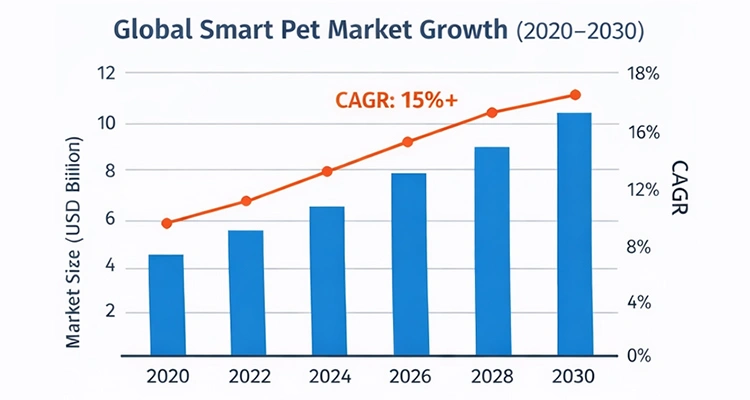
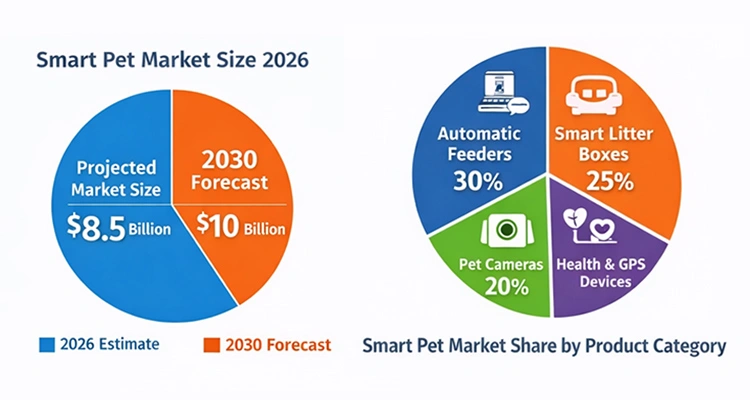
Market data highlights how quickly this transformation is accelerating. Industry reports estimate that the global smart pet market size reached approximately $2.3–$2.6 billion in 2023 and could exceed $8–10 billion by 2030.
That represents a projected compound annual growth rate (CAGR) of roughly 15–18% as connected pet technology becomes more widely adopted across global markets.
Behind these numbers lies a deeper behavioral change among pet owners. As pet ownership continues to grow worldwide, consumers are increasingly willing to invest in intelligent pet products that deliver convenience, automation, and meaningful health insights.
Research from the American Pet Products Association (APPA) shows that U.S. pet industry spending surpassed $147 billion in 2023 alone—clear evidence that pet owners are prioritizing premium and technology-enabled care solutions.
Looking ahead, the smart pet industry trends 2026 are being shaped by several powerful forces:
- Rapid adoption of AI in pet care and data-driven pet monitoring
- The expansion of IoT pet monitoring devices and connected ecosystems
- Increasing popularity of automatic pet care devices
- Growing venture capital interest in pet innovation startups
These developments are not occurring in isolation. Each innovation contributes to a broader shift toward a connected smart pet ecosystem, where devices, apps, and data work together to support healthier and more convenient pet care.
For readers interested in the product innovations driving this transformation, you might find our Top 10 Smart Pet Product Trends in 2026 guide helpful. It highlights the emerging technologies and product categories that are shaping the next generation of smart pet devices.
This global pet tech industry report takes a closer look at the forces behind today’s pet tech market trends, the accelerating smart pet industry growth rate, and the opportunities emerging in the future of pet care technology.
What Is the Smart Pet Industry?
The smart pet industry represents a rapidly growing segment of the pet economy, focused on technology-enabled pet care products and connected devices designed to improve convenience, automation, and animal health monitoring.
It’s a space where technology meets the daily routines of pet owners, making life easier while supporting pets’ well-being in ways traditional products cannot.
Unlike conventional pet products, smart devices combine hardware, software, and data connectivity to deliver actionable insights and enhanced control for owners. From feeding schedules to real-time health alerts, these tools are shaping the expectations of modern pet caregivers.
The smart pet technology ecosystem can be divided into three primary categories:
Automated Pet Care Devices
These are products that take over routine tasks, saving time for busy pet owners and reducing the stress of daily care.
Examples include:
- automatic pet feeders
- self-cleaning litter boxes
- smart pet water fountains
These devices ensure that pets are nourished, hydrated, and comfortable, even when owners are away or tied up with work and family commitments.
Pet Monitoring and Tracking Devices
Monitoring a pet’s activity, behavior, and location has moved far beyond traditional collars. Today’s devices provide data-driven insights that empower owners to respond proactively to health or behavioral issues.
Examples include:
- AI pet cameras
- GPS pet trackers
- wearable health monitoring collars
By integrating analytics, these devices help owners understand pets’ daily habits, ensuring better care and peace of mind.
Connected Pet Technology Platforms
This category unites multiple devices under a single ecosystem, often powered by mobile apps and cloud platforms.
Examples include:
- IoT pet monitoring devices
- smart home integrated pet devices
- AI-powered pet health tracking systems
These platforms allow seamless communication between devices, making pet care smarter, more responsive, and more convenient.
Together, they form the backbone of the modern smart pet ecosystem, where data and automation work hand-in-hand to enhance pet health, safety, and daily care.
Global Smart Pet Market Overview: Market Size, Growth & Forecast
The global smart pet market is emerging as one of the fastest-growing segments within the overall pet industry. Accelerated by technological adoption and evolving consumer expectations, this sector is expanding at a remarkable pace.
Recent research indicates a compound annual growth rate (CAGR) of approximately 15–18%, significantly outpacing the broader pet products market. By 2030, global smart pet device sales are projected to exceed $8–10 billion, as owners across North America, Europe, and Asia embrace connected pet technology.
Pet ownership trends also support this growth. According to the World Animal Foundation, over 66% of households in the United States own at least one pet, with global ownership continuing to rise, particularly in urbanized regions.
Several factors are fueling this expansion:
- Premiumization of Pet Care – Pet owners are increasingly willing to invest in high-quality products. Growing premium pet product demand means more households are adopting digital pet monitoring and connected pet devices that offer convenience and advanced health insights.
- Urban Lifestyles – Busy schedules and dual-income households create a need for automated pet care systems. Devices such as smart feeding systems and automatic pet care devices ensure pets are well cared for even during long workdays or travel.
- Smart Home Integration – As smart homes become more prevalent, the adoption of connected pet technology accelerates. IoT pet monitoring devices can now integrate with home automation systems, allowing owners to track and respond to pet needs from anywhere.
Smart Pet Industry Timeline
A quick look at key milestones highlights how quickly this industry has evolved:
| 2015 – Early smart feeders and pet cameras enter the market |
| 2018 – Connected IoT pet devices start integrating with mobile apps |
| 2020 – Rapid growth in smart home integration and remote monitoring |
| 2023 – AI powered pet health monitoring devices gain popularity |
| 2026 – Smart pet ecosystems emerge with interconnected devices |
| 2030 (forecast) – AI-driven predictive pet health platforms become mainstream |
Key Smart Pet Industry Trends Shaping the Market in 2026
Smart pet industry trends 2026 are revealing how technology is reshaping not just products, but the entire experience of pet ownership. Today’s pet owners expect more than basic care—they want convenience, insights, and tools that support their pets’ health and happiness.
This evolution is being powered by artificial intelligence, IoT connectivity, and automation, creating opportunities for brands to innovate in ways that directly address consumer needs.
Several emerging trends in pet technology are setting the pace for the industry’s next phase, influencing which products succeed and how pet owners interact with them daily.
AI Pet Technology and Intelligent Pet Monitoring
Artificial intelligence is becoming a core feature in modern pet health tracking technology. Sensors combined with machine learning algorithms allow devices to monitor pet behavior, feeding patterns, and overall health in real time.
Many AI powered pet devices now offer predictive alerts, detecting unusual activity and notifying owners about potential health concerns before they escalate.
Recent veterinary studies published in Frontiers in Veterinary Science indicate that AI-driven monitoring systems may significantly enhance early detection of behavioral and health changes in pets, helping owners intervene sooner.
Examples of intelligent pet products making a real difference include:
- Smart feeders that adjust portions automatically
- Litter boxes that track pet weight and bathroom habits
- Cameras that analyze pet behavior using AI
For a closer look at how machine learning and data-driven insights are shaping the next decade of pet care, you might find our guide on the Future of AI in Smart Pet Care helpful.
IoT Pet Devices and the Rise of Connected Pet Ecosystems
The rapid adoption of IoT pet monitoring devices is another transformative force. These devices give owners the ability to monitor, interact with, and even care for their pets remotely through intuitive mobile apps.
The emergence of connected pet technology is leading to a fully integrated smart pet ecosystem, where feeders, cameras, and health monitors communicate seamlessly with one another.
Examples of connected pet devices currently redefining daily pet care include:
- Smart feeders connected to mobile apps
- GPS-enabled pet trackers
- Home cameras designed specifically for pet monitoring
For insights into how these interconnected platforms are shaping pet care, you can read our analysis on IoT Pet Devices: How Connected Pet Products Are Changing the Industry.
Automation and the Rise of Self-Managing Pet Care
Automation is becoming a central feature in today’s pet tech market trends.
Devices such as automated litter boxes, smart feeding systems, and other automatic pet care devices allow pets to receive consistent care with minimal human involvement—a game changer for busy pet owners.
Rising smart pet device demand is particularly strong among urban households and professionals seeking reliable, stress-free solutions.
As technology progresses, the next generation of automated pet care solutions is expected to include predictive feeding schedules, health alerts, and behavioral insights that create a proactive, rather than reactive, approach to pet care.
Smart Pet Market Size & Forecast (2025–2030)
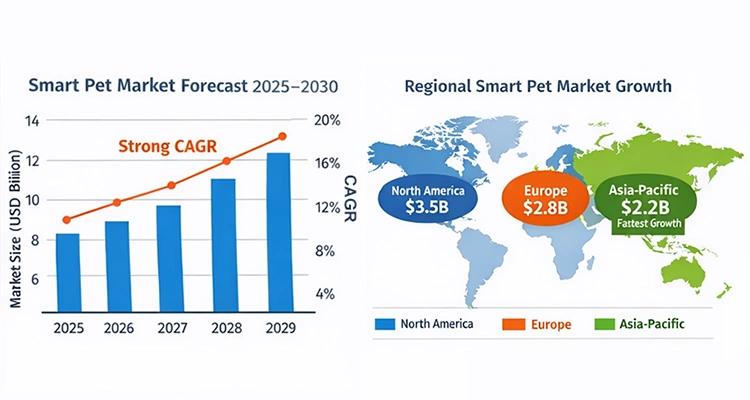
The smart pet market size is projected to grow rapidly between 2025 and 2030, maintaining a robust CAGR of 15–18%.
Categories like smart feeders, automated litter boxes, and connected cameras are emerging as the fastest-growing segments, reflecting strong consumer appetite for innovation-driven convenience.
The smart pet market forecast 2030 highlights several dominant categories:
- Automatic pet care devices
- AI powered pet devices
- Connected pet monitoring systems
Geographically, North America and Europe are expected to sustain strong demand, while Asia is projected to see the fastest growth due to increasing urbanization and surging smart pet product demand.
For a more granular view of category growth and regional market projections, you might find our Smart Pet Market Size & Forecast (2025–2030) report helpful.
Smart Pet Industry Trends in Product Innovation
Innovation continues to shape the landscape of smart pet industry trends, and it is becoming the key differentiator for brands that want to stand out.
Today’s pet owners expect more than just functional products—they want innovative smart pet products that seamlessly blend convenience, health insights, and connectivity into their daily routines.
The rise of pet tech innovations is transforming what was once simple pet supplies into sophisticated, high-tech solutions that anticipate both owner and pet needs.
For those curious about the standout breakthroughs, you might find our Most Innovative Pet Tech Products overview helpful, highlighting products that are setting new benchmarks in the industry.
How Smart Pet Industry Trends Are Driving Product Innovation
Advances in technology are giving brands the tools to develop devices that are smarter, more responsive, and deeply integrated into the connected home.
Many modern smart home pet devices leverage sensors, AI-driven algorithms, and cloud-based analytics to deliver meaningful insights and improved pet care experiences.
These intelligent pet products now have the ability to:
- Track pet activity levels in real time
- Monitor feeding habits with precision
- Send instant alerts for unusual behavior or potential health concerns
The accelerating pace of pet tech innovations is pushing manufacturers to experiment with new materials, advanced sensors, and more sophisticated software solutions, ensuring that pet products are both smarter and more reliable than ever before.
Popular Smart Pet Gadgets Loved by Modern Pet Owners
Pet owners increasingly value popular smart pet gadgets that combine convenience with peace of mind. Today’s must-have devices include:
- Smart feeders equipped with camera monitoring
- Interactive pet cameras that enable real-time engagement
- Health-monitoring collars that provide insights into activity and wellness
These innovative pet tech products reflect the evolving behavior of millennial pet owners, for whom technology is central to daily pet care routines and overall pet wellbeing.
Fastest Growing Smart Pet Product Categories
Within the smart pet industry, certain product categories are experiencing faster adoption due to strong demand and tangible owner benefits. Three segments, in particular, stand out for their growth potential and innovation.
Smart Cat Litter Box Market Growth & Opportunities
The smart cat litter box market is expanding rapidly as owners seek hygienic, automated, and intelligent solutions for their pets. Modern automated litter boxes now include:
- Automatic cleaning cycles that reduce daily maintenance
- Odor control systems for a fresher home environment
- Weight monitoring and health insights for proactive care
These features are transforming litter boxes into advanced digital pet monitoring tools. You might find our Smart Cat Litter Box Market Growth & Opportunities guide helpful for a comprehensive look at adoption trends and product innovations in this segment.
Automatic Pet Feeder Market Analysis
The automatic pet feeder market continues to see strong growth as owners look for reliable, flexible feeding solutions.
Many contemporary feeders integrate smart feeding systems with mobile apps, enabling owners to schedule meals, track feeding habits, and maintain portion control even when they are away from home.
This category has emerged as a core part of smart pet product demand, reflecting both convenience and the growing desire for connected pet care. Detailed demand trends and competitive insights can be explored in our Automatic Pet Feeder Market Analysis.
Smart Pet Water Fountain Market Trends
Rising awareness around pet hydration and overall health has fueled growth in the smart pet water fountain market. Today’s advanced fountains feature:
- Multi-layer filtration systems to ensure clean water
- Circulation monitoring for freshness and safety
- Usage tracking to better understand pets’ drinking patterns
These enhancements make them essential elements of the connected smart pet ecosystem, offering both convenience and wellness benefits. Market trends and product innovations in this segment are highlighted in our Smart Pet Water Fountain Market Trends report.
Technology Driving Smart Pet Industry Trends
Technology continues to be the driving force behind smart pet industry trends, shaping not only the products available today but also the expectations of modern pet owners.
Breakthroughs in sensors, AI, and cloud computing are rapidly advancing the capabilities of pet devices, while research from the U.S. National Institutes of Health highlights how wearable monitoring systems and behavioral data analysis can help detect health issues in pets earlier than ever.
This technological momentum is transforming routine pet care into a more connected, proactive, and data-driven experience.
AI – Powered Pet Health Monitoring
Modern pet health tracking technology is enabling devices to identify subtle behavioral changes and potential health concerns before they escalate. The World Small Animal Veterinary Association underscores the increasing importance of digital monitoring in preventive veterinary care.
Many AI powered pet devices now analyze patterns such as:
- Eating habits
- Litter box usage
- Activity levels
These insights allow owners to intervene early, offering more effective care while reducing stress for both pets and their families.
How Smart Pet Industry Trends Are Accelerating IoT Adoption
The surge of IoT pet monitoring devices is fueling the growth of a fully connected pet technology ecosystem. These connected pet devices allow owners to manage multiple products from a single mobile app, creating a seamless and intuitive experience.
As smart home adoption becomes widespread, the integration of smart home pet devices—from feeders to cameras—will feel as natural as adjusting the thermostat, offering convenience while improving pet wellbeing.
This seamless connectivity also allows data from multiple devices to inform AI-driven insights, further personalizing care.
Consumer Behavior in the Smart Pet Industry
Tracking pet owner technology adoption is essential for understanding the future of smart pet industry growth. Younger generations of pet owners are redefining expectations, valuing convenience, automation, and actionable insights that fit their busy lifestyles.
You might find our report on Consumer Behavior in the Smart Pet Industry insightful for seeing how these trends translate into product demand.
Globally, pet ownership is growing at an unprecedented pace. Surveys indicate that over 70% of millennial pet owners are interested in using smart devices to monitor and care for their pets, reflecting a clear shift toward connected pet technology.
This demographic also exhibits a strong preference for digital pet monitoring tools, automated feeding systems, and integrated ecosystems that simplify care while keeping pets healthy and happy.
The ongoing pet humanization trend amplifies this demand for premium pet products, making smart, technology-enabled solutions more than just gadgets—they become an essential part of daily life.
According to the American Veterinary Medical Association (AVMA), more pet owners are prioritizing preventive health measures and digital tools that offer real-time insights into pet wellbeing.
Retail Case Example
A U.S. online pet retailer reported that in 2025, smart feeders and automated litter boxes ranked among the top three fastest-growing categories, with year-over-year sales growth exceeding 30%.
The growth reflects consumers’ eagerness to embrace connected pet devices that offer convenience, health tracking, and real-time control from anywhere.
Smart Pet Technology Ecosystem
The smart pet ecosystem can be visualized as a layered network of hardware, connectivity, intelligence, and users:
| Hardware Layer | Connectivity Layer | Data Intelligence Layer | User Layer |
| Smart feeders | IoT sensors | AI behavior analysis | Pet owners |
| Automatic litter boxes | Cloud data platforms | Health monitoring algorithms | Veterinarians |
| Pet cameras | Mobile apps | Predictive feeding systems | Pet tech companies |
| Wearable pet trackers |
This layered approach illustrates how each technology component contributes to a cohesive system, making pet care smarter, safer, and more convenient.
Global Smart Pet Market: US vs Europe vs Asia
The ways pets are cared for around the world are influencing the course of smart pet industry trends in fascinating ways.
Regional differences reveal not just market size, but also how consumers, regulations, and lifestyle factors shape demand for connected pet technology.
Our report Global Smart Pet Market: US vs Europe vs Asia highlights these regional dynamics and adoption patterns.
North America currently sets the pace, thanks to high consumer spending, tech-savvy pet owners, and widespread adoption of pet technology.
Homeowners in this region are increasingly looking for devices that save time, track pet health, and offer convenience without compromising care quality.
Europe follows closely, driven by stricter pet welfare regulations, higher expectations for intelligent pet products, and growing awareness of pets as integral family members.
Here, innovation often focuses on health monitoring, sustainable design, and smart integration within daily routines.
Asia represents the fastest-growing market segment. Rapid urbanization, rising disposable income, and a growing middle class are driving pet tech adoption worldwide at unprecedented speed.
In many urban centers, smart feeders, automated litter boxes, and AI-powered devices are quickly becoming household essentials rather than luxury items.
Pet Tech Investment & Startup Trends
The pace of investment in pet tech startups has accelerated remarkably over the past few years, reflecting growing confidence in the market potential of connected pet devices and AI-powered care solutions.
Industry venture capital databases show that global investment in pet technology startups exceeded $1.4 billion between 2020 and 2024. Funding is particularly concentrated on smart home pet products, AI-driven health monitoring, and scalable connected platforms.
The surge of venture capital in pet tech demonstrates strong investor belief in the future of smart pet industry, particularly as the adoption of intelligent devices continues to rise.
According to data from the OECD AI Observatory, AI investments are expanding across multiple sectors, and consumer-focused technologies like smart pet ecosystems are capturing attention due to their clear market demand and growth potential.
Recent pet technology investment trends indicate that investors are especially drawn to companies building robust, scalable connected pet technology platforms.
For those seeking a closer look at funding patterns, emerging startups, and investment hotspots, you might find our Pet Tech Investment & Startup Trends guide helpful.
Smart Pet Industry Trends Creating New Business Opportunities
The momentum of smart pet industry trends is not only reshaping consumer expectations but also opening doors for entrepreneurs, startups, and established pet brands.
As more households integrate technology into daily pet care, innovative business models are emerging. Some promising approaches include:
- private label smart pet devices
- OEM smart pet products
- Direct-to-consumer pet tech brands
For those weighing market entry strategies, our guide Smart Pet Market Opportunities for New Brands explains which product categories and business models hold the most potential for growth.
Many successful brands accelerate their market entry by partnering with experienced smart pet product suppliers and smart pet device manufacturers.
These partners often provide smart pet product manufacturing services that allow startups to launch efficiently while controlling development costs and ensuring quality.
Industry Case
Consider a European pet brand that launched a private-label automatic feeder in 2024. Within just 18 months, the company achieved over $2 million in annual sales.
Their approach combined strategic partnership with an experienced OEM smart pet product manufacturer in Asia and a focus on app-connected smart feeding systems designed for remote pet care.
By leveraging external expertise, the brand minimized development time and costs while quickly tapping into the growing smart feeder market.
This example illustrates how thoughtful adoption of smart pet industry trends can accelerate growth and create a strong competitive position.
Best Smart Pet Devices in 2026
The best smart pet devices 2026 are no longer just convenient gadgets—they are tools that seamlessly combine automation, connectivity, and health monitoring to make pet care easier, safer, and more insightful.
Pet owners today are looking for products that can save time while improving the wellbeing of their furry companions.
Popular categories capturing attention include:
- smart feeding systems
- automated litter boxes
- connected pet cameras
- health tracking collars
These popular smart pet gadgets showcase the most practical applications of pet technology currently available.
For those interested in a closer look at top-performing products and their features, you might find our curated overview in Best Smart Pet Devices in 2026 helpful—it highlights devices that combine innovation with everyday usability.
Smart Pet Industry Statistics (2026)
Having reliable data is critical for brands, investors, and manufacturers planning their next move in the smart pet industry.
The latest Pet Tech Industry Statistics (Updated 2026) provide a clear snapshot of where the market stands and where it’s heading:
- Estimated global smart pet market size (2023): $2.3–$2.6 billion
- Projected market size by 2030: $8–10 billion
- Estimated global market CAGR: 15–18%
- Smart device adoption among millennial pet owners: over 70% interest
- Fastest growing product category: smart cat litter boxes
- Most common smart pet devices: feeders, cameras, litter boxes, health trackers
- Leading regional market: North America
- Fastest growing region: Asia-Pacific
These pet tech statistics illustrate the accelerating role of innovation and technology within the broader pet industry.
Brands looking to invest, expand, or launch new products will benefit from reviewing smart pet market data to understand demand, consumer preferences, and regional opportunities.
Industry Insights: What Smart Pet Industry Trends Mean for the Future
The evolving landscape of the smart pet industry trends points to a shift from standalone gadgets to fully integrated digital ecosystems.
The combination of AI powered pet devices, IoT connectivity, and automated solutions is allowing devices to communicate with each other, analyze pet behavior, and provide actionable insights to owners.
Over the next five years, smart pet products are expected to move beyond simple convenience tools.
They are becoming data-driven health monitoring platforms, capable of detecting subtle behavioral changes or early signs of illness, helping pet owners intervene sooner and support longer, healthier lives for their animals.
An expert in the field emphasizes:
“The convergence of artificial intelligence, IoT connectivity, and behavioral data analytics will fundamentally reshape how pets are monitored and cared for. Smart pet devices are evolving from convenience gadgets into essential health monitoring tools.”
— Pet Technology Industry Analyst
For those following the industry, these insights highlight the importance of aligning product development with emerging trends.
Frequently Asked Questions About the Smart Pet Industry
What are the main smart pet industry trends in 2026?
Key trends are centered around intelligent and connected experiences that simplify pet care while providing deeper insights into pet health and behavior.
Highlights include AI-powered pet monitoring, IoT-connected pet devices, automated feeding systems, and data-driven pet health tracking. Each of these innovations reflects a broader shift toward more responsive and personalized pet care solutions.
How big is the smart pet market?
The global smart pet market size was estimated at approximately $2.3–$2.6 billion in 2023, with projections suggesting it could surpass $8–10 billion by 2030.
This growth is fueled by the increasing adoption of connected pet technology and the willingness of consumers to invest in smarter, more convenient ways to care for their pets.
Which smart pet products are growing fastest?
Categories experiencing the fastest growth combine automation with health monitoring, giving pet owners both convenience and confidence.
Leading products include automated litter boxes, smart feeding systems, and AI-powered pet monitoring cameras. These devices not only reduce manual care tasks but also generate valuable data that informs better pet health decisions.
Why are investors interested in pet tech startups?
The allure of the pet technology sector lies in the combination of strong consumer demand, recurring product usage, and the opportunity to leverage data for advanced pet health insights.
Venture capital interest is rising because smart pet devices can create scalable solutions that blend convenience, care, and technology, offering both innovation potential and sustainable business growth.
Conclusion: The Future of the Smart Pet Industry
The smart pet industry is entering an era of dynamic growth, shaped by technology, innovation, and shifting consumer expectations.
From AI in pet care to connected pet devices, emerging technologies are transforming how pets are monitored, fed, and cared for on a daily basis.
The coming years are expected to see continued expansion in:
- AI powered pet devices
- automated pet care systems
- Advanced pet health tracking technology
These trends are not just creating new products—they are reshaping the future of pet care technology itself, offering significant opportunities for brands ready to embrace innovation and deliver smarter, more connected experiences for pets and their owners.
Planning to Launch a Smart Pet Product Brand?
Entering the smart pet product business is exciting, but it comes with important strategic decisions—particularly around product development, sourcing, and positioning. Success often hinges on selecting the right approach to development and partnering with the right suppliers.
Many emerging brands work closely with experienced smart pet product suppliers and smart pet device manufacturers to accelerate product launches while ensuring quality and innovation. These partnerships can help bridge the gap between concept and market-ready product.
You might find the following guides helpful for shaping your launch strategy:
These resources provide actionable advice for evaluating OEM smart pet products, identifying reliable manufacturing partners, and launching your own private-label smart pet devices successfully in international markets.
Smart Pet Industry Research Sources
Reliable insights come from trusted industry data. For a comprehensive understanding of market dynamics and technology adoption, consider these authoritative sources:
American Pet Products Association (APPA)
World Animal Foundation
AVMA (American Veterinary Medical Association)
WSAVA (World Small Animal Veterinary Association)
NIH (National Institutes of Health)
OECD AI Observatory
Frontiers in Veterinary Science
These sources offer a mix of market data, veterinary research, and technology trends that can help brands make informed decisions and stay ahead in the evolving smart pet industry trends landscape.